Lattafa — Atheeri
Essence
Atheeri is Lattafa’s bid for the “dewy clean-girl floral” lane that Gucci Flora Gorgeous Orchid opened - a luminous, transparent passion-flower/orchid bouquet wrapped around a creamy vanilla-amberwood drydown. It is the house’s most directly identifiable designer dupe in the floral category, leaning brighter and more aquatic than its usual oud-and-amber output. Where most Lattafas project warmth and density, Atheeri reads cool, juicy, and feminine-leaning, with a polished, almost mass-market designer feel that disguises its sub-$30 origin. It is the rare Lattafa built for spring and summer rather than the cold-weather opulent register.
Scent Profile
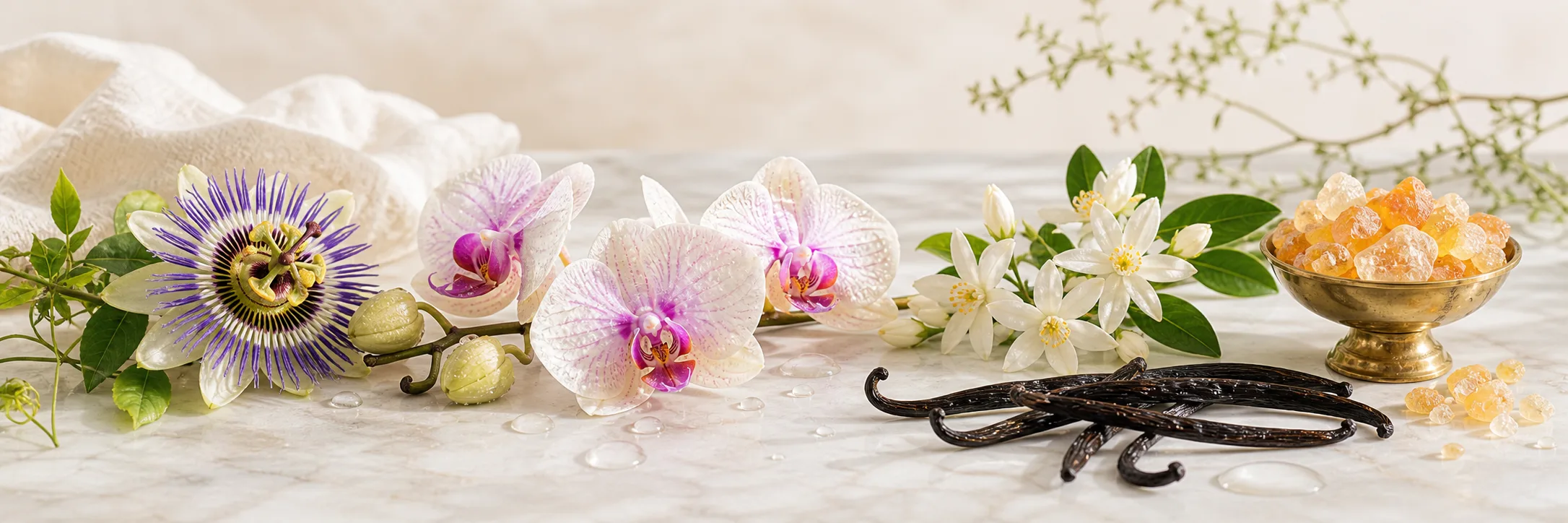
The opening is the most demonstrative phase: a bright, slightly tropical wash that reads as juicy pink-coral fruit rather than literal passion flower. Many wearers - and wearers in particular - report a phantom honeydew-melon facet that is not listed in the pyramid, almost certainly an artifact of the passion-flower/dew-drop dialogue with the aldehydic top of the orchid accord. The “dew-drop” note functions as a watery, ozonic transparency layer that keeps the sweetness from going sticky, similar in role to the calone-adjacent freshness in Gucci Flora Gorgeous Orchid. There is a faintly green, almost cucumber-skin lift in the first ten minutes before the white-floral heart blooms. The heart, settling in around the thirty-minute mark, is where the orchid accord asserts itself: creamy, fleshy, mildly indolic but heavily polished and stripped of any animalic edge, supported by a clean ionone-leaning jasmine that smells more like jasmine-tea than enfleurage. This is not a complex floral arrangement - orchid and jasmine blur into a single “soft white petal” accord rather than reading as discrete materials. Listed but submerged: passion flower as a recognizable note is largely indistinguishable once the heart opens; it has effectively dissolved into the general fruitiness of the top. By the three-hour mark, the drydown is doing the heavy lifting and is the most distinctive part of the composition relative to its inspiration. Vanilla here is not gourmand - it is the soft, semi-powdery, balsamic vanilla that pairs with white musk in modern designer florals. The amberwood (a captive-style ambery synthetic, almost certainly an Iso E / Norlimbanol / Ambroxan blend) gives the base a faintly woody-saline rasp that separates Atheeri from the more strictly ozonic Gucci. Linearity is moderate: there is a clear top-to-base arc, but no dramatic accord changes after the first hour. The signature accord is “dewy white floral over creamy vanilla-amber” - a clean-girl floral with a slight cashmere warmth in the tail.
Performance
Projection is moderate in the first hour - a one-to-two-foot bubble that is noticeable but not aggressive - and softens to a close-skin signature after roughly three hours. Sillage is modest by Lattafa standards; this is not a room-filler in the Khamrah or Oud for Glory mold. Longevity skews honest rather than miraculous: five to seven hours on skin is the consensus range from wearers and wearers, with notably stronger persistence (eight-plus hours, sometimes overnight) on fabric, scarves, and hair. The vanilla-amberwood base in particular clings to clothing. Heat behaviour is a meaningful strength - unlike many dewy florals that collapse under humidity, Atheeri’s amberwood backbone holds up in summer wear without going sour, though projection compresses further in heat. In cold and dry air, the vanilla becomes more prominent and the fragrance feels heavier and less aquatic, which some wearers prefer and others find muddy. Best application strategy: three to four sprays minimum (this is not a one-spray fragrance), targeting both pulse points and a fabric application on collar or scarf to extend the trail. Maceration matters - wearer consensus is that the bottle improves noticeably after three to four weeks of rest, which is typical for Lattafa.
Wearing Context
Spring and early summer are the natural habitat - daytime wear, brunch, office, errands, casual dates. The composition reads young, feminine, and “polished casual”; it is not a fragrance for black-tie or for situations that call for gravitas. It performs well in the May-through-September window in temperate climates and is one of the few Lattafa florals that survives genuine heat. It falls flat in formal evening contexts, in deep winter (where the freshness reads thin and the vanilla isn’t substantive enough to anchor it), and in any setting where you want the fragrance to project authority rather than approachability. Social perception skews emphatically feminine despite the unisex tag - male wearers are uncommon outside very specific clean-musk-floral preferences. Compliments tend to cluster around “you smell expensive,” “fresh,” and “clean,” rather than the sultry/sexy register Lattafa more typically generates. It is a useful office and daytime fragrance precisely because it is inoffensive, which is also its limitation: nobody will be enchanted, but nobody will be repelled.
Comparisons & DNA
Atheeri is widely circulated as the closest affordable interpretation of Gucci Flora Gorgeous Orchid (Alberto Morillas, 2023). Side-by-side comparisons on wearers and from YouTube reviewers including Redolessence and Wilberto Mejia put the similarity at roughly 80 - 90% on the opening and heart, with the most notable divergence in the drydown: Gucci stays lighter, more ozonic, and somewhat cleaner, while Atheeri introduces a warmer creamy vanilla-amberwood tail that adds longevity but reads slightly more synthetic. Gucci is also more linear; Atheeri evolves more. Secondary DNA neighbours: Lancome Hypnose Eau de Parfum is occasionally invoked for the vanilla-white-floral combination, though Hypnose is sweeter, more passion-flower-forward in the gourmand sense, and lacks the dewy ozonic register. Lattafa Yara and especially Yara Tous share the “creamy feminine floral” zip code but skew warmer, sweeter, and more orchid-vanilla-gourmand; Atheeri is the lighter, fresher cousin. Lattafa Angham (Burberry Goddess-adjacent praline-vanilla) is frequently mentioned as the cold-weather counterpart to Atheeri’s warm-weather brief, and wearers commonly layer the two. Compared to other Gucci Flora dupes on the market, Atheeri is the cleanest interpretation; Maison Alhambra Floraison and several Armaf attempts in the same lane are widely considered cruder and more synthetic. Atheeri does not have a documented niche or “prestige” inspiration beyond the Gucci reference - it is squarely a designer dupe rather than a niche-aimed homage. Lineage-wise, it sits inside the broader 2020s “clean girl floral” wave kicked off by Glossier You and amplified by Sol de Janeiro, Phlur Missing Person, and Gucci Flora - Lattafa entered late but cheaply.
Reception
critics (Turin/Sanchez, Burr, Beaulieu) have not covered Atheeri, and niche blogs (Bois de Jasmin, Now Smell This, Colognoisseur, Persolaise) likewise have no published reviews - this is below their typical attention threshold. Reception is therefore measured through wearers, wearers, wearers, and YouTube. wearer consensus on wearers skews positive but mixed. The dominant praise: it is a credible Flora Gorgeous Orchid alternative at roughly one-fifth the price, with surprisingly capable summer performance and a pleasant creamy drydown. Recurring praise notes: “dewy,” “juicy,” “clean-girl,” “compliment-getter.” Polarization runs along two axes. First, the dupe question: a meaningful minority insists Atheeri “does not smell like Gucci” and accuses the dupe-coverage of overselling the similarity; this faction reads it as a generic white-floral. Second, the projection question: lovers of stronger Lattafas (Khamrah, Yara, Oud for Glory) consistently flag Atheeri as comparatively weak. A common wearers critique: “It’s just a designer dupe, and I’m not a big fan of this direction” - capturing the disappointment of users who expect Lattafa to deliver beastly performance. On wearers, Atheeri appears most often in the spring/summer feminine recommendation threads rather than in the clone-discovery threads. Blind-buy verdict: yes, with caveats - safe blind buy for anyone who likes the Gucci Flora register or general dewy florals; not for buyers who want Lattafa’s signature opulence or for those allergic to clean-musk-vanilla bases.
Versions & Reformulation
Single composition, no known reformulations. Atheeri is sold exclusively in the 100 ml EDP bottle (the standard Lattafa packaging tier with the bee/floral motif on a pink-toned bottle). No oil, intense, or extrait variants have been released as of mid-2026, and no batch-to-batch quality complaints have surfaced at scale.
Acquisition Notes
Pricing tier sits in the Lattafa standard range: $25 - $40 USD for 100 ml depending on retailer, with Amazon, FragranceNet, FragranceX, and Perfume Spot the most common channels. The decant ecosystem is thin - Atheeri does not see major Scent Split or Surrender to Chance traffic the way the Bade’e Al Oud line does, because the full bottle price is already low enough to discourage decanting. Best authentic channels: Amazon direct from Lattafa Perfumes storefront, FragranceNet, Perfume Spot, Notino in Europe, and Tiendita-style Middle Eastern retailers in the GCC.
Notable Facts & Lore
- Atheeri’s launch year is officially listed on wearers as 2025, making it one of Lattafa’s more recent releases and notable for being the house’s most committed entry into the “clean girl” floral lane that Gucci dominated in 2023 - 2024.
- The perfumer is undocumented - Lattafa rarely credits perfumers, and there is no public statement from the house about authorship or creative intent for this specific fragrance.
- The Arabic name “” (Atheeri) translates roughly to “ethereal,” which aligns with the airy, dewy character of the composition and reads as an unusually demure name choice for a house that typically favours grandiose vocabulary (Khamrah = wine, Asad = lion, Oud for Glory).
- The fragrance entered the wider Western fragrance conversation through TikTok in early-to-mid 2025, primarily through women-focused micro-influencers and Lemon8 reviewers, rather than through the male-dominated YouTube fragrance commentariat that drove Oud for Glory and Khamrah.
- It became a recurring “Gucci Flora dupe” recommendation in TikTok perfume comment sections, and saw spillover discussion in Lattafa-focused wearers threads.
- There are no notable celebrity associations, controversies, or marketing campaigns attached to the release - Lattafa’s strategy with Atheeri appears to have been to ride the Gucci comparison organically rather than to push it through formal marketing.
- The name is occasionally misspelled “Atheri” or “Athiri” by Western retailers, which complicates search.