Stella McCartney — Stella
Essence
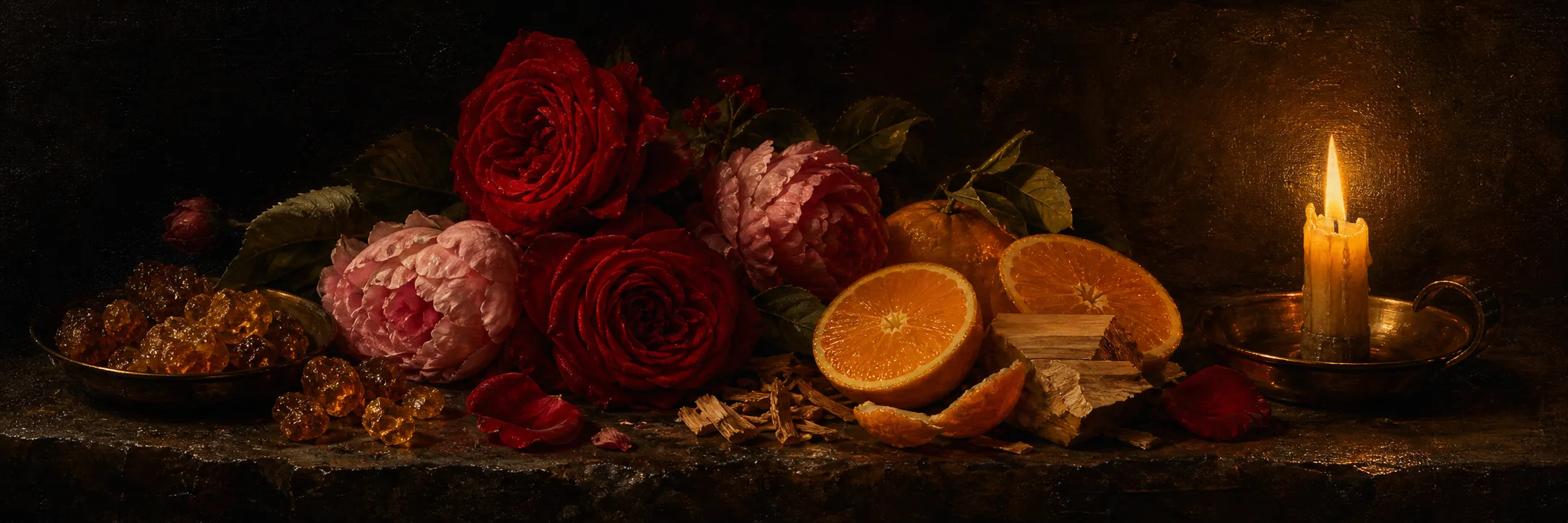
Stella is the 2003 debut fragrance from Stella McCartney’s house, composed by Jacques Cavallier Belletrud, the perfumer behind L’Eau d’Issey and Jean Paul Gaultier Le Male. It is a deliberate exercise in modernizing the rose: Bulgarian rose absolute as the dominant note, framed by peony in the top, mandarin as a fresh-sweet lift, and a transparent woody-amber base. The composition is famously simple, three or four legible elements with no orientalist excess, and reads as Cavallier’s case for the rose as a contemporary daily-wear flower rather than a grandmother’s powder. Discontinued in its original EDP form, it has acquired a quiet noughties-classic cult.
Scent Profile
The opening is bright and slightly sweet without being confectionary: mandarin leads with a fresh, zesty lift, peony joins immediately as a pink, watery, dewy floral that reads as rose-adjacent, and the rose itself is present from the first spray. Some wearers detect a subtle aldehydic shimmer, a soft sparkling-rose-lemonade quality. The heart is the whole fragrance: Bulgarian-style rose absolute, rendered to read as natural rather than abstract or candied. Cavallier’s signature here is restraint, letting the rose be a rose without thickening it into a syrupy oriental or thinning it into a tea. Wearers consistently call it among the closest to real roses, and describe it as dark or even gothic, with a faint spicy edge. It is plush but not heavy, neither screechy nor obviously soapy. The base is intentionally minimal: a transparent, slightly warm amber that works as a wash under the rose rather than as a discrete stage, with a quiet woody facet but no vanilla, no animalic depth, and no big drydown. The composition is broadly linear, settling into rose-amber from about half an hour in until the end. It is a deliberately simple fragrance executed at a quality level the simplicity makes possible.
Performance
Longevity is moderate-to-above-average and sillage modest, consistent with a quality EDP at typical projection. Wearers cluster around five to seven hours on skin, with skin-scent behavior in the second half of the wear and a noticeable fade after roughly five hours. The original 2003 EDP is widely held to outperform the later 2014 reformulation and 2015 EDT, both reported as substantially weaker. Two sprays is the typical application; this is not a fragrance that rewards overdose.
Wearing Context
Stella is versatile and daytime-favorable, leaning spring and summer, though some wearers use it year-round and prefer it in cooler weather where the rose reads richer. It suits daytime, office, errands, casual lunches, and evening wear when you want to read romantic rather than seductive. It is widely described as office-safe, unlikely to offend, and a comfortable easy choice. The age skew is broad and the rose is age-flexible because it is not powdery; social perception runs romantic, feminine, and classy, with several wearers describing a vintage, English-garden sensibility despite the 2003 vintage.
Comparisons & DNA
Stella’s reference frame is the modern designer rose. The most-cited comparisons include Frederic Malle Une Rose, Diptyque Eau Rose, and Chloe Roses, alongside various budget rose entries that occupy adjacent territory. Within Cavallier’s own work, Stella is a more legible rose than the watery L’Eau d’Issey but shares his instinct for transparency. Within the house, Stella Rose Absolute (2005) is the deeper, richer winter flanker often held to be the best in the line, while Sheer Stella is the lighter summer take. Stella stays quieter and less ambitious than a statement rose like Frederic Malle Portrait of a Lady: this is daily-wear modern rose, not a dramatic one.
Reception
Reception is broadly positive with stable polarization. Praise centers on the naturalism and quality of the rose, the elegant simplicity of the composition, the beauty of the faceted amethyst-purple bottle, and the modern-rose positioning. Criticisms split two ways. Some find the composition under-developed or insufficient as an EDP, describing it as a safe, familiar daytime rose. A minority detect a fake-strawberry or fake-peach fruitiness in the top and dislike the cheaper smell-alike association. Critical coverage from Victoria Frolova at Bois de Jasmin contextualizes Cavallier’s modernization of the rose across the line. The overall verdict is a yes for anyone who loves a real-rose fragrance and tolerates a quiet, linear composition.
Versions & Reformulation
The version history is unusually well-documented. The original Stella EDP (2003, launched with YSL Beauty in the distinctive amethyst-purple bottle) is the canonical version with the highest regard. Stella Rose Absolute (2005) is the deeper, more ambered EDP flanker, widely considered the line’s best. Stella in Two (2006) split the rose and amber into separable components, and the Print Collection (2011) reissued the original in collectible bottles. The 2014 relaunch, also by Cavallier, came with a Coty-era ownership change and is consistently reported as weaker and less rich, while the 2015 Eau de Toilette shifted toward iced lemon and freesia, the most divergent from the original. The Coty era is the reformulation breakpoint most cited by enthusiasts.
Acquisition Notes
The original 2003 EDP is discontinued and acquired on the secondary market, where the amethyst-purple bottle is desirable and commands premiums. The Print Collection 2011 reissue bottles are also collected, sometimes at lower prices. The 2014 reformulation is more available but is a poor substitute for purists. Stella Rose Absolute has commanded around $190 at peak resale moments. Counterfeit risk exists but is lower than for cult-status masculines since demand is not at hype levels, and the original rollerball is sometimes noted as performing better than the spray.
Notable Facts & Lore
- Stella was Stella McCartney’s first fragrance, released in 2003 with YSL Beauty before the line later moved to Coty.
- McCartney is the daughter of Paul McCartney and a vocal animal-welfare and cruelty-free advocate.
- Her stated inspiration was a vintage photograph of a rose whose petals fall at a gentle touch, a “frail beauty, this moment of perfection.”
- The fragrance launched as a counterargument to the idea that rose was old-fashioned and became a touchpoint for the mid-2000s rose-revival wave.
- The 2014 relaunch campaign featured Lara Stone, photography by Mert Alas and Marcus Piggott, and music by Warpaint, with Harrods holding exclusive early sales rights.