Versace — Baby Blue Jeans
Essence
Baby Blue Jeans is the 1995 “junior” flanker to Versace’s 1994 Blue Jeans - sold in a small powder-blue tin with a child on the box, pitched at teenagers in a marketing idea that aged poorly from the start. The juice has nothing childlike about it: a powdery citrus-aromatic that sets lime, bergamot, and mandarin against a bitter green iris heart, then drifts into vanilla, sandalwood, and musk. In wear it reads as a soft retro masculine - lemon candy dusted in baby powder over a creamy woody shadow.
Scent Profile
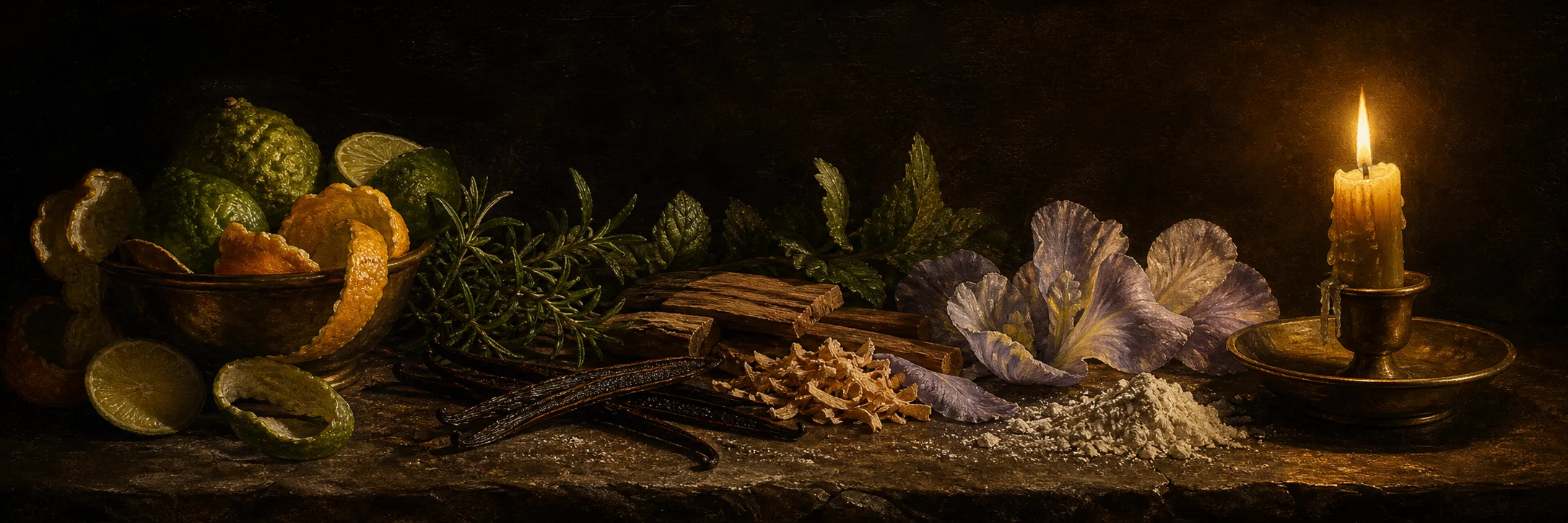
The opening fires off a tart, slightly sour lime-bergamot accord, sharper and more astringent than the parent Blue Jeans, with mandarin softening the edges. Within five minutes galbanum cuts in with a bitter-grassy snap that keeps the citrus from turning to candy, and rosemary adds a dry, almost medicinal herbal lift. These first ten to twenty minutes are the most aromatic phase and the only stretch where the top notes are individually legible. In the heart, iris takes over - but earthy and powdery-rooty rather than the cool, carrot-like orris of higher-end fragrances, closer to a cheap soft suede. Galbanum threads bitter green through the powder while the rosemary recedes. This is where the signature “baby powder plus citrus” character emerges: iris and white musk amplify each other into a laundered, slightly cloudy texture, and the bright citrus sinks to a faint oily shadow. From about hour three the base shows its wholesale designer character. Vanilla stays restrained and dry-powdery rather than sweet, the sandalwood is the creamy, milky synthetic typical of mid-1990s Euroitalia work, cedar adds dryness, and low-dosed patchouli gives just a faint earthy grip. White musk carries persistence and lends a “freshly laundered baby clothes” finish. The overall signature is iris-powdered citrus over creamy sandalwood-vanilla - often likened to a stripped-down, more masculine Shalimar. Evolution is gentle rather than dramatic, and the drydown dominates the wear.
Performance
This is modest, 1990s post-shave-cologne territory, not a modern projector. Projection is light to moderate - a soft cloud at arm’s length in the first hour, collapsing to a skin scent by hour two or three, with sillage rarely reaching beyond a foot once it settles. Longevity runs four to six hours on skin for most wearers, though the iris-musk-sandalwood base clings to clothing for eight hours or more, often into the next day. Warm humid weather thickens the powder and can read sour; cool dry air lets the citrus shine. The best approach is a generous three to four sprays onto a clothed torso after a shower, since bare warm skin burns off the citrus top quickly.
Wearing Context
Spring and early summer daytime are the natural home: the galbanum and citrus want a little warmth to lift, but real high heat turns the powder strange. It is office-safe to the point of vanishing after the first hour and suits errands, casual dates, and mild-weather commuting. It falls flat in cold weather, where the citrus disappears and only powder remains, and in formal evening settings, where it is too soft and retro-casual to compete. Socially it tilts unintentionally feminine to modern noses - the “baby powder plus lime” character codes unisex-leaning-feminine for younger wearers - while those who knew it in the 90s wear it as nostalgia rather than statement.
Comparisons & DNA
Most directly, Baby Blue Jeans is the brighter, thinner, more citrus-forward sibling of Versace Blue Jeans, which carries lavender, anise, and a heavier vanilla-tonka core that this flanker drops in favor of lime. It sits in the same powdery-aromatic family as Pierre Cardin Pour Monsieur, sharing an iris-citrus opening, and traces structural DNA back to the original Versace L’Homme, identified by writer Varanis Ridari as an ancestor of the broader Jeans line. For the iris-powder-vanilla axis, the closest mass-market analog is the much later Burberry Touch For Men, sometimes called its spiritual father.
Reception
The consensus is affectionate but clear-eyed: an underrated nostalgia piece with weak performance and a charming bottle. Praise centers on the citrus-powder balance, the soft iris-sandalwood drydown, the low price, and the kitsch packaging. Criticism targets the faint longevity and projection, the dated 90s powder some find too feminine or too “Play-Doh,” and constant confusion with Blue Jeans itself. The split is generational: wearers who grew up with it rate it highly and mourn its discontinuation, while younger reviewers often find it bland and generic. The standing advice is that it is a safe cheap curiosity only if you already enjoy iris-powder-vanilla scents - and emphatically not a modern Versace masculine in the Eros or Dylan Blue mold.
Versions & Reformulation
Baby Blue Jeans is officially discontinued, though small quantities resurfaced under the “Versus” branding in the early 2000s after Euroitalia consolidated the Jeans line. Whether those Versus-era bottles were reformulated or merely rebranded is disputed - long-term wearers find the later juice noticeably thinner and more synthetic, but no official formula change has been confirmed. Only the EDT concentration ever existed at retail, and the secondary market now carries both the original Versace tin and the Versus reissue.
Acquisition Notes
This is designer-tier pricing on a fully discontinued scent, typically found around fifteen to twenty-five USD when in stock, with sealed vintage bottles fetching more. The usual format is a 75 ml EDT in the blue bottle-shaped glass inside its powder-blue tin, with smaller minis appearing occasionally. Counterfeits are rare since the resale value never justified faking; the real risk is age-degraded juice, betrayed by an off-key sour opening and a flat, plasticky base, so favor sealed stock and check the batch code on the bottle base.
Notable Facts & Lore
- The “Baby” concept put a child on the box styled as “playing a man,” aiming at a pre-teen market that never matched the adult cologne inside.
- It belongs to Gianni Versace’s Jeans Couture diffusion line, an early accessible-luxury denim sub-brand decades ahead of the current trend.
- A widely repeated claim that it was “Lady Gaga’s favorite” among the Jeans flankers traces to a single interview and is best treated as folklore.
- Its powder-blue tin and bottle-shaped glass make it one of the more collectible kitsch objects of the 90s Versace diffusion era.
- Perfumer attribution is officially unknown; some retailer pages wrongly credit the Blue Jeans perfumer, but no primary source confirms it.