Bortnikoff — Oud Maximus
Essence
Oud Maximus (2018) is Bortnikoff’s animalic floral-oud flagship, dedicated to the perfumer’s son Maxim. It is the wilder, more challenging counterpart to the crowd-pleasing Oud Monarch: where Monarch tames oud with cacao, Maximus leans into civet, deer musk and birch tar over a high concentration of Laotian, Indian and Thai oud, then balances that animalic core against four rose oils and tropical florals. The house frames it as an exploration of how rich and unusual the character of wild oud can be when fully revealed in a masterful blend. Critic Kafkaesque, reviewing the 2018 original, called it a fragrance that veers between an animalic floral oud, a floral oud leather, and a slightly gourmand, ambered scent, and admitted he did not expect to like it as much as he did.
Scent Profile
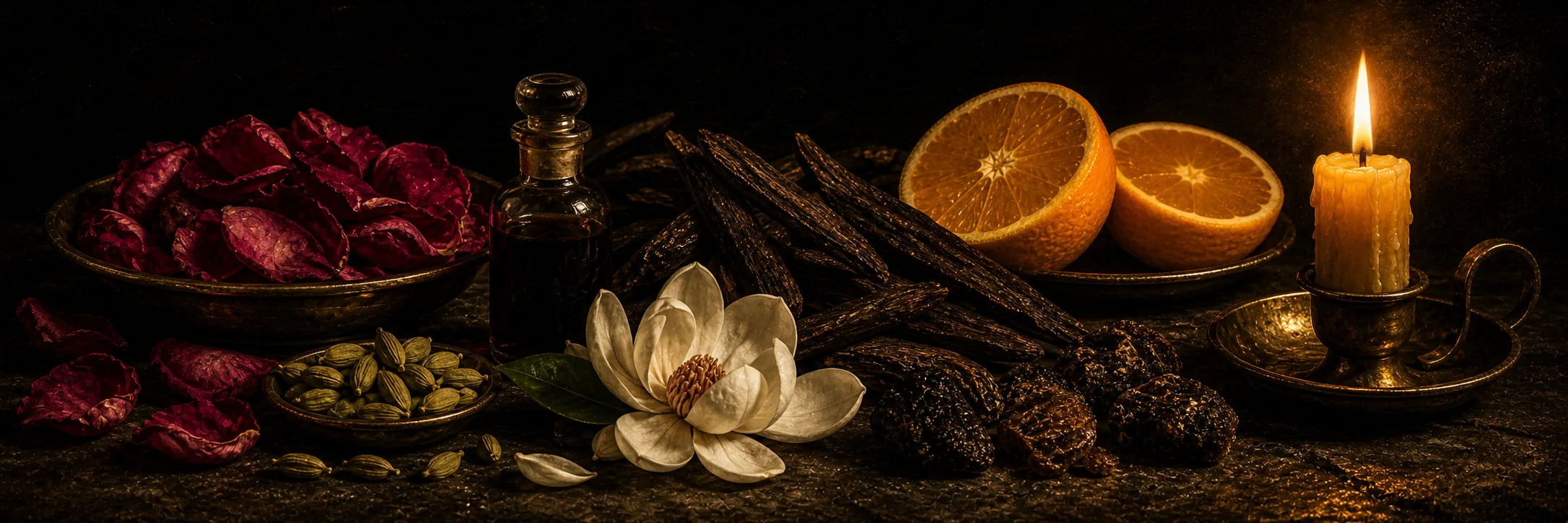
The opening is a bright citrus-floral burst of sweet orange and bergamot with jasmine sambac, pink pepper and cardamom that, for a few minutes, almost disguises what is coming. Then the animalics arrive. The heart is a voluminous, jammy accord of multiple roses, including rose de mai and tea rose, alongside frangipani, magnolia and clove. The base is the controversial engine: civet, Indian and Laotian oud, deer musk, birch tar, tolu balsam and vanilla, producing what wearers variously call animalic, barnyard, fecal, or at the extreme like sour urine or moldy cheese. Opinion splits exactly on this point. For some it reads as more fecal than anything else; for others the civet and oud settle within five to ten minutes into one of the most beautiful, uplifting and balanced fragrances they have smelled. Birch tar gives a leathery, smoky spine, and the drydown turns musky, rosy and balsamic, several wearers noting it converges toward the smooth musk of the house’s Musk Khabib.
Performance
Performance is strong. Longevity is rated above-average, and reports describe potent, robust projection in the opening hours that settles into a long-lasting, radiant scent bubble. One detailed wearer placed the heaviest animalic phase at around twenty to twenty-five minutes in, lasting an hour and a half to two hours before the musk-and-oud drydown takes over for the long haul. By consensus it is more powerful and longer-lasting than Musk Khabib and should be dosed sparingly; one spray on covered skin is a common refrain.
Wearing Context
This is a cool-weather, evening fragrance, and only for those comfortable with overt animalics. Even fans warn newcomers to be patient through the civet-and-oud opening. It is unisex, though the rose-oud-animalic structure reads classically oriental. Wearers who find it versatile note it works in warm or cool weather but is probably too cloying for hot summer days. It is a connoisseur’s wear rather than a crowd-pleaser, best for private enjoyment or settings where a bold, vintage-styled oud is welcome.
Comparisons & DNA
Within the house it sits closest to Oud Monarch and Lao Oud, being the more animalic and less gourmand of the three, with Lao Oud often described as the middle ground between them. A vintage-leaning reading finds its mid-to-drydown turning into an old-world oriental chypre, explicitly recalling Dana Tabu, YSL Opium and Guerlain Shalimar, just with better ingredients. The recurring cross-house comparison is to Areej Le Dore’s heavier, more characterful animalic ouds, with one wearer framing the two distillers as opposite poles. Some also liken its Laotian and Indian oud blend to the territory of Asrar Indonesia.
Reception
Reception is polarizing but anchored by a devoted core. Admirers call it the most characteristic fragrance from the house, a masterpiece, and arguably Bortnikoff’s best artistic achievement, prizing its complexity and the quality of its naturals. Detractors find it too pungent or animalic beyond their tolerance, while a more interesting critique holds that it flashes its potential without quite living up to it, coming across as funky, goofy and unfinished. The blue-cheese analogy recurs, with more than one wearer initially recoiling and then coming to love it after developing an oud palate.
Versions & Reformulation
This is the most version-complex fragrance in the line. The original 2018 release, the catalog subject, is discontinued, followed by yearly iterations in Autumn 2019 and 2020 that Kafkaesque describes as essentially the same but with fractional differences from each year’s harvest and distillations. The 2018 and Autumn 2019 editions are apparently discontinued, while the 2020 version folded into the permanent collection. Per critic Sergey Borisov, a limited Oud Maximus Elixir of only thirty bottles, at a maximum concentration of 45 percent, was released in 2025 for a single boutique. Newer stock has also carried a sticker stating the product contains no animal-derived ingredients, suggesting later batches use no real musk, a genuine wrinkle for collectors chasing the original animalic profile.
Acquisition Notes
The original 2018 extrait is discontinued and now a collector’s item; the 2020 version and the higher-concentration Elixir are the in-production routes to the composition. It is sold direct from the house and through decanters. Because of the documented year-to-year and possibly material differences, and the strongly polarizing animalic profile, sampling the specific version you intend to buy is essential. Those chasing the original’s funk should verify the batch year, while those wanting a smoother take may prefer a later edition or Oud Monarch.
Notable Facts & Lore
- The name honors Maxim, the perfumer’s son, a personal counterpart to the house’s Khabib homage.
- Bortnikoff describes a special technique developed to mix Laotian, Indian and Thai oud with four rose oils so the roses survive the oud’s intensity.
- Its base lists specific sourced ouds tied to the Feel-Oud distillation lineage that Bortnikoff shares with Areej Le Dore.
- A packaging sticker on newer stock declaring no animal-derived ingredients sparked debate about whether earlier natural-musk and civet claims were ever literally animal-derived.
- It is widely treated as the house’s most characteristic and divisive work, a litmus test for an oud palate.