Bortnikoff — Sayat Nova
Essence
Sayat Nova is the fragrance that put Dmitry Bortnikoff’s artisanal, natural-materials house on the wider enthusiast map: a dark, boozy, oud-anchored oriental built around an astonishingly photographic dried-apricot-and-rum opening. Co-composed by Bortnikoff and Indian perfumer Rajesh Balkrishnan and released in 2020, it is an extrait of very high natural content, named for the legendary 18th-century Armenian troubadour Sayat-Nova - a documented, deliberate inspiration, not a coincidence. It is simultaneously one of the house’s most loved and most divisive works, and where it lands for you depends almost entirely on whether your skin reads the opening as nectar or as medicine.
Scent Profile
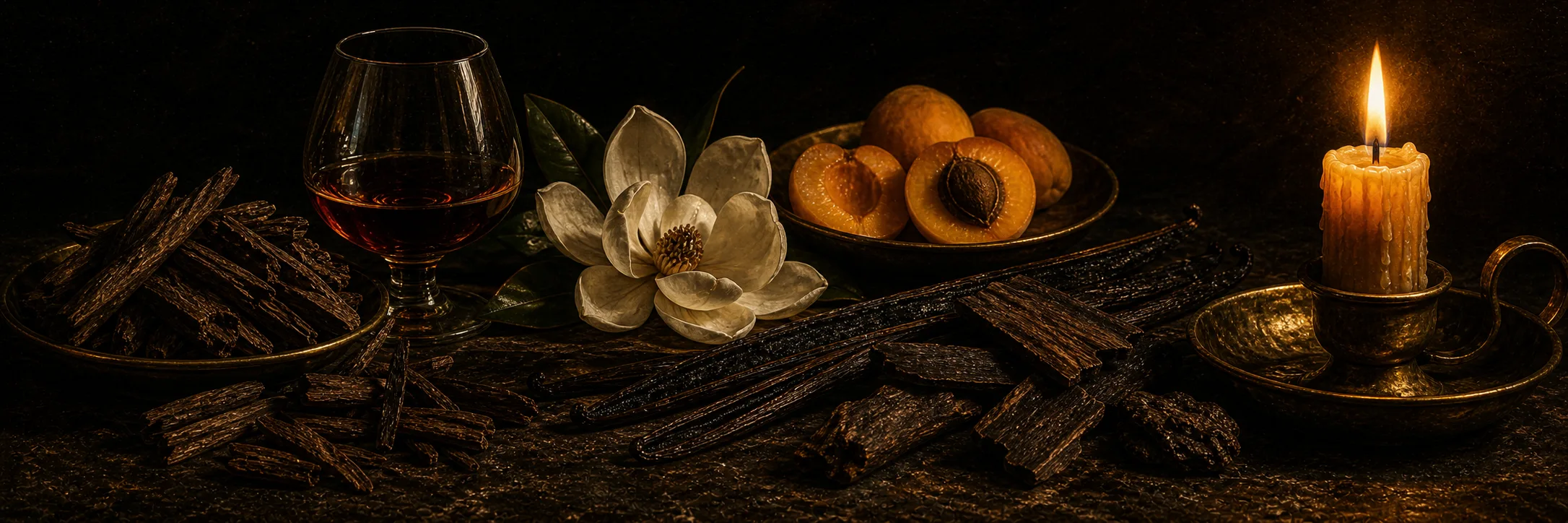
The opening is the star and the flashpoint. At its best it is one of the most lifelike fruit accords in niche perfumery - a thick, syrupy apricot drowned in rum, compared by wearers to apricots reduced in a frying pan, with narcissus adding a green, faintly animalic edge underneath. A significant minority experience that same opening as sour, pungent or medicinal; one wearer nicknamed it “Sayat Novocaine” for an anesthetic, knock-out-gas quality before it grew on him. There is near-universal agreement that the scent improves dramatically on skin versus paper, and that it sweetens and settles within the first minute or two. The heart turns boozy, creamy and balsamic. The vanilla here is repeatedly described as not a sweet-gourmand vanilla but a smoky, caramelized, marshmallow-tinged one, and many wearers detect a cinnamon-and-cocoa holiday warmth - hot chocolate with a splash of whiskey is a recurring image - even though neither note is officially listed. The base is three distinct ouds, from Laos, Bengal and Trat in Thailand, laid over natural oakmoss. Despite the trio, wearers consistently note the wood is supportive rather than animalic or smoky: “not especially oudy” for something containing three ouds. The drydown is woody, mossy, boozy and long, with a chypre-like structure from the prominent oakmoss and a faint tobacco quality some detect even though none is listed. The juice is very dark and stains clothing.
Performance
As a high-concentration natural extrait, longevity is the strength - strong-to-eternal, with all-day-plus wear and residue lingering on skin and fabric far longer (staining being the trade-off). Projection and sillage are more moderate: strong in the first hour, then settling close to the skin, with medium projection-sillage the common verdict. It rewards gentle application - patting rather than spraying - and a little goes a long way. One serious caveat: there is a documented stability concern, with at least one experienced wearer reporting his sample oxidized over roughly four years into “literal motor oil,” a known risk with heavy all-natural compositions worth weighing before buying a large bottle to sit on.
Wearing Context
This is a cold-weather, evening, introspective fragrance - boozy dried fruit, feast tables and warm woods, tied repeatedly to Christmas and the holidays. It is unisex but leans masculine-to-neutral on account of the dark oud-and-moss base, even as the sweet apricot-vanilla pulls feminine: “very yummy and edible, but definitely not girly.” It rewards being worn for yourself rather than for compliments, given the close-to-skin behavior after the first hour. It is emphatically not a beginner or office scent; this is a contemplative, deliberate wear for someone who already enjoys naturals, oud and boozy gourmands.
Comparisons & DNA
The closest reference is internal: Bortnikoff’s own Tabac Dore shares the same dark, boozy, oud-backed DNA - often described as Sayat Nova with thick, dense tobacco replacing the apricot. Outside the house, several noses hear a Slumberhouse influence, with one calling it a “tribute to Slumberhouse” and likening it to Baque - a comparison about dark, dense boozy-fruit texture rather than a literal match. A separate wearer found a textural kinship to Dior Hypnotic Poison through shared fuzzy, vanillic density. Broader genre neighbors like Tom Ford’s tobacco and oud work are adjacent but cleaner and more synthetic by contrast; Sayat Nova’s selling point is precisely its raw, natural, slightly untamed character. Within the house it is most often compared to Areej Le Dore’s small-batch naturals, with the consensus that Bortnikoff’s work is the more approachable and wearable of the two.
Reception
Reception is intense and polarized in a way that itself defines the fragrance. The admiring camp is rapturous, praising a perfectly balanced apricot, vanilla and oud unlike anything else they have tried, with several calling it the best the house has ever done. It is also hype-flagged: one wearer pointed to the disproportionate number of reviews as evidence of a strong hype train, and a vocal contingent ranks Tabac Dore, Lao Oud, Triad and others above it. Detractors cite the medicinal opening, the stability and aging issues, and the price. The sharpest negative came from critic Varanis Ridari, who argued that all-natural oil-bash houses tend to “devolve to sludge and base materials” and described his aged decant as “literal motor oil” - a verdict widely read as partly about an oxidized, partially-empty vial rather than the fresh juice. The dominant pattern across reviews is a hated-it-then-loved-it conversion arc.
Versions & Reformulation
Sayat Nova exists in two forms: this alcohol-based Extrait de Parfum and a thicker oil-based Sayat Nova Attar (also 2020), which wearers describe as related but distinct - heavier and darker, with one extrait-lover finding the attar “a powdery mess and not even that similar,” while others rate its vanilla among the best they have smelled. Because the house works with natural materials in small batches, there is inherent batch-to-batch variation by design, and collectors reference an older “wooden cap” edition that runs funkier and more oud-forward than tamer later runs. This is not reformulation in the designer sense but inherent variability plus an attar flanker. Stock status reads ambiguously, with conflicting database flags, but the brand continues to list both the extrait and the attar - the practical reality is limited-batch production with periodic sell-outs.
Acquisition Notes
Sayat Nova sits at the artisanal high-price tier and is sold direct from Bortnikoff’s website and a small set of authorized resellers and decant sites, with generously-sized but expensive samples by design. It launched as a limited Luckyscent exclusive of only 100 bottles before moving into broader production, so availability has fluctuated and bottles are intermittently listed as unavailable. Given the documented aging risk and the polarizing opening, a sample or decant first is strongly advised - it is not a safe blind buy. Expect staining and apply carefully to skin, not clothes.
Notable Facts & Lore
- The name honors Sayat-Nova (born Harutyun Sayatyan), the 18th-century Armenian poet-troubadour whose title means roughly “Lord of Song” and whose work was immortalized in Sergei Parajanov’s 1969 film The Color of Pomegranates.
- The apricot opening is a quiet cultural echo: the apricot’s botanical name is Prunus armeniaca, the “Armenian plum,” long identified with Armenia.
- It is a three-continent collaboration between Bortnikoff and Indian perfumer Rajesh Balkrishnan, blending naturals sourced across multiple regions.
- The three named ouds - Laos, Bengal and Trat - were, per the brand, specially distilled for this composition.
- One wearer wished the formula had used brandy rather than rum to further cement the Armenian connection, Armenia being famed for its brandy.
- Bortnikoff’s credibility rests on his Feel Oud distilling pedigree and use of genuinely rare materials, including real deer musk in Musk Khabib.