Bortnikoff — Sir Winston
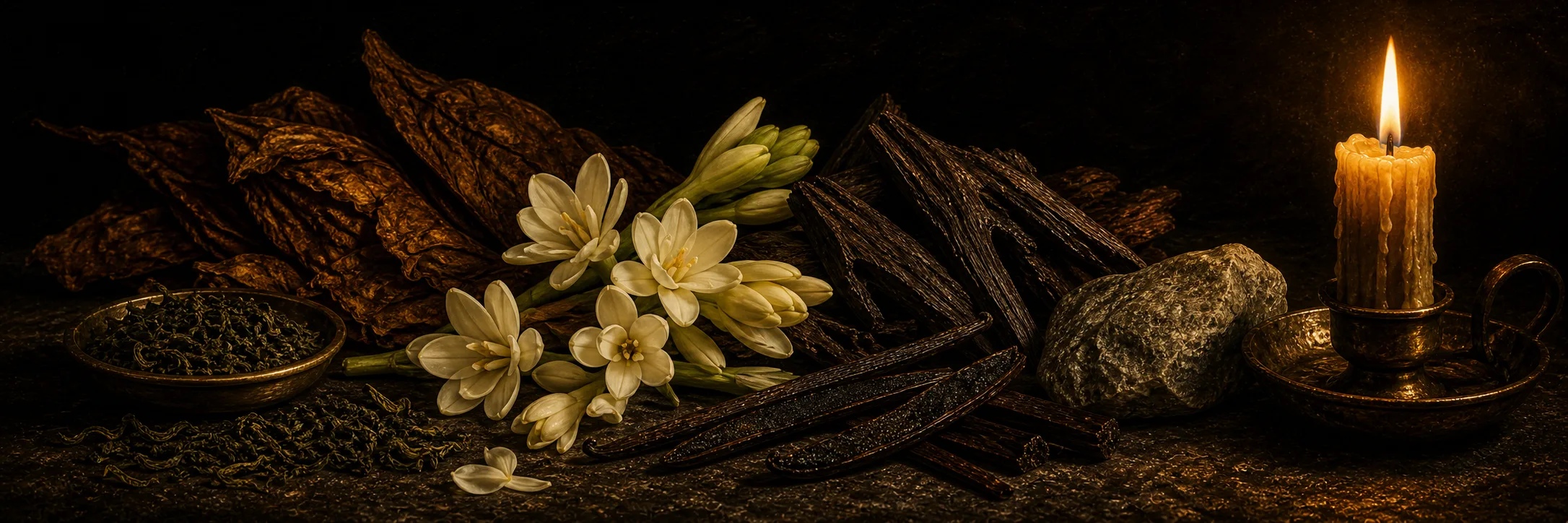
Essence
Sir Winston is the bait-and-switch of the artisanal oud world: a fragrance named for the cigar-and-brandy archetype of Winston Churchill that turns out to be, on most skins, a creamy, candied tuberose drenched in real ambergris. Released in 2019 as part of Dmitry Bortnikoff’s fourth collection, it is an extrait built almost entirely from naturals - genuine ambergris, tobacco absolute and Indonesian Bouya oud rather than synthetic reconstructions. What makes it distinctive is the gap between expectation and reality: the green-tea-and-tobacco “dandy” concept the name promises is real but submerged, while a buttery white-floral gourmand dominates. It is a connoisseur’s curiosity rather than the masculine smoke-beast its branding implies.
Scent Profile
The opening is the most Churchillian stretch: a dry, vegetal green tea note, sometimes astringent or camphoraceous, occasionally with a flash of boozy brandy-like sweetness some call an unlisted cognac accord. Within the first hour the tuberose takes command and rarely relinquishes it. This is where the fragrance forks by skin chemistry. Many wearers get a pronounced “Bazooka bubble gum” facet from the tuberose-vanilla pairing - sweet and almost confectionary, estimated by one critic at well over half the bouquet on her skin. The much-touted real ambergris is the other star: a salty, radiant, faintly animalic golden warmth that lifts the florals. The tobacco is real but abstract, described as an unlit cigar or cherry pipe tobacco rather than smoke, and the oud is even more recessive - some get a barnyard Hindi facet, others cannot find it at all. Linearity is moderate. After the tea-led opening it settles into a fairly stable creamy tuberose-vanilla-ambergris accord that intensifies rather than transforms, with tobacco and wood growing only in the deep drydown over many hours. The base notes the marketing foregrounds - tobacco, vanilla, oud - are the ones most wearers struggle to find under the persistent floral. The signature accord is buttery tuberose lacquered in salty-sweet ambergris.
Performance
As an all-naturals extrait, longevity is excellent: one detailed account clocked roughly 19 hours total on skin, turning to a skin scent around the 10th hour but detectable up close until the 14th, and reports broadly converge on 8 hours or more with the ambergris and vanilla anchoring the base. Projection and sillage are more moderate - strong in the first two to three hours, one spray enough to fill a room for the tuberose, then increasingly intimate. It amplifies in warmth, and given the sweet, creamy profile most position it as a cooler-weather or controlled-climate scent rather than a hot-weather performer. Apply conservatively; the tuberose is potent.
Wearing Context
Despite the masculine name, this reads unisex-to-feminine on most skins, with the cake-batter and bubble-gum sweetness pushing it toward the feminine end - several male wearers reported handing it to wives or partners. It is most often placed in spring, summer and mid-season, evoking vacation and “dolce vita” rather than a British winter study, though it also suits autumn and cooler spring days, daytime or evening, and intimate rather than professional settings given the loud, sweet florals. Socially it is a compliment-getter among those who enjoy creamy white florals but a potential headache-inducer for those who find tuberose cloying. The practical reading is a creamy daytime-to-evening floral for tuberose lovers, not the cigar-lounge scent the name implies.
Comparisons & DNA
The dominant reference is Amouage Portrayal Woman, which wearers repeatedly call very close to Sir Winston, or describe Sir Winston as a tuberose-forward version of it - Portrayal Woman being a smoky-sweet blend of fig, tobacco and vanilla that Sir Winston pushes further into candied territory. Its tobacco-leaf drydown is likened to Bortnikoff’s own Tabac Dore, “but sweeter and maybe a bit more floral.” Critic Sergey Borisov invoked the Soviet classic Krasnaya Moskva (Red Moscow), writing that its ghost “hovers over Sir Winston,” placing it in an old-fashioned green-floral lineage. Andy Tauer’s candied white florals, such as Loretta and Sotto la Voce Luna Tuberose, are also reached for, though Sir Winston is noted as far more cloyingly sweet and Pez-like than either. Within the house it shares gourmand warmth with Musk Khabib.
Reception
Consensus is genuinely split. The positive camp praises a delectable green-tea, tuberose and tobacco combination with excellent material quality, and devotees called it the standout of the fourth collection, predicting it would benefit most with age as the tobacco absolute strengthens. The negative camp is blunt: a self-described ambergris lover found it headache-inducing and cloying and rated it the worst Bortnikoff they had tried, while the critic known as Kafkaesque, herself a tuberose lover, ultimately struggled with how sugary it was. Between the poles sit wearers fascinated by its weirdness, describing a tea-meets-ambergris accord “more like art than perfume.” The throughline across all camps is that this is a tuberose fragrance first and the base notes are elusive, with skin chemistry dramatically changing how much oud, tobacco and booze emerge. It is not a blind buy at extrait prices.
Versions & Reformulation
Two formats exist: the Extrait de Parfum (2019) and a richer Sir Winston Attar (2020), both by Dmitry Bortnikoff. The extrait opens more bubble-gum-sweet, while the attar opens more vegetal - fresh tea, camphor and minty oud, with damp tobacco leaves in the drydown - but with weaker longevity. As with all Bortnikoff, micro-batch production yields natural batch variation rather than formal reformulation; because the naturals, especially oud and ambergris, vary by batch, exact replication is impossible, and early “wooden cap” bottles are spoken of nostalgically by collectors as distinct from later runs. There is no conventional reformulation in the IFRA sense.
Acquisition Notes
This sits in the high niche and artisanal tier - at review time the 50 ml extrait was priced around $350, with a 9 ml decant near $90 and 0.7 ml samples around $8, and the collection broadly sat at $350-380 for 50 ml. The attar is a separate, even more concentrated purchase. It remains in production rather than being a true limited edition, but as a small-batch artisanal release availability fluctuates, secondary-market supply is thin, and prices have risen. Given the strong skin-chemistry variance and divisive profile, sampling is essential; buy direct from the brand or authorized retailers. Collectors specifically prize original-batch bottles with the wooden cap.
Notable Facts & Lore
- The fragrance is an explicit tribute to Winston Churchill, with marketing leaning on cigars, the gentrified aura of the English aristocracy, and a hint of booze.
- The central irony, endlessly noted, is that the finished scent reads as a sweet feminine tuberose rather than the brawny smoke-and-brandy portrait the name evokes.
- It showcases the house’s signature use of real ambergris, the material most consistently credited with the scent’s salty, radiant golden quality.
- Dmitry Bortnikoff trained as an architect at the Moscow Architectural Institute before co-founding the Feel Oud distillation venture in 2013, then launching his eponymous house from Thailand.
- It belongs to his fourth collection (2019), noted as his first to largely move away from heavy oud toward floriental compositions, alongside Symphonie de Neroli and Zemfira.