Floris — Amaryllis
Essence
Amaryllis is a discontinued 2010 Floris Private Collection EDP: a smoky, spicy white-floral oriental with incense, myrrh, caramel and patchouli under the floral name. The twist is that it does not smell like an amaryllis flower, and the flower itself is largely scentless. Floris used the name as a poetic frame for a dark, polished floral that now sits in collector territory.
Scent Profile
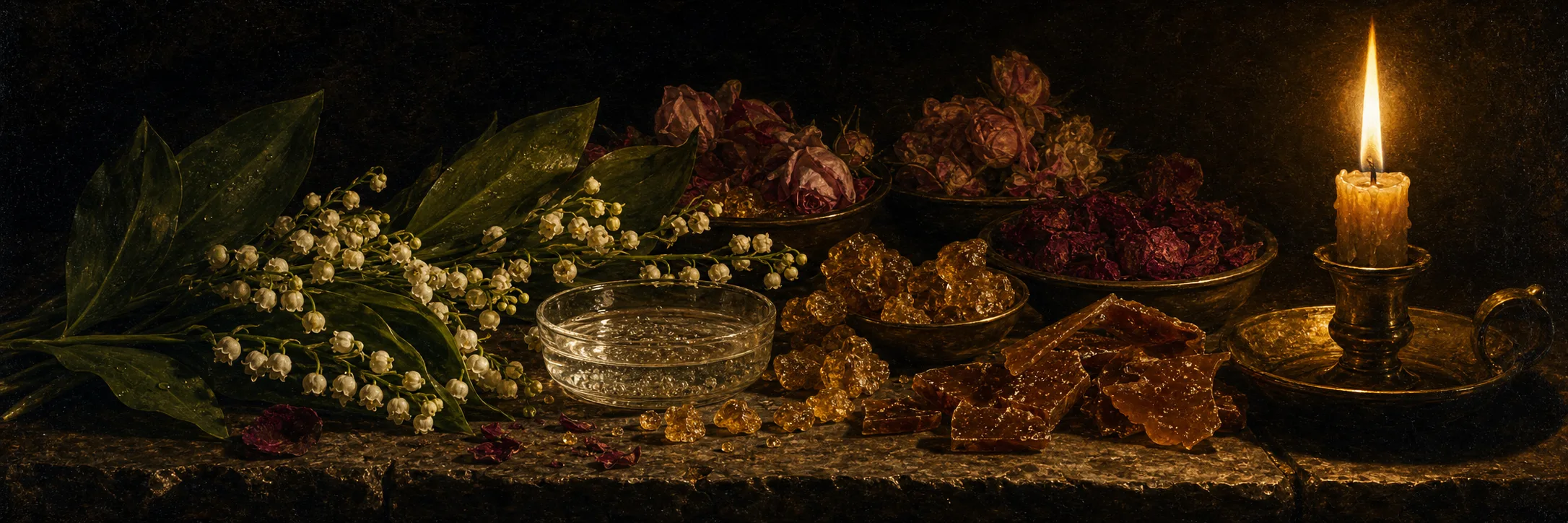
The opening is warmer and darker than the name suggests. The catalog lists lily, while Floris sample material also points to clove, sheer bergamot and cooling marine tones. In wear, the opening is a smooth clove-spiced floral with a faint watery mineral edge, not an obvious beachy aquatic. The heart is the most distinctive part: lily, tuberose and ylang-ylang wrapped in incense and myrrh. The sea-water note acts as contrast, a cool mineral thread against warm florals and smoke. This makes Amaryllis feel more like a smoky floral oriental than a clean bouquet. The base carries caramel, patchouli and heliotrope. Patchouli gives earth and darkness, caramel gives sweetness, and heliotrope adds a soft powdery almond finish. This base is also the dividing line: some find it delicious and plush, while others hear soap, detergent or synthetic sweetness.
Performance
Performance appears above average. Wearers describe long-lasting EDP behavior with moderate-to-good sillage: present and durable, but not usually aggressive. The incense-patchouli base is the anchor, clinging for hours and making the fragrance more substantial than its floral name implies.
Wearing Context
Amaryllis is best understood as cool-weather, evening-leaning wear. Late summer nights, autumn and winter suit its incense, myrrh, patchouli and caramel weight. It reads sophisticated, mature and dressed-up, with enough resinous darkness to feel functionally unisex despite the feminine marketing.
Comparisons & DNA
Lalique Nilang is the most precise comparison for the patchouli-forward sweet floral base, especially the post-2011 style mentioned by one wearer. Tom Ford Black Orchid is a useful dark-floral touchstone, though Amaryllis is less bombastic and more incense-marine. Penhaligon’s Amaranthine is a name-adjacent reference from preview commentary: both live near ylang and tuberose oriental territory, but Amaryllis is smokier and more resinous. The broader DNA is smoky white florals plus sweet patchouli orientals, not fresh lily soliflore.
Reception
Reception is small-scale but favorable among people who found it. Praise centers on sophistication, uniqueness, a high-quality smoky floral effect and a balanced oriental sweetness. Criticism centers on the caramel-patchouli base, which can read soapy or detergent-like, and on the oddity of the marine note inside a dark floral. There is no major critical review to anchor the record. The scent’s reputation is therefore narrow, collector-led and colored by discontinuation: people discuss it as something to hunt down rather than a current Floris staple.
Versions & Reformulation
Amaryllis was released once in 2010 as a 100 ml EDP in Floris’s Private Collection. It is discontinued, with no documented reformulation or flanker. An older Floris body cream remembered by some wearers is a separate product, not a vintage version of this perfume.
Acquisition Notes
This is a discontinued collector bottle rather than a regular retail purchase. Expect 100 ml EDP bottles, with price depending heavily on condition, fill level and box. Be alert for recreated “type” products, which are not authentic Floris stock. There is no special batch-code lore; inspect presentation and provenance.
Notable Facts & Lore
- The amaryllis flower is largely scentless, so the name is symbolic rather than note-literal.
- “Amaryllis” traces to pastoral poetry and imagery of shining or sparkling.
- The flower’s folk names include “naked lady” and “belladonna lily.”
- Floris launched Amaryllis in 2010, the same year it marked its 280th anniversary.
- Floris was founded in 1730 on Jermyn Street and remains tied to the Floris/Bodenham family.
- The fragrance’s name-flower mismatch is one of the recurring curiosities around it.