Floris — Lily of the Valley
Essence
Floris Lily of the Valley is a Victorian muguet interpreted through lemony green freshness, soft florals, and clean musk. Its interest is less photorealism than continuity: an 1847 Floris signature that still carries the house’s restrained English manner.
Scent Profile
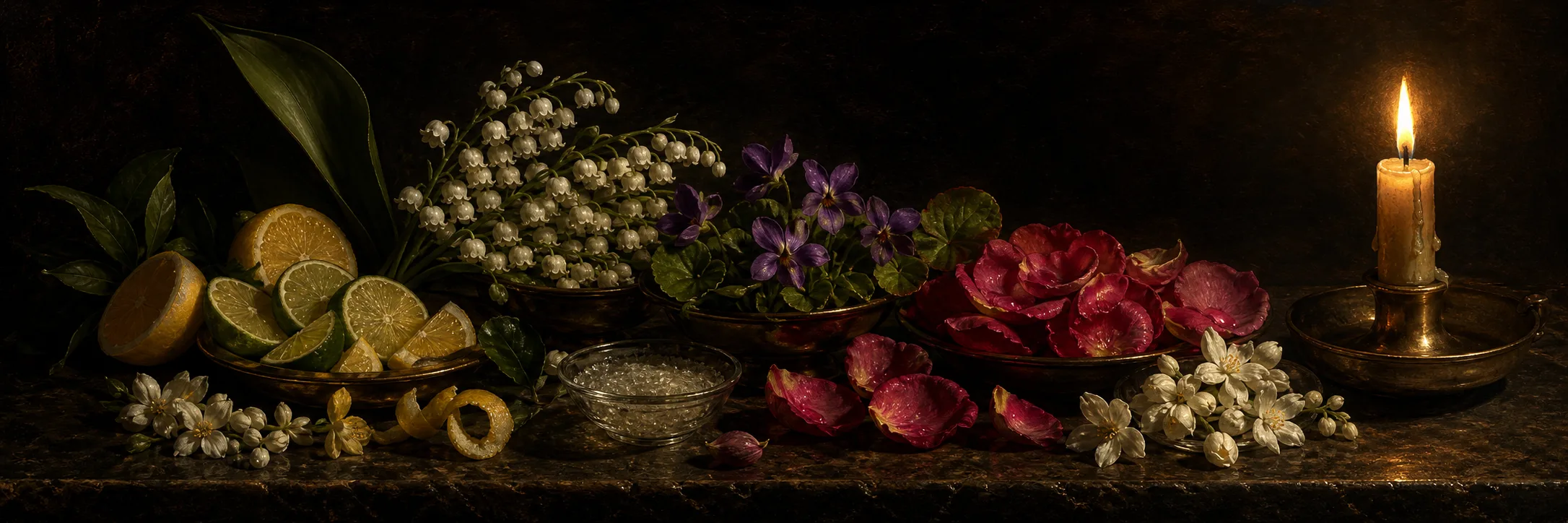
The opening is bright, green, and citrus-led. Amalfi lemon and crushed leaves arrive before the flower, giving the perfume a sharp spring-clean clarity that some wearers find invigorating and others find too lemony. The heart softens into reconstructed lily-of-the-valley with violet, rose, jasmine, and ylang-ylang around it. The floral effect is delicate and slightly powdery rather than lush; the muguet is present, but it shares the stage with the clean green frame. The drydown is light musk: soapy, discreet, and close. The scent’s identity is a lemon-green, clean muguet rather than a creamy lily-of-the-valley soliflore.
Performance
Expect moderate performance for a green floral: a clear opening, intimate-to-moderate sillage, and a soft trail that can last through a daytime wear on some skin. It is not designed as a projector; its better use is as a clean, springlike refresh.
Wearing Context
This is most at home in spring and early summer, especially for daytime, office, and low-key formal wear. It leans feminine in presentation but is green and clean enough to read unisex on the right wearer. Cold weather and dramatic evenings can make it feel too thin.
Comparisons & DNA
Dior Diorissimo is the obvious muguet benchmark: richer, creamier, and more true-to-flower, while Floris is greener, more lemon-forward, and more soapy-clean. Guerlain Muguet and Hermes Muguet Porcelaine occupy a more polished, luxury flower-study lane; Floris feels older, lighter, and more English. Floris Lily is the in-house contrast. Lily opens with white tea and watery freshness, while Lily of the Valley keeps the brighter citrus-green antique signature.
Reception
Wearers split over whether the lemon and musk sharpen or cheapen the muguet. Admirers hear a clean, elegant spring floral with historic charm; detractors hear synthetic musk, sharp lemon, and soap before they hear lily-of-the-valley. Value sentiment is cautious because buyers seeking a richer muguet often prefer sampling it against Diorissimo or other dedicated flower studies.
Versions & Reformulation
There is no single documented modern reformulation event, but a formula in continuous production since 1847 should be understood as evolved rather than untouched. Current bottles represent the living Floris version of the idea, not a sealed Victorian reconstruction.
Acquisition Notes
Sold as an Eau de Toilette in 50 ml and 100 ml sizes, with matching bath products. It sits in Floris’s heritage luxury tier and is easy enough to sample through the brand, stockists, and decant channels. Counterfeit risk is not a prominent concern; the more practical issue is whether the clean lemon-musk balance suits the buyer.
Notable Facts & Lore
- Lily of the Valley dates to 1847 and is among Floris’s longest-running fragrances.
- The scent is tied to the European May Day tradition of gifting lily-of-the-valley.
- Floris was founded in 1730 and still operates from 89 Jermyn Street in London.
- House lore attributes the original scent to Juan Floris.
- The flower’s wedding and purity associations were reinforced when it appeared in Kate Middleton’s 2011 bridal bouquet.