Floris — White Rose
Essence
White Rose is one of the oldest commercially available perfumes still sold — Floris dates the composition to the early 1800s, created in the founder-era at the house’s Jermyn Street shop and reintroduced for modern sale. It is not a jammy rose soliflore but a powdery, aldehydic soft floral built around rose, violet, iris and carnation. Its distinction is as much cultural as olfactory: a heritage scent from the world’s oldest independent family-owned perfumer, carrying an unusually well-documented royal and historical pedigree, and deliberately restrained in the early-19th-century sense of “clean.”
Scent Profile
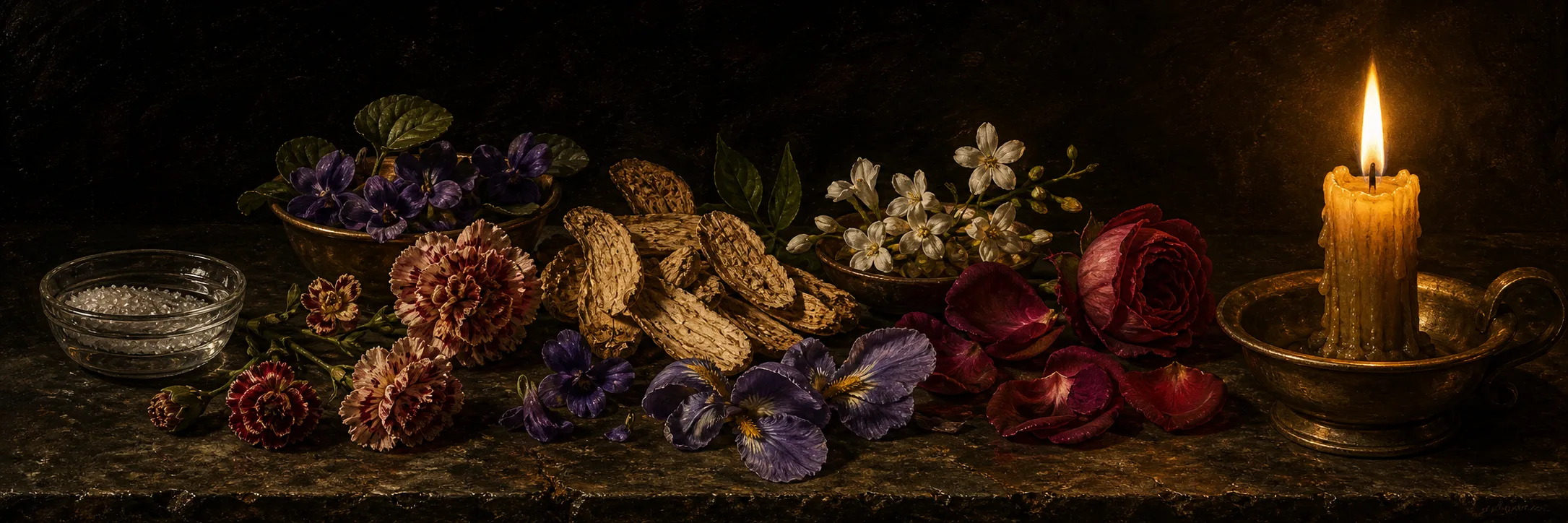
The opening is aldehydic and green — a sparkling, soapy-clean sparkle that reads crisp and almost citrusy rather than sweet. Critic Ida Meister describes “sparkling aldehydes and green notes” leading the wear. Into the heart, a rose-violet duet takes over, threaded with a spicy carnation note, quiet iris, and a faintly indolic jasmine. The rose is not especially dominant; the carnation and iris do as much work, pushing the effect toward effervescent violet, dry powder, and old-fashioned cosmetic textures — talcs and lipsticks. Some readings catch a cool, sharp, even shrill edge, and a faint plasticky “dolls’ heads” facet. The drydown rests on a powdery, gently musky base tinged with amber. The signature accord throughout is powder-plus-aldehyde over a soft rose-violet. Wearers split on the texture: some find it creamy, others chalky.
Performance
This is a deliberately quiet fragrance. As an EDT (roughly 10% concentration), longevity is commonly reported around four to six hours, with polite, close-to-skin sillage. Several wearers note it is faint on skin and easy to lose, in keeping with its period-accurate intent of giving discreet wafts rather than a projecting cloud. One quirk reported repeatedly: it can bloom most beautifully when wet, as in the shower. Apply generously and to pulse points, and do not expect a powerhouse.
Wearing Context
White Rose reads best as a daytime, spring-and-summer, formal-leaning floral — office wear, daytime events, and dignified or traditional occasions. It sits firmly in a “ladylike and clean,” very traditional British register, and is unambiguously feminine in presentation. The carnation-iris-violet powder can skew toward an “old lady” impression depending on the wearer’s age and taste. It is poised and reserved rather than warm or seductive — austere and complex rather than cozy.
Comparisons & DNA
- Within Floris, it contrasts with Snow Rose, a warmer, sweeter, more modern vanillic rose, and with China Rose.
- Its sparkly-aldehydic floral facet recalls Kenzo Flower, though with more aldehydes up top.
- In its springtime rose mode it has been likened to YSL Paris.
- As an aldehydic-powdery floral with iris and carnation, it belongs to the broad family of restrained classic florals rather than the modern fruity-rose or jammy-rose camps. There are no true designer clones; this is a heritage composition.
Reception
Reception is genuinely polarized along a single axis: heritage charm versus dated dowdiness. Admirers call it classic but not matronly, timeless but not stodgy, and prize its blending and historical resonance. Detractors are blunt, comparing it to a cheap air freshener or a grandmother’s plug-in. Luca Turin and Tania Sanchez were dismissive of the house as a whole in their A-Z Guide, judging Floris to produce nothing especially noteworthy and to trade on British heritage and Royal Warrants. The consensus blind-buy verdict: buy it for the history and if you love restrained powdery florals; look elsewhere if you want something rich, projecting, or rose-dominant.
Versions & Reformulation
White Rose has a documented reformulation history. While Floris dates the original creation to the early 1800s, the version sold today is a modern reformulation, variously cited as reintroduced around 2002, 2004, or 2006. Ida Meister judged the reformulation a success. A separate White Rose Eau de Parfum concentration is also documented. Buyers should assume the current EDT is not identical to any genuinely vintage bottle, though some long-term wearers suspect it is little-changed from older formulas.
Acquisition Notes
White Rose is widely and officially available; Floris is not a hard-to-find or discontinued house. It comes in standard 50ml and 100ml EDT bottles with the house’s signature blue paper and ribbon gift wrap, alongside matching bath and body products. It sits in a mid-tier price bracket for a heritage perfumery. Authentic channels include Floris’s own boutiques and website and authorized stockists. Since 2020 Floris donates a share of White Rose 100ml EDT sales to the Florence Nightingale Foundation. No counterfeit or batch-code concerns are documented.
Notable Facts & Lore
- Floris displays a treasured 1863 letter from Florence Nightingale thanking “Mr Floris” for the nosegays of sweet-smelling roses that “cheered my sick bed”; she had bottles shipped to her during the Crimean War.
- Floris, founded in 1730 by Juan Famenias Floris, is the world’s oldest independent family-owned perfumer, now run by the ninth generation.
- Queen Elizabeth II is widely reported (as tradition rather than hard fact) to have worn White Rose on her 1947 wedding day and throughout her life; Floris held the Royal Warrant as her perfumers from 1971.
- Meghan Markle is reported to have worn a bespoke Floris blend at her own wedding.
- Floris’s 89 Jermyn Street shop featured as Villanelle’s favorite perfumery in the series Killing Eve.