Floris — China Rose
Essence
China Rose is a big, opulent, old-school fruited-rose oriental from the historic British house Floris, launched in 2000 and now long discontinued. Despite the name it has nothing to do with China botanically: the “China” refers to roses-painted-on-fine-china imagery rather than Chinese plants. What it actually is, is a rich, sweet, spicy, clove-laced rose wrapped in amber and powder — a heavyweight, slightly retro rose bomb that fans adore and others find cloying.
Scent Profile
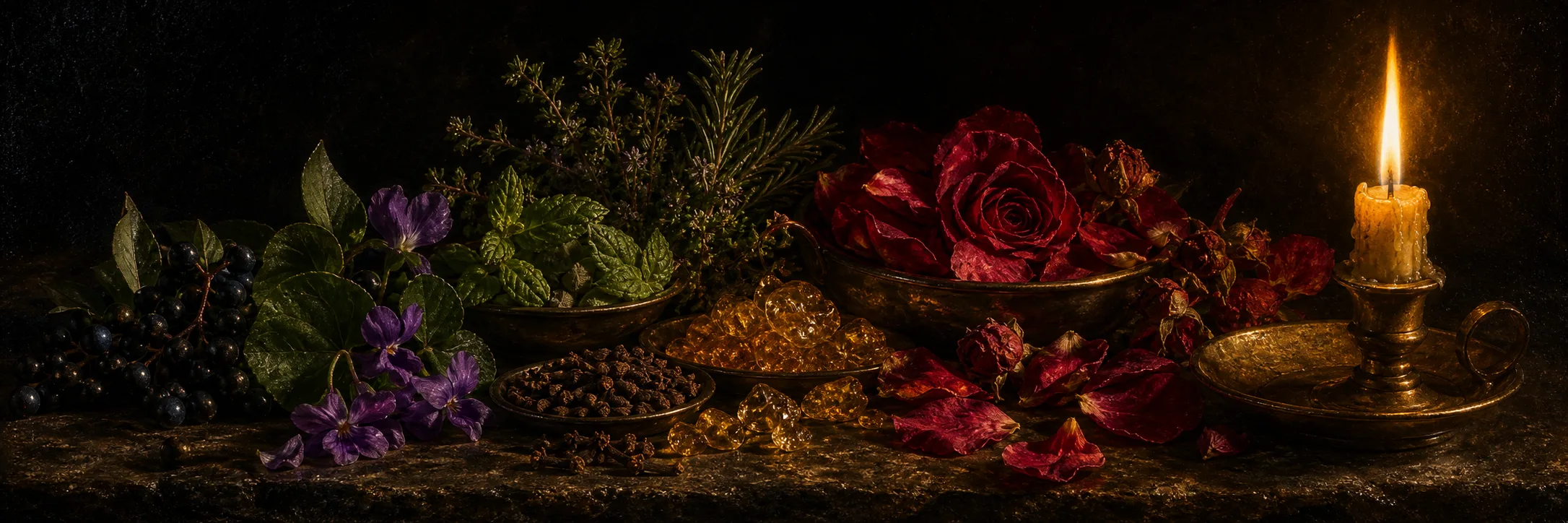
The opening is fruity, with peach and raspberry giving a brief juicy lift and sage adding a faint herbal edge, though the fruit is fleeting and the rose dominates almost immediately. The heart is the main event: a full, lush, blowsy rose, deepened and spiced by clove and rounded by geranium and powdery violet. To many it reads as a perfumey, powdery old-English rose rather than a fresh-cut garden rose. The base is warm and balsamic, amber-forward, with vanilla, tonka, patchouli, sandalwood and vetiver. In practice the amber and clove tend to dominate while the woods stay submerged. It is rich and sweet throughout, with a spicy clove-rose over sweet amber as its signature accord.
Performance
Performance is consistently described as strong, and is a defining trait. The fragrance projects boldly and lasts well; wearers report it as potent and long-lasting, with one likening its strength to the original Opium and noting that a little goes a very long way. This catalog entry is the lighter EDT, which still performs well at roughly four to six hours with moderate-to-heavy sillage; the EDP is a genuine powerhouse. Cautious, sparing application is the universal advice.
Wearing Context
This is a cool-weather, evening, occasion fragrance. One reviewer framed it as a scent for a grand entrance, in the old-fashioned mode of perfume worn only for occasions, and it ties naturally to autumn and winter richness, though a few enjoy it as a spring fruited rose. Given the strength and sweetness it skews mature, dramatic and feminine, and suits nights out and special occasions far better than the office or hot weather. It reads bold, romantic and vintage; detractors warn it can come across as heavy.
Comparisons & DNA
The most-cited reference is Yves Saint Laurent Opium, used as a benchmark for sheer intensity rather than as a scent twin. For its dense, sweet, fruited-rose style it sits near the Sophia Grojsman school of roses, with Boucheron Jaipur and Lancome Tresor cited as kindred bold, rich florals. Guerlain Nahema is invoked as another grand rose in the same opulent register, and Vivienne Westwood Boudoir as a comparably naughty rose. The shared DNA is clearly amber-oriental fruited rose with prominent clove, a turn-of-the-millennium take on the opulent roses of the 1980s and 1990s.
Reception
Reception is genuinely polarized, which is the headline. Devotees call it lush, sensual, complex and unique, one of the most powerful scents Floris makes, a rose that earns compliments and nostalgia. Detractors find it overwhelming, cloying or headache-inducing, with notable skin-chemistry sensitivity, some getting sour or rotten-flowers facets. The clearest axes of disagreement are sweetness and strength tolerance and individual skin chemistry. Several wearers also note that the official pyramid does not fully match what they smell, detecting little of the listed woods. Given the polarization and discontinuation, it is best treated as a sample-first proposition.
Versions & Reformulation
China Rose was made in both Eau de Toilette and Eau de Parfum, plus a full ancillary line of body lotion, bath and shower gel, dusting powder and soap that fans layered for an all-over effect. This entry is the EDT, which is lighter than the EDP but still well-performing; the EDP bottle is distinguished by a bow detail the EDT lacks. The line was discontinued, reportedly lasting only about five years in stores, and now trades on the vintage market. No formal reformulation history is documented; the distinction wearers care about is EDT versus the stronger EDP, and fresh versus aged stock.
Acquisition Notes
China Rose is discontinued and now a vintage-market item, surfacing on specialist discontinued-perfume sellers in both EDT and EDP, often alongside leftover ancillary products. Because it never had blockbuster volume, counterfeiting is not a documented concern; the real risk is age and condition, since turned or evaporated stock is common, along with price gouging on rare full bottles. The safest approach is to buy well-stored, boxed examples from reputable vintage sellers.
Notable Facts & Lore
- The “China” in the name is decorative imagery of roses painted on fine china, not Chinese botany.
- An original marketing conceit paired the rose with a black China-tea note and caraway seed; tea never appears in the published note tree.
- Floris is a long-established Jermyn Street perfumer holding a Royal Warrant, noted on the ancillary packaging as “By appointment to Her Majesty The Queen.”
- The fragrance was made in both EDT and EDP, with the EDP bottle distinguished by a bow detail.
- The line was discontinued, reportedly lasting only about five years in stores.
- Floris later released a separate rose, “A Rose For…,” in 2016, which one reviewer felt echoed China Rose’s overall vibe.