Givenchy — Gentleman
Essence
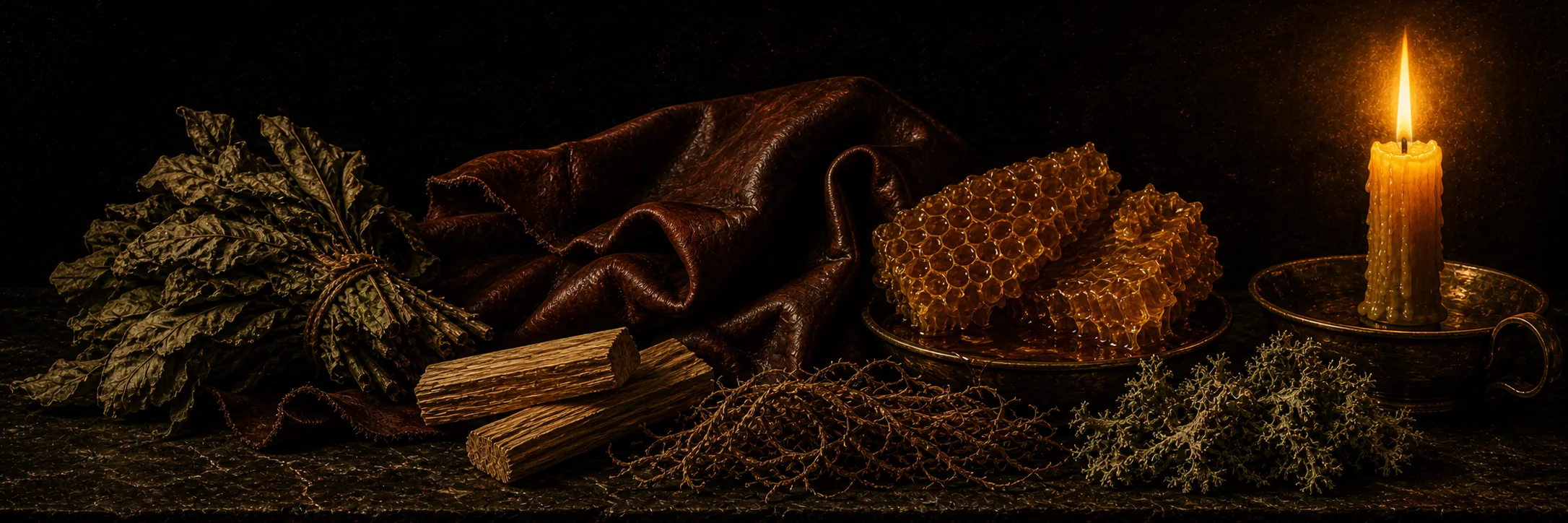
Gentleman is the 1974 Paul Leger composition that anchors one of the most discussed and now most ghosted lineages in masculine perfumery: a honeyed, dirty, patchouli-leather chypre-oriental built around a sticky honey-rose accord propped up on civet, oakmoss and Russian-leather. Where its contemporaries (Aramis, Kouros, Jules) shout, Gentleman murmurs - Luca Turin calls it “one of the quietest voices” of its decade. It is the polite-dirty masculine: brown, woody, faintly animal, recognisably a couturier’s idea of a man in a velvet smoking jacket rather than a stockbroker in a power suit.
Scent Profile
The opening is misleadingly elegant for what follows. Bergamot and lemon flash for perhaps ninety seconds, but the citrus is structurally a wick - it lights tarragon and cinnamon, and the heat of those aromatics meets a syrupy honey almost immediately. Within five minutes the honey-rose accord is doing the heavy lifting at the top, more textural than floral: warm, slightly fermented, with the cinnamon reading as dry cedar-bark rather than holiday spice. The composition is patchouli-forward from the first quarter-hour. This is not the cleaned-up modern fractionated patchouli; vintage bottles deliver the camphoraceous, cocoa-bitter, slightly mouldy Indian profile that defines the genre. By the half-hour the heart is open and the structure is fully visible: cedar and orris give a dry, faintly powdery spine around which the patchouli wraps; jasmine is technically present but functionally submerged, contributing indolic warmth rather than floral identification. The signature accord - and the reason Gentleman keeps getting compared to Giorgio Beverly Hills for Men, Jacomo de Jacomo and Kri
Performance
Vintage Gentleman (silver-cap metal-look bottles, pre-2000s) projects moderately for the first two to three hours, casting a roughly arm’s-length sillage rather than a room-clearing trail. Longevity on skin is genuinely long - eight to twelve hours is typical, with traces detectable at fourteen. On clothing, particularly wool, it can be smelled days later: oakmoss, patchouli and leather all bind to fibre. Later 2000s and 2010s reformulations project louder for the first hour but drop faster, and lose roughly two to four hours of tail. Heat amplifies the honey-civet aspect and can push the composition into territory some readers find sour or “old-syrupy”; cold weather and humidity flatter it, lengthening the leather-moss phase. Dry winter air is the ideal medium. The best application strategy is conservative - two to three sprays to skin (chest, behind ears), no clothing, no overspray. Gentleman is a fragrance whose density rewards restraint; four sprays of vintage juice will read as heavy in close quarters. Aftershave-balm and EDT splash variants existed and wear lighter and shorter (four to six hours), useful for those who find the spray formulation too dense.
Wearing Context
Gentleman is autumn-winter at its core, with shoulder-season utility in cool, damp weather. It is fundamentally an evening fragrance by modern standards but in 1974 - 1990 was worn daytime by men in tailoring; today’s offices read it as too heavy, too sweet and too distinctly “vintage” for most daywear. Where it shines is dinner, library, fireside, opera, theatre - anything indoor, intimate and not requiring projection across a room. It falls flat in heat (the civet and honey can curdle), in gym/casual contexts (entirely wrong register), and on anyone under 25 wearing it ironically - Gentleman wears its maturity earnestly. The social-perception skew is sharply generational: men who came up in the 1970s - 80s recognise it instantly and warmly; under-30 noses raised on Bleu de Chanel and Sauvage often read it as “thrift store” or “grandfather”, a sentiment frequently echoed on wearer reports.
Comparisons & DNA
Luca Turin places Gentleman in a specific lineage on his Substack: “inspired by Monsieur Rochas (smokier), and a precursor to Guerlain’s Derby (more dense) and Dior’s Jules (sweatier), less distinctive and less forward than any of them and none the worse for that.” That triangulation is the essential map. Beyond Turin’s axis, Gentleman’s nearest cousin is Giorgio Beverly Hills Giorgio for Men (1984) - same honey-patchouli skeleton but louder, sweeter, more 1980s, “Givenchy Gentleman with sugar diabetes” as one wearer reports regular put it. Jacomo de Jacomo (1980) shares the leather-patchouli-honey territory with a smokier, drier reading. Kri
Reception
wearer consensus on vintage Gentleman is reverent. wearer reports and wearer reports treat it as a benchmark of the 1970s patchouli-leather genre; an Italian wearer reports reviewer placed the vintage juice “next to Tiffany for Men or vintage Chanel Antaeus” in the “Olympus” of masculine classics. On wearer reports, the average rating sits high, with the criticism falling into two predictable buckets: younger reviewers calling it “old”, “musty”, “thrift-store” or “barbershop-gone-wrong”; and reformulation-conscious veterans complaining that post-2010 bottles are pale shadows of pre-2000 juice. Turin’s verdict on Substack (Dec 2024), revisiting both vintage and a current re-release: “Gentleman is the exemplar of a particular muted, transparent, tea-like genre of masculine perfumery, that spanned the 1970s and in retrospect feels both reserved and confident, both attributes sorely lacking in recent masculines.” He found the current re-release “remarkably faithful to the original, with a slight change of balance in the heart, less herbaceous in the recent one.” Persolaise has not formally reviewed the 1974 at length but treats it as the legitimate Gentleman in his coverage of the modern flankers. Colognoisseur’s Mark Behnke explicitly classes the 1974 as “one of the best examples of a masculine powerhouse of the 1970s” and “a masterpiece” he wishes Givenchy had left alone. Axes of polarisation: civet tolerance, honey tolerance, vintage availability, and the eternal “this smells like my dad/grandfather” question. Blind buy verdict: yes for anyone who already loves vintage Kouros, Jules, Derby or Aramis; no for anyone whose reference points are post-2010 designer masculines.
Versions & Reformulation
Gentleman went through multiple reformulations across its long life. The most reliably “rich” vintage juice carries the silver-on-black presentation in metal-look bottles with the wider collar, predominantly 1970s - 1990s production. A transitional period in the late 1990s through early 2000s retained much of the character. Post-IFRA reformulations (oakmoss restrictions tightened materially in 2008, with further revisions through the 2010s) softened the moss and reduced the civet; later batches read sweeter and less dirty. An aftershave splash and EDT were the main concentration variants - no proper EDP existed historically. Givenchy quietly discontinued the original through the late 2010s, then released “Gentleman Original” in 2024 as what Turin describes as a faithful reissue, distinct from the 2017+ reboot line. The 1974 bottle line and the 2017+ black-bottle line should not be confused; they share only a name.
Acquisition Notes
Vintage Gentleman trades on eBay, Catawiki and vintage specialists. Typical pricing for a sealed 1980s - 90s 100ml EDT runs roughly $100 - $300; unsealed used bottles, $60 - $150 depending on fill. The 2024 reissue retails at boutique pricing roughly comparable to current Givenchy EDT (around $90 - $110 for 100ml where stocked). Counterfeits exist for vintage juice - telltales include incorrect spray-no
Notable Facts & Lore
- No additional lore was documented.