Givenchy — Xeryus Rouge
Essence
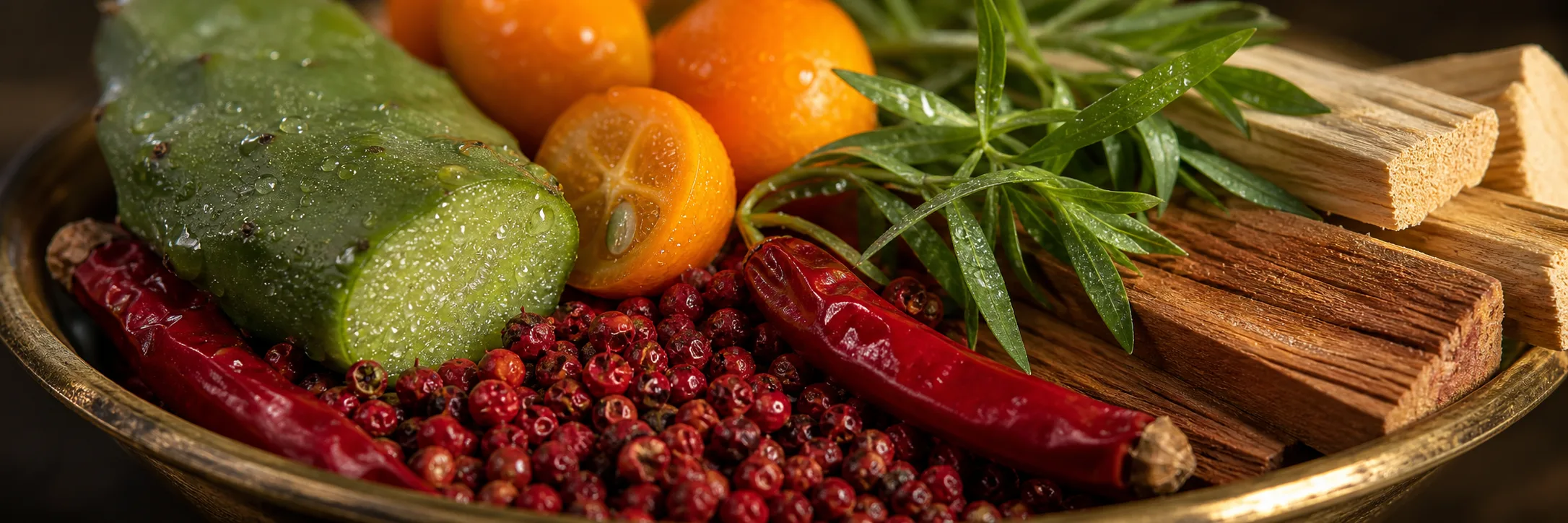
Xeryus Rouge is Givenchy’s 1995 oriental-fougere for men, an Annick Menardo composition that pairs a sweet-synthetic fruit accord (kumquat, cactus) with red pimento spice over a sandalwood-cedar base. Its signature is genuine strangeness: a chalky, sweetish, peppery-woody profile that smells like nothing else of its era and remains hard to place even now. Loud, divisive, and built around an unusual “cactus” note, it is the cult-classic outlier in the Givenchy masculine lineup - a fragrance enthusiasts seek out precisely because it refuses to smell mainstream.
Scent Profile
The opening is the loudest and most divisive stretch. A round, almost artificial fruity-sweet accord hits first - the listed kumquat and “cactus” read together as a bright, slightly chalky, candied tang - laced immediately with the green-anisic bite of tarragon. Several wearers describe the first 15 - 20 seconds as “artificially sweet/cactus/tarragon,” then “something like cedar” arriving fast on its heels. This is a polari
Performance
Performance skews strong, and Givenchy itself marketed later bottlings as “Intense.” Projection is moderate-to-strong in the first few hours - clearly detectable at arm’s length and beyond when freshly applied - before settling closer to the skin. Reported longevity is genuinely high for an EDT: most wearers cite a strong 8 - 9 hours, and one wearer reports reviewer reported it “still projecting” 11 hours after four sprays to the neck. On clothing it can persist a day or more (one wearer reports wearer noted lingering scent that required showering off). Skin longevity in the 7 - 10 hour range is typical. It performs best in cool weather; in heat the sweet-spicy density can read as cloying, so the opening’s loudness becomes a liability in summer. Cooler, drier conditions flatter the pepper and cedar. The single most important application advice from the wearers is restraint: two sprays maximum. This is a composition where more is dramatically worse - heavy application collapses the structure into synthetic geranium soup, while a light hand preserves the cactus-pepper-cedar interplay. Apply to skin rather than over-dosing clothing if you want the nuanced version.
Wearing Context
Xeryus Rouge is a fall and winter fragrance first, with spring viability for those who find it greener and fresher in mild weather; the height of summer is its weakest season. It leans evening and cool-weather daytime - warm, spicy, and a touch dramatic rather than office-neutral. Several longtime wearers happily use it as a near-signature daily scent in cooler months, and it can stretch from day into a night out, though it isn’t really a dedicated nightclub “beast.” Where it shines: as a distinctive, conversation-starting personal scent for someone who wants to smell unlike the room. Because almost nobody around you will be wearing it, it confers individuality - a frequent point of praise. Where it falls flat: conservative professional settings (the loud, sweet, peppery opening is risky), hot humid environments, and any context where inoffensive blandness is the goal. Socially it skews mature and masculine; multiple reviewers flag it as “not a scent for boys” and note it may read as dated or “old-mannish” to younger noses, even as others insist it still feels modern. It is emphatically not a safe blind buy - test first.
Comparisons & DNA
The closest documented relative is Ouragan (marketed as Ouragan / Masculin by Bourjois, 1997): a detailed wearer reports head-to-head calls them “so similar,” sharing a “formica-like, clear, sour, woody-plastic off note,” but finds Ouragan softer, sweeter, more floral and more natural, while Xeryus Rouge is “dryer, more acidic and spare” - and Ouragan was available in supermarkets at a third of the price. Davidoff Hot Water is repeatedly cited as overlapping in warm-spicy style, though distinctly its own thing and not a true match. wearer consensus is blunt: there is no exact dupe - “there’s nothing that smells exactly like Xeryus Rouge,” and reviewers note that cheap oil “smell-alikes” sold as Xeryus Rouge frequently turn out to smell like Fahrenheit instead, not the Givenchy. The opening’s pungency draws frequent comparison to Dior Fahrenheit - both have famously sharp, love-it-or-hate-it tops “likely to offend those with olfactory sensitivities.” Within Givenchy, it is the “deeper, more sensual” sibling of the original Xeryus (1986), an aromatic fougere that is greener and more traditional. One wearer reports reviewer cheekily positions Xeryus Rouge as a 1990s “signpost saying ‘Sauvage this way 11 years’” - i.e., an early, weirder ancestor of the warm-spicy crowd-pleaser template, though it never spawned a direct lineage the way Dior Sauvage did. Menardo herself later became associated with smoky-vanilla-rubber profiles (Bulgari Black, Lolita Lempicka au Masculin), and fans of her unconventional streak pri
Reception
wearer sentiment across wearer reports, wearer reports and wearer reports is sharply polari
Versions & Reformulation
Xeryus Rouge has been reformulated over its life, and the wearer consensus is that vintage bottles outperform and out-character later ones. Older bottlings are described as richer, deeper, more animalic in the drydown with a more pronounced red pimento; later formulations read brighter in the opening and smoother (some say weaker and “castrated”) in the base, accompanied by a repackaging many find cheaper-looking. One longtime owner reported losing “a couple of hours” of longevity moving from an older bottle to a newer one, though still strong. Concentration was EDT throughout. With the fragrance now discontinued, “current” effectively means late-production stock; vintage is sought specifically for the fuller, spicier, more animalic profile. Buyers chasing the legendary version should target older batches and be aware that condition (some vintage has “gone sour”) matters as much as formulation.
Acquisition Notes
This is a designer fragrance now in discontinued limbo: late-production bottles still circulate at discounter prices (commonly cited around $43 - $47 at Jomashop/FragranceX/FragranceNet historically), while sealed vintage and well-kept older bottles command steep premiums - fans cite OG bottles fetching $400+ on the secondhand market, with eBay prices described as “a fortune.” Standard si
Notable Facts & Lore
- No additional lore was documented.