Givenchy — Organza
Essence
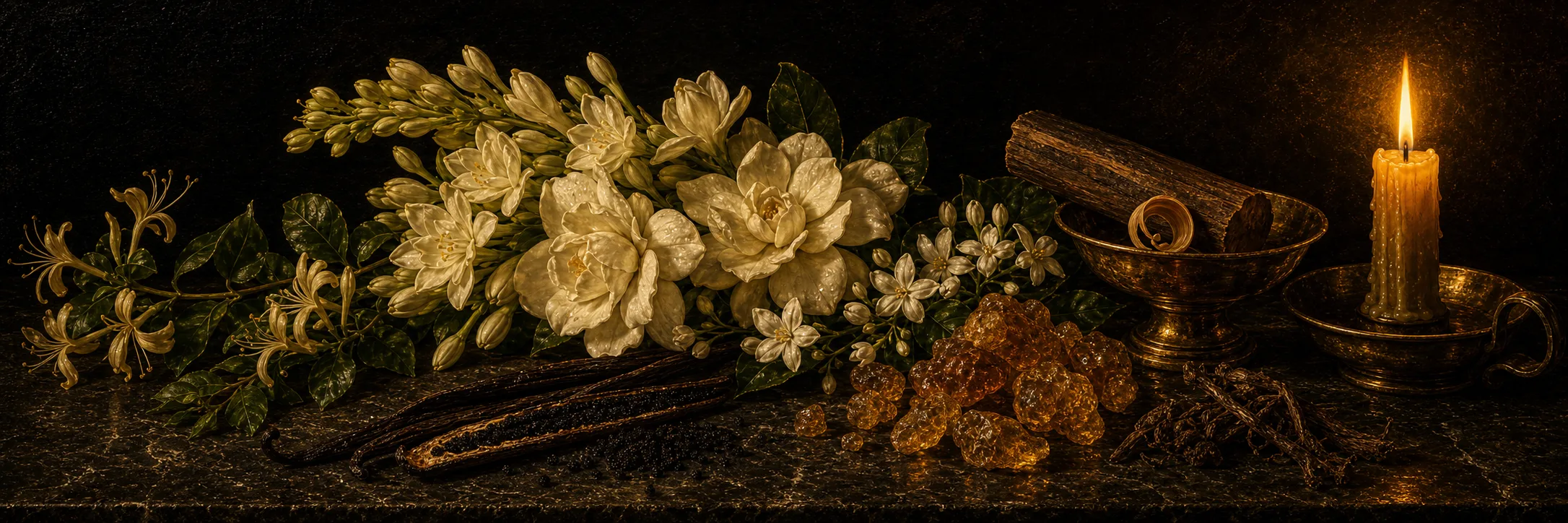
Organza (1996, perfumer Sophie Labbe for Givenchy, with Sophia Grojsman also credited on some databases) is a landmark late-’90s oriental floral: a “kitchen sink” of opulent white flowers (tuberose, jasmine, honeysuckle, gardenia) wrapped in nutmeg/mace spice and a warm vanilla-amber-guaiac base, presented in Serge Mansau’s iconic fluted-column “goddess” bottle. Its distinctiveness is the marriage of a heavy white-floral bouquet to a creamy, edible, spiced amber drydown - a fragrance that reads simultaneously as a grand floral and a comforting warm oriental. Luca Turin summed it up memorably as “a fine instance of vulgarity done exactly right.”
Scent Profile
The opening reads green and spicy-bright - dewy green stems, bergamot/neroli, a feminine gardenia, and a distinct prickle of nutmeg/mace that several reviewers call the fragrance’s signature twist. The heart is the “unfettered floral storm”: tuberose typically in the foreground, affirmed by jasmine, a creamy honeysuckle, ylang, iris, and peony, with the much-discussed walnut and nutmeg adding an unusual nutty-spiced “rare feeling” that gives the bouquet depth. Crucially, reviewers repeatedly note the sweetness “always remains civil” - it walks “the tightrope between intensity and sickly banality very carefully,” never turning plasticky or cloying. The drydown is the payoff: a deep, almost edible vanilla with amber, guaiac/woody warmth, and lingering nutmeg - “buttered cinnamon French toast”-adjacent richness, though with Organza the spice is nutmeg rather than the cinnamon of its flanker. Perceptible throughout: tuberose, the nutty-spice accord, and the vanilla-amber base. It is a slow, rich linear-ish bloom rather than a dramatic shapeshifter.
Performance
Vintage Organza is a documented powerhouse: wearers report “eternal longevity, beast mode projection when oversprayed,” with one logging a “magnificent fourteen hours” and strong-but-civil sillage. Projection and longevity both rate above average. The major performance caveat - and a near-universal complaint - is the reformulation: the current clear-glass version is widely described as “watered down,” with diminished projection and sillage, and at least one wearer of modern juice reporting just 1 - 2 hours on hot skin. Weather behavior: its warmth and white-floral richness make it an autumn/winter and evening scent for most, though fans wear it year-round.
Wearing Context
Organza is coded as a grown-up, feminine, evening/occasion fragrance - “a lady in a beautiful evening gown,” “classy at 18 and 70,” sophisticated and formal rather than casual. Multiple reviewers, however, insist it also works for daytime/office on a lighter hand. Seasonally it leans cool-weather and evening, when its vanilla-amber warmth shines. Social perception is “sophisticated, classic, head-turning” - the recurring anecdote is that it draws “what are you wearing?” attention and reads as expensive and deliberate.
Comparisons & DNA
Within the house, reviewers tie Organza to Givenchy Ysatis (Givenchy) as the older, comparably grown-up and intensely feminine Givenchy oriental floral it most evokes - one wearer recalls “the one this reminds me of (which my mother used to own) was Ysatis, which again was a very grown up and feminine fragrance.” The most important in-house relationship is with its flanker Organza Indecence (see below), which fans warn is frequently confused with the original despite being a very different spicy-woody-vanilla. Across houses, critics place it alongside the big late-’80s/’90s florals - Givenchy’s own Ysatis, Boucheron Boucheron, and Giorgio (Giorgio Beverly Hills) cited as the bombastic genre predecessors that make Organza’s relative polish notable. For the creamy-vanilla-white-floral facet, Hanae Mori Butterfly (Hanae Mori) and Thierry Mugler-adjacent comparisons surface; the curated “alternatives” lists pair it with Chanel No. 5 (Chanel) as a fellow powdery-floral oriental of “undeniable feminine authority” and Lancome Tresor (Lancome) as a gentler, more romantic step-down. Among modern relatives, Dior J’adore (Dior) is called its “brighter, more modern cousin.”
Reception
Organza is a beloved modern classic with broad affection and real critical standing. Luca Turin praised it in Perfumes: The Guide, classifying it as a “vanillic floral” and delivering the oft-quoted verdict that it is “a fine instance of vulgarity done exactly right” - affectionate praise for its unapologetic richness. The dominant criticism is not about the original composition but about the reformulation - one wearer captures the consensus exactly: “Vintage Organza (the woman’s silhouette is frosted glass and the juice is darker)… The current reformulation is a watered down aromachemical version and lacks the plushness.” Secondary criticisms: a minority find it dusty, old-fashioned, or “sweet like plaster,” and the white-floral intensity is inherently polarizing.
Versions & Reformulation
Organza is the pillar of a substantial Givenchy family. The original 1996 EDP (frosted-glass figure, darker juice) is the benchmark; the current production EDP comes in clear glass with lighter juice and is the widely-criticized reformulation (attributed to IFRA/cost pressures, with naturals swapped for aromachemicals). Concentration/format variants include a Parfum and an “Eau d’Ete Parfumee”/Legere lighter summer version (1997), plus festive/limited presentations. The flanker line is large - a house retrospective counts Organza as the start of a family of eight flankers and the seed of the later “Les Parfums Mythiques” (2007) and “Les Creations Couture” (2012) collections, plus five Givenchy Harvest editions (2006 - 2010).
Acquisition Notes
Organza occupies the upper-designer price bracket. As of 2024 it remained available on Givenchy’s site at roughly $125 for 50 ml and $154 for 100 ml EDP, with online discounters listing it lower.
Notable Facts & Lore
- Organza debuted at the Givenchy pret-a-porter show in October 1996, the campaign built around supermodel Yasmeen Ghauri in a white organza haute-couture gown sewn in the Givenchy workshops from a John Galliano sketch, shot against desert landscapes.
- The launch slogan was “Quelque chose en moi d’eternel” (“Something eternal in me”); the US market used “Slip Into Luxury.”
- The Serge Mansau bottle - a fluted classical column transforming into a draped female figure, evoking the Pygmalion myth - is celebrated as one of perfumery’s great bottle designs, with craquelure on the gold stopper of vintage editions.
- The name traces to organza, the sheer silk fabric, whose etymology is linked to the Silk Road city of Urgench in Uzbekistan.
- Givenchy’s own documented description of the scent was “flowery yet earthy.”
- A persistent piece of retailer-driven lore ties the bottle’s spirit to Audrey Hepburn, Givenchy’s muse, though this is marketing framing rather than a documented design brief.