Hind Al Oud — Emarati Musk
Essence
Emarati Musk is a 2017 release from the respected Emirati house Hind Al Oud, conceived explicitly as a patriotic “Proud to be Emarati” tribute and built on an unusual hook: it claims to be a musk fragrance led by a sweet date note - a nod to Gulf culture - wrapped in vanilla and soft white musk. In practice it is a sweet, powdery, gently gourmand floriental skin-warmer that reviewers find comforting, polarizingly cotton-candy-sweet, and very much in Hind Al Oud’s recognizable house style.
Scent Profile
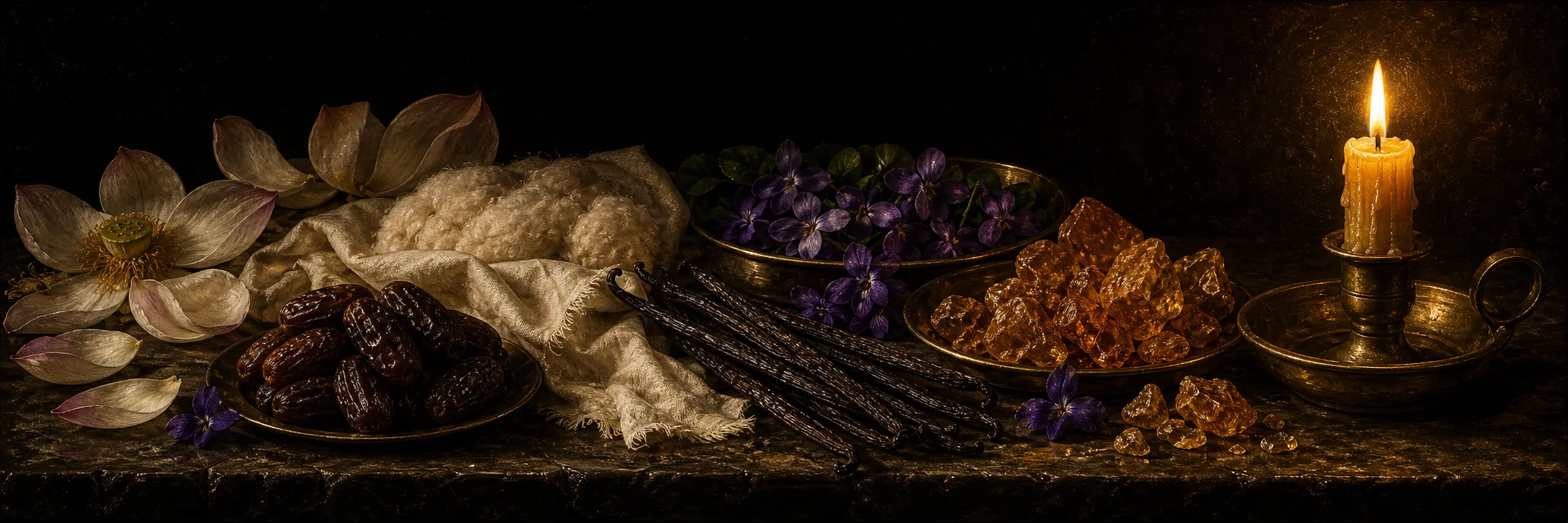
The brand’s official pyramid is minimalist - date, vanilla, white musk - but on skin reviewers consistently find more going on, plus a notable gap between the marketing and the experience. The date note is real but elusive: “noticeable in the opening, but it would be difficult to identify as date blindly,” and it fades into a “general diffuse vanillic sweetness” in the drydown. Around it, wearers detect a soft floral bouquet - lotus and violet are named repeatedly on wearers (“the heart is floral, especially lotus,” “this date-violet-lotus-musk dream”) - over a base that is powdery, creamy, slightly smoky, and dominated by a soft white musk. The overall impression splits between “beautiful, iridescent, alive, sensual” and, for skeptics, “cotton candy with vanilla… a marshmallow,” “ideal for a little girl.” It leans sweet, powdery and feminine despite its unisex billing, and several note a faint Hind Al Oud “house base” (an oud/white-floral signature) detectable underneath.
Performance
Strong - above-average projection and longevity are the consensus and a genuine selling point. The one caveat is application: multiple reviewers warn it can turn cloying if oversprayed (“I made the mistake of overspraying, and it became cloying. Control your sprays”). As a parfum-concentration Gulf release, a little goes a long way; restraint is rewarded.
Wearing Context
Versatile but sweet-weather-dependent on the wearer. Some place it firmly in warm weather and as a fresh post-shower/travel “freshen-up” musk and layering base; others find its sweetness and powder better suited to cooler seasons. It works as a comforting daily “signature” scent and is frequently described as a layering tool - “a base musk to layer with other perfumes.” Given the powdery-sweet, slightly feminine tilt, men wearing it should expect a soft, cozy effect rather than anything sharp or “masculine.”
Comparisons & DNA
Within Hind Al Oud’s range, reviewers describe a recognizable, recurring house accord (an oud/white-floral base, “easily recognizable among many fragrances of this brand”). One wearer explicitly flags that, despite the date-musk concept, it has “NO similarity to Across Sands” by Maison Margiela Replica. Otherwise it sits in the broad Gulf sweet-musk/floriental category; comparisons to Western fragrances are rare in the material because its date-led sweetness is genuinely regional. Detractors reach for “marshmallow,” “cotton candy,” and even (dismissively) “smells like alien” - pointing to its idiosyncrasy rather than a clear dupe lineage.
Reception
Polarized between rapturous and indifferent. The high end is genuinely effusive - wearers reach for “I have died and gone to heaven,” “compared to that, Amouage is just a body splash,” “unlike anything I’ve ever smelled before.” Hind Al Oud enjoys, per an Emirati reviewer, “a pretty firm reputation among us Emiratis,” and the brand is called by fans “one of the most worthy Arabian brands on the perfume market.” The skeptical end finds it overly sweet and juvenile - “a gourmet perfume that smells of cotton candy… ideal for a little girl,” “smells like alien to me.” The most balanced reviews land on: well-blended, linear, strong-performing, pleasant, but sweet and not especially complex or, for some, worth its price. Coverage is concentrated in wearers material (wearers, wearers) and Gulf retail; no public critic review exists, so this profile is built from enthusiast consensus.
Versions & Reformulation
Marketed by the Mohamed Hilal Group, sold as a parfum, most commonly in a 50ml bottle (priced around AED 770 at the house’s own MHGboutique). No reformulation history surfaces in public material - it remains in production as a current Hind Al Oud release rather than a discontinued or reformulated one. Note that ingredient lists circulated by decant retailers show a conventional functional-fragrance composition (alcohol denat., a roster of standard aroma-chemicals and EU-allergen declarations like Lyral, Lilial, coumarin, etc.), consistent with a modern spray parfum rather than a traditional oil attar.
Acquisition Notes
The recurring buyer caution is twofold: it’s relatively pricey for 50ml, and it’s polarizingly sweet, so a sample/decant first is strongly advised. Because performance is strong and it oversprays easily into cloying territory, even a small quantity will serve a long time. Good candidate for those who like Gulf sweet musks or want a date-vanilla layering base; poor candidate for anyone sweet-averse.
Notable Facts & Lore
- The concept is overtly nationalistic: Hind Al Oud frames Emarati Musk as a “tribute to our homeland,” invoking the UAE’s cultural association of musk with “luxury and honor.” - The date note is the marketing hook - the house’s own MHGboutique listing claims it is “the only perfume in the world to have the sweet notes of Dates and Vanilla. The base is Musk, a balancing, warm scent characteristic of the region,” though reviewers find the date hard to isolate blind. - It anchors a deliberate pair with Emarati Oud, the “deeper, more complex” oud-and-olibanum sibling launched the same year - buy/sample both to understand the house’s flagship statement. - Reviewers repeatedly identify lotus and violet in the heart despite neither appearing in the brand’s three-note pyramid - a reminder that the official notes understate the composition. - The “control your sprays” warning is near-universal: its strength is real, and overapplication is the most common self-reported mistake.