Hind Al Oud — Sheikh A
Essence
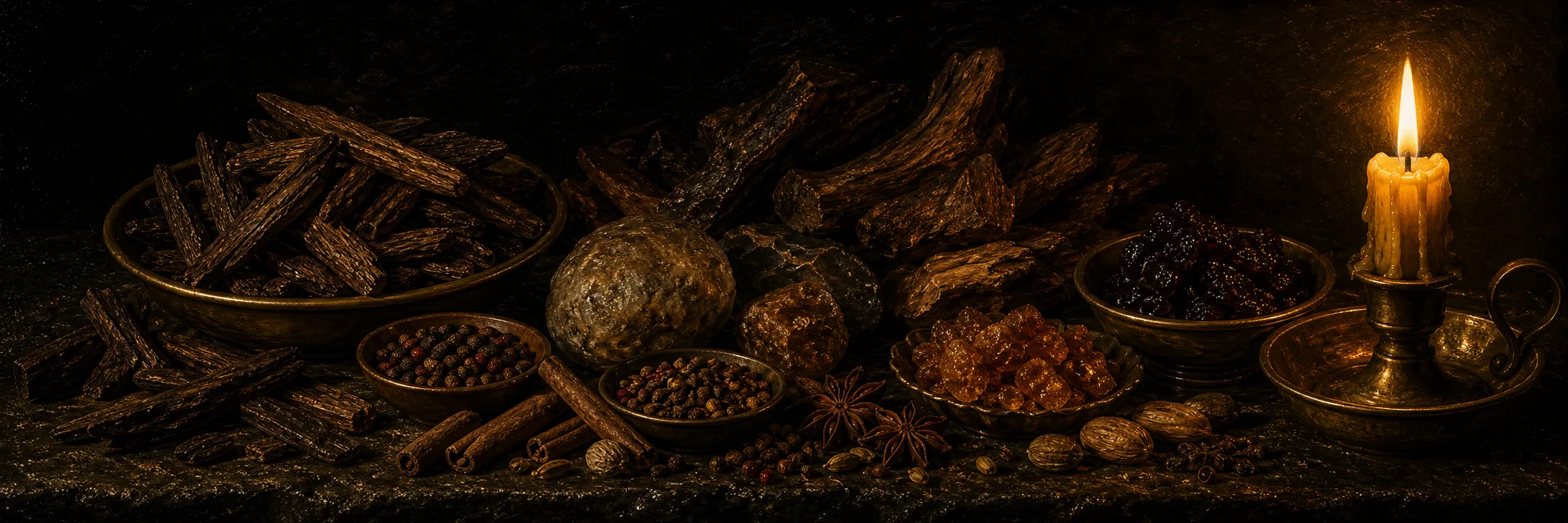
Sheikh A is Hind Al Oud’s foundational fragrance - literally the first scent the house ever created - and it is an unapologetically traditional, Gulf-style ode to raw Indian oud. Where Ahojas courts the Western sweet-tooth, Sheikh A goes the other direction: a bold, animalic dehn-al-oud experience built to read as the real thing - pure Hindi/Cambodian oud oil rendered in spray form, with spice up top and an ambergris-and-balsamic resolution. It was originally released under the name Sheikh Abdullah; “Sheikh A” is the modernized, rebranded version, positioned by the house as a more contemporary take on the original. This is the house’s statement of oud credibility rather than a crowd-pleaser.
Scent Profile
The opening is the polarizing centerpiece: immediate, raw oud power that reviewers describe as “dark, deep… like dehn (pure) Hindi oud,” intensely animalic and “almost barnyard,” with a spicy lift. The fecal/manure facet that defines classic Indian oud is present and is the single most-discussed element - a Fashionicide reviewer captured the paradox well: “there’s a distinct manure-esque aroma, but at the same time, it doesn’t smell like that at all… such is the mystery of oud.” On most skins the funk burns off within roughly ten minutes (one blind-buyer’s words) and the scent settles into a smoother, resinous, balsamic, faintly sweet woody-amber drydown - “divine,” per the same Fashionicide review, with musky warmth retained over the woody core. Spices (the listed information’s top accord) read herbal and green early; ambergris and amber drive the warm, sweet-resinous base. Some reviewers detect a dark rose-and-patchouli facet and a leathery quality emerging late. Skin chemistry matters: the Fashionicide reviewer noted it went woodier and earthier on her husband than on her. The signature accord is raw animalic Hindi oud resolving into sweet balsamic amber.
Performance
Loud and long is the consensus on the opening; the tail is more debated. Wearers classifies longevity as above-average, and one wearer claimed “the longevity for those who seeks it is around 4 days on plotter and going fair.” On skin, reports diverge: enthusiasts describe a daylong scent bubble that gradually quiets, and warn the scent transfers easily to clothing and skin (“if you apply it to your neck and touch it, your hands will smell like it”). But at least one devoted oud-lover found skin longevity shorter than expected - “about 4 hrs for me then it became quite faint” - attributing it to under-spraying given the strong opening. Application strategy from experienced wearers: a pro tip is to lay down a pure oud oil on pulse points first, then spray Sheikh A over it to extend projection. Caution - reviewers warn it can stain light or delicate clothing, so avoid spraying directly onto white fabric.
Wearing Context
This is a cool-weather, evening, formal-occasion oud in the Gulf tradition. Arabic-language reviewers explicitly tie it to “formal occasions or formal people,” calling it raqi (refined/classy) and fakhem (luxurious) - the kind of scent worn to weddings, majlis gatherings and ceremonial events in the Middle East. It is marketed masculine and reads “very masculine” to most, though several oud-lovers (including women) consider it functionally unisex. Social-perception skew is bifurcated: in a Gulf context it signals wealth, tradition and seriousness; in a Western casual context the animalic opening is emphatically not a safe office or daytime scent - “not a casual scent AT ALL,” as one reviewer flatly states. It rewards an audience that already appreciates oud as a note.
Comparisons & DNA
Reviewers most often place Sheikh A against pure dehn-al-oud oils and other Gulf oud blends rather than Western niche. Wearers likens it to Areej Le Dore and Bortikoff territory (artisanal natural-oud houses), and one reviewer compares the ambergris-spice drydown to a Mancera/Montale-adjacent “Fars”-type blend. Within Hind Al Oud’s own range, a wearer frames it as the “airy, hollow” younger sibling to the house’s much pricier Ghali Al Athman (“oud being the prominent note for both… [Sheikh A] is more of an airy version while [Ghali Al] Athman oud has the depth”). The most pointed comparative criticism is value-based: reviewers argue GCC-market oud blends offer “stronger and more robust takes on aged Indian oud” at a quarter of the price. The earlier Sheikh Abdullah (original name) and a Sheikh A Special Edition (described as classier, less “cow bottom,” with a prominent cardamom note) are closely related house variants.
Reception
Among oud fans the reception is enthusiastic - “one of the best oud fragrances I’ve smelt so far,” “I cried tears of joy,” and repeated praise for high-quality oud and a smooth balsamic resolution. The two polarization axes are stark: the animalic/fecal opening (a barrier for some - “the fecal oud smell is too much for me” - and the entire appeal for others) and price-to-value (the loudest sustained complaint, with a wearer calling the ask “quite exaggerating! 170$+ for 50 ml!… there are HUGE similar blends in GCC countries… [at] quarter the price!”). Blind-buy verdict: wearers is explicitly cautious - “Test first, don’t blind buy” recurs - because the raw Hindi profile is divisive. It is a confident recommendation only for established oud lovers.
Versions & Reformulation
Sheikh A is a rename/modernization of the house’s original Sheikh Abdullah, the first fragrance Hind Al Oud created; the brand positions Sheikh A as the contemporary version. A Sheikh A Special Edition exists, described by wearers as classier and fruitier/spicier with a cardamom emergence and less animalic funk than the original. Concentrated oil (“Sheikh A Jewel” / “Sheikh Abdullah Jewel,” 6ml) and other formats are sold alongside the spray. Beyond the AbdullahA rename and the Special Edition, no granular reformulation history is documented in public material.
Acquisition Notes
Upper-niche pricing: roughly 740 AED / ~GBP163 for 50ml per a 2025 Fashionicide purchase, with wearers citing $150-$170+ depending on sales; the concentrated-oil “Jewel” formats run higher (eg, ~965 AED for 6ml). The standard spray is 50ml. As with the rest of the line, availability was long Middle-East-centric (Dubai boutiques), with international access via UAE e-tailers, grey market and decants.
Notable Facts & Lore
- The defining piece of lore is its primacy: Sheikh A (as Sheikh Abdullah) was the very first Hind Al Oud creation and remains highly popular in the Middle East - making it the cornerstone of the house’s identity.
- The name signals royalty/nobility, consistent with the brand’s “inspired by royalty” framing.
- The AbdullahA rebrand is itself a documented evolution that intrigues longtime fans, several of whom express curiosity about how the original differed.
- No perfumer is publicly credited - flag this as a genuine gap; no public material names a nose.
- No celebrity tie-ins or controversies appeared in public coverage beyond the perennial value debate.