Hind Al Oud — Hind
Essence
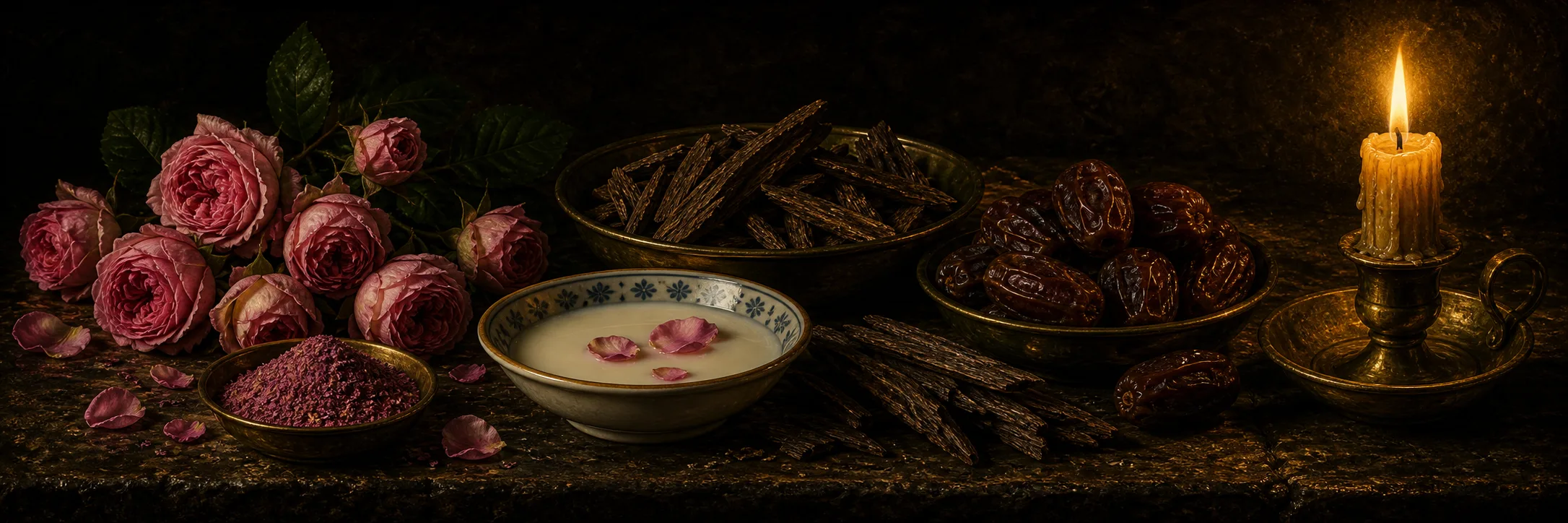
Hind is the eponymous, feminine-leaning signature of Hind Al Oud, an Emirati house within the Mohamed Hilal Group that has cultivated a near-deliberate obscurity outside the Gulf. The brand built its reputation on a specific, recognizable DNA - smooth, creamy, high-concentration compositions that bridge Western/French polish and Khaleeji richness - and Hind is its rose-forward, milky, oud-shadowed flagship. It’s a 2017 parfum built on a deceptively short note list: rose, agarwood, and a lactonic “milk” accord. Coverage is thin in the Western critical press by design - this is a house you discover “purely by chance at a Sephora in Dubai,” in one wearer reports user’s words - so the most reliable reads come from wearers, wearers, wearer reports and Gulf-focused enthusiasts.
Scent Profile
The advertised idea is a creamy rose over agarwood, lifted by a soft lactonic milkiness and “clean powdery notes.” In practice, wearers splits on how literal the milk is. The dominant read is a rich, dewy Middle Eastern rose made plush and slightly gourmand: one wearer describes “that oudy rosy mix and added to it the slightest sugared drenched milk possible… as delicious as rose water with more doses of dewy juicy pink roses, & delicious dates,” arguing the sweetness reads more like dates than sugar. A skeptical counter-review reports getting “no lactonic or milky notes” at all but rather “a perfect balance of some kind of slightly spicy wood (like sandalwood perhaps) & rose,” with the creaminess coming from the rose itself rather than a literal milk note - and crucially “no barnyard traces.” A harsher take pegs it as “dates molasses mixed with rose water and a little bit of white musk.” Net: a clean, creamy, rosy-oud with a powdery finish and only a discreet, non-fecal oud presence.
Performance
Hind Al Oud’s whole pitch is concentration. The house’s Dubai Mall staff told the blog Fashionicide that “their fragrances all contain 40% perfume oil,” versus a typical EDP’s 15-20% - a verbal, staff-stated claim relayed by a single blogger rather than a lab figure, but consistent with the line’s reputation. Wearers summary classification for Hind reports “projection and longevity are above-average.” Reviewers describe a soft, slow bloom that builds rather than announces itself - one wearer recounts wondering “if i felt anything at all” in the first twenty minutes before “an hour after, i smell it everywhere.” Treat it as a moderate-to-strong, long-lasting but initially intimate scent.
Wearing Context
This is a cool-weather, dressed-up, evening-leaning fragrance in the Khaleeji idiom, though its cleanliness and lack of barnyard funk make it more crossover-friendly than the house’s heavy ouds. Reviewers consistently flag it as feminine - one explicitly argues “I don’t think this can be classified as unisex. Very feminine” - though the listed information and wearers list it unisex, and the soft rose-oud could read either way in Gulf wearing norms. It’s the Hind Al Oud most often recommended as an entry point “as a crossover from Western/French perfumes into niche Arabic ones.”
Comparisons & DNA
Internally, Hind sits in a tight cluster with the house’s similarly-named siblings, and the distinction is real but subtle. Per the house’s own descriptions: Hind is the rose-forward signature with a creamy lactonic facet; “Hindi” leads instead with “lactonic notes, milky and soft” before the rose arrives (the milk-first sibling); and “Rose” drops the milk entirely for a “blend of rose and geranium” over agarwood. No robust independent side-by-side of all three exists - the practical difference is mostly which note opens the composition. Externally, one reviewer likens Hind’s creative ambition to “Kilian when it was a quality fragrance brand.” The broader house DNA gets compared to Lorenzo Villoresi for its earthy-green character, and stablemates like Bass Ketha to Tom Ford Tuscan Leather and Musk Al Shiokh to Dior Midnight Poison / Tom Ford Black Orchid.
Reception
Sparse but warm among those who’ve found it. There is no critic review of Hind specifically - Luca Turin/Sanchez, Bois de Jasmin, Persolaise and the major blogs have not covered it, which is itself telling about the house’s distribution. The most substantive specialist writing on the brand (Fashionicide, discussion threads) focuses on the ouds and the house ethos rather than Hind itself.
Versions & Reformulation
Hind is a spray parfum, launched 2017, and as of the latest listed information data is part of a roughly 29-fragrance house lineup spanning 2017-2021. No documented reformulation history exists in the accessible material - unsurprising for a relatively young Gulf release. Note the naming hazard: “Hind” (rose/oud/milk), “Hindi” (milk/rose/oud), and “Rose” (rose/geranium/oud) are three distinct products that are easily conflated, as are body-spray and bakhoor versions within the brand’s product matrix.
Acquisition Notes
This is the crux for non-Gulf buyers. On the house’s own boutique (MHGboutique), Hind parfum 50ml lists at Dhs 770.00 (roughly $210), frequently discounted to Dhs 616.00, with a 5ml mini around Dhs 70. Prices are steep by design and reviewers acknowledge it - “their prices are steep, which is why it took me so long to get into the brand.” Sample before committing given the milk-note variability across skin chemistries.
Notable Facts & Lore
- The house is named for, and fronted by, a real person within the Mohamed Hilal Group, which also operates other fragrance brands at varying price points.
- Its deliberate low profile is a recurring theme in collector discussion - wearer reports users marvel that for a brand making fragrances “of quality,” its obscurity seems “perhaps deliberate,” contrasting it with the much louder international pushes of Amouage, Ajmal and Arabian Oud.
- The signature “Hilal’s Wood” base appears across the line as a house marker.
- And the milk/lactonic conceit - rose softened by a creamy dairy-adjacent accord - is the brand’s most distinctive olfactory signature, echoed across Hind, Hindi and others.