Hind Al Oud — Musk Al Shiokh
Essence
Musk Al Shiokh is the rose-patchouli-musk pillar from Hind Al Oud, the Emirati luxury house founded by Mohamed Hilal in 2001 and operated under the Mohamed Hilal Group out of Business Bay, Dubai. The listed information lists it as a 2017 Parfum, unisex, in the floral family, built on rose and patchouli over a musk base, with rose/musky/woody/patchouli/floral/animalic accords. In practice it reads as a Gulf-style “musk” composition - the regional category of dense, skin-forward musk blends - that has been pushed toward a darker, woody-patchouli rose rather than the powdery white-musk template. House marketing frames it explicitly as a layering vehicle: “Layer this luxurious experience over your oud or oil for a dynamic new scent that is uniquely yours.” That positioning matters, because much of how the Gulf audience wears this fragrance is on top of an oud oil or dokhoon rather than alone. The name translates loosely as “musk of the sheikhs,” and the bottle sits in Hind Al Oud’s spray line rather than its concentrated oil line. Staff at the brand’s Dubai counters have described the Hind Al Oud range as carrying around 40% perfume oil, far above a typical 15-20% Eau de Parfum, which squares with the Parfum designation in the listed information and with the longevity reports below.
Scent Profile
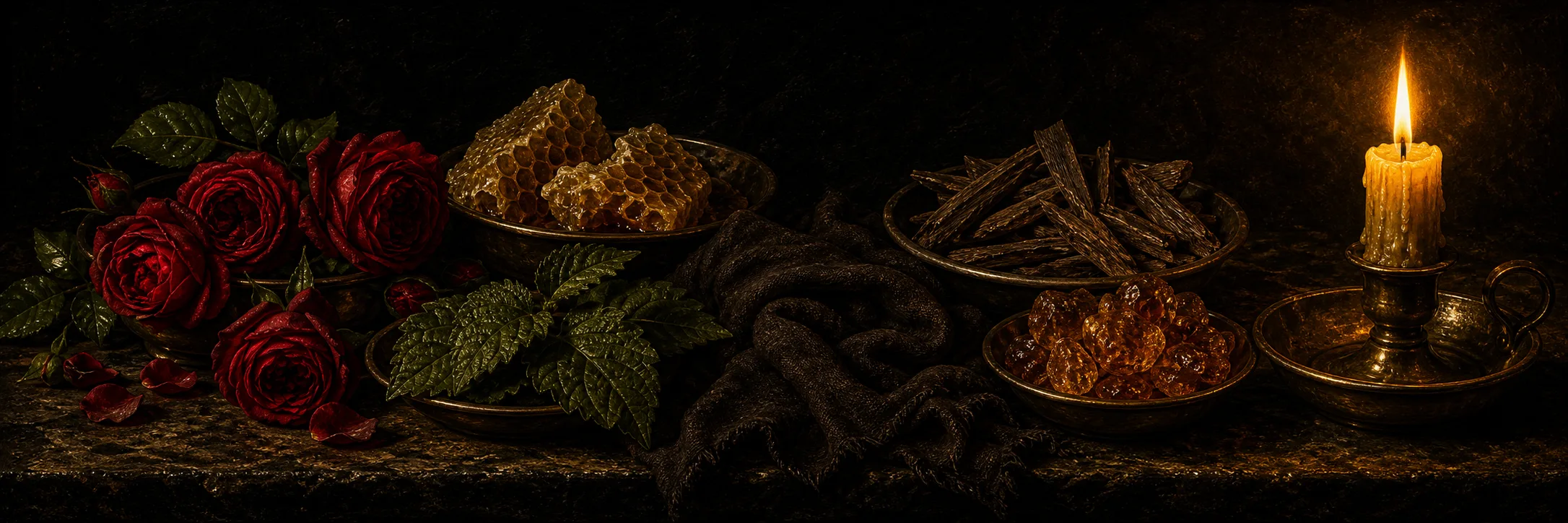
The composition is straightforward in structure but rich in feel. It opens with a juicy, slightly fruited rose - wearers noses repeatedly describe a sweet, nectar-like Turkish-rose character rather than a sharp Bulgarian or Taif rose - laced quickly with patchouli. One frequently referenced wearers description: “Juicy rosy musk… It has juicy fruitty roses with the lightest musk that you can find, & added some carnations, bit of patchouli, cedar, touch of spices. I believe the roses are Turkish cause i can sense the sweetness within.” That carnation/spice facet and a whisper of cedar are commonly noted even though the listed information pyramid lists only rose, patchouli and musk. The patchouli is the spine. A wearer who bought it in Saudi Arabia mapped the arc cleanly: “It begins dark, like Dior’s Midnight Poison, goes through a warm, almost floral stage, like a very soft, reserved version of Tom Ford’s Black Orchid, and settles into a musky, dry, patchouli scented woody base.” Another wearers note praised “a very pleasant, woody patchouli without any screechiness,” likening it to “the smell of woodwind instruments (like when you open the a clarinet case)” - a useful pointer to the dry, slightly lacquered, resinous quality of the patchouli here rather than a dirty, earthy head-shop patchouli. The musk is the woody-animalic kind rather than clean laundry musk; the official note breakdown on retail listings cites “deer musk” (ie, a musk accord evoking it).
Performance
Reports split, which is itself a useful signal. The dominant view is that this is a powerhouse: “This perfume will fill the room. I love wearing it during colder seasons. Love the bold and unapologetic trail of this fragrance with the oud undertone.” The wearer reports buyer reported both Silver Musk and Musk Al-Shiokh “are strong and last all day.” wearers classification rates projection and longevity as above-average. This is consistent with a ~40%-oil Parfum. There is a dissenting minority who get far less: “Sadly this one is quite intimate and on me disappeared within an hour or so. I would have liked to smell like that for a bit longer.” That kind of split usually points to skin-chemistry variance with musks (anosmia to certain musk molecules is common) rather than batch inconsistency. Net read: budget for strong performance, but sample first if you are someone who goes anosmic to musks.
Wearing Context
This is a cool-weather, evening-leaning scent in most wearers’ hands - the “I love wearing it during colder seasons” comment is representative, and the dark patchouli-rose-musk profile fits autumn/winter and dressed-up occasions better than hot daytime. It is genuinely unisex in the Gulf idiom: rose-musk-patchouli reads as masculine, feminine or neutral depending on culture and styling, and Hind Al Oud markets it to “every man and woman.” Western wearers may find it leans slightly feminine because of the juicy rose, but the patchouli-musk base keeps it from being sweet or girly. The single most important context point is layering. The house instruction to wear it “over your oud or oil” is not just marketing - in Gulf practice these spray musks are routinely used as a top layer over a dehn al oud or a dokhoon-smoked garment, where the rose-musk softens and sweetens a raw oud. If you own Hind Al Oud or another oud oil, that is arguably the intended use.
Comparisons & DNA
The most concrete anchors come from the wearer reports buyer who owned the scent: it “begins dark, like Dior’s Midnight Poison” and passes through “a very soft, reserved version of Tom Ford’s Black Orchid” before drying into musky patchouli. Those two - Dior Midnight Poison and Tom Ford Black Orchid - are the best Western reference points for the dark-rose-into-patchouli trajectory, though Musk Al Shiokh is less gothic and less sweet than either. Within its own house, it is most often cross-shopped with Hind Al Oud Silver Musk (the brand’s cleaner, more famous musk), with several buyers preferring Musk Al Shiokh for being earthier and rosier. More broadly it sits in the Gulf rose-patchouli-musk family alongside countless Arabian-house “musk” sprays, but the specific dry-woody-patchouli treatment is what distinguishes it. critic comparisons do not exist; Hind Al Oud is essentially undocumented by Luca Turin, Bois de Jasmin, etc., a function of its near-exclusive Gulf distribution (historically via Paris Gallery), and one wearer reports member’s apt analogy was to Lorenzo Villoresi for the shared earthy-green sensibility across the house, not for this scent specifically.
Reception
Within wearers that knows it, reception is warm. Wearers commentary skews positive on the quality of the rose-patchouli blend and the trail, with the main criticisms being (a) occasional weak longevity on certain skins and (b) the price relative to its relative simplicity. There is broad agreement it is “not that complex” but “smells great” and is “different overall than typical European fragrances” - less sweet, earthier and stronger. No critic has reviewed it; all reception here is wearers-documented (wearers, wearer reports, wearers).
Versions & Reformulation
Single composition, no known reformulations. Note that it circulates in both a 50ml and a 50ml-in-manufacturer’s-bottle format and is sold as Parfum; some third-party listings label it “EDP” while the house and most retailers call it Parfum. The listed information’s Parfum designation should be treated as authoritative.
Acquisition Notes
This is the hard part. Hind Al Oud distributes almost entirely within the Gulf - historically through Paris Gallery department stores and the house’s own MHG boutiques in the UAE, Kuwait, KSA, Qatar, Oman and Bahrain. As one reviewer put it, the house’s “obscurity” outside the region is striking given its quality, and it is “the number one brand in the perfumes sector in Paris Gallery’s department stores across the UAE.” Outside the Middle East, availability is patchy: a handful of Western niche resellers list it (often around $215 for 50ml), and Gulf retail prices run roughly $140 for 50ml or about 740 AED at MHG’s Kuwait boutique.
Notable Facts & Lore
- The house was founded in 2001 by Mohamed Hilal, a former pilot who quit aviation to pursue perfumery; Hind Al Oud was his first brand and is now the anchor of the Mohamed Hilal Group, which also owns Khaltat and Anfasic Dokhoon and, per the group’s own corporate copy, operates “over 120 shops in the GCC.” - Hind Al Oud was awarded “Best Traditional Niche Fragrances” by the Economic Department of Dubai in 2004, and per the Mohamed Hilal Group CEO page the brand “broke a record by achieving the highest figure that has ever been achieved among perfumes and cosmetics houses, such as DIOR and CHANEL in Paris Gallery’s history.” - The name “Musk Al Shiokh” - musk of the sheikhs - and the house’s framing of the scent as something to layer over oud reflect a specifically Gulf approach to fragrance as a customizable, stackable wardrobe rather than a single finished perfume. - The perfumer is undocumented; like nearly all Arabian-house releases, Musk Al Shiokh carries no named nose, and the listed information correctly lists the perfumer as unknown.