Imaginary Authors — In Love With Everything
Essence
In Love With Everything is Imaginary Authors at its most deliberately pop: a loud, candy-bright raspberry-citrus-sugar scent that trades the house’s usual oddball shadows for roller-rink nostalgia and fruit-punch excess. What makes it distinctive is attitude rather than realism - the composition keeps flirting with body-spray and cocktail associations, then pulls itself back with rosy sandalwood and a smoother skin-scent drydown, landing as niche play rather than straightforward mall-fruit sugar.
Scent Profile
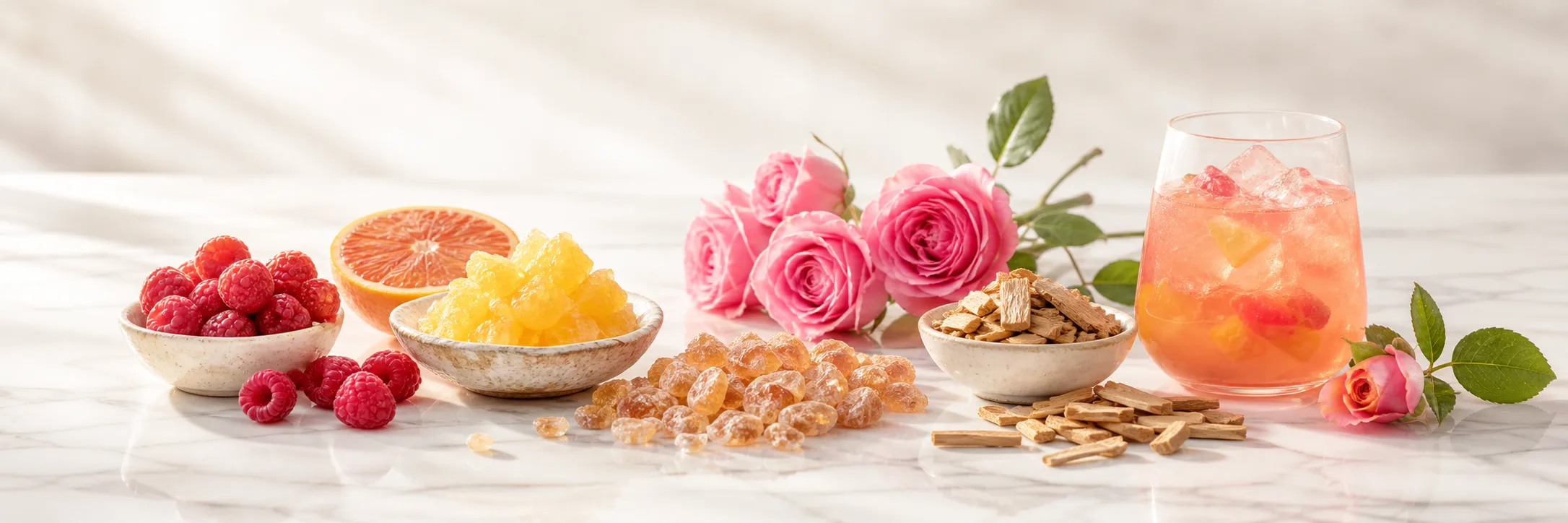
The opening is a neon raspberry-fruit-punch burst - fizzy, cocktail-like, tart-sweet, and reading more as an artificial party drink than photorealistic fruit. Citrus pulp acts as a brightness control rather than a true citrus-cologne facet, while the rose element reads less as a classical petal rose than as a raspberry-red floral tint baked directly into the fruit accord, rounding and coloring it rather than announcing itself as a standalone floral note.
Development moves from sparkling fruit punch into coconut-palm-sugar warmth, then into a gentler, sandalwood-tinged drydown that feels vanillic and skin-close rather than still-bubbly. The composition stays fairly linear in theme throughout, even as its texture shifts - the red-pink sugar-fruit identity never really disappears. A recurring split in reception is whether that base reads as pleasantly nostalgic (lip gloss, hairspray, roller disco, summery Escada energy) or as plasticky and body-spray-like. The signature accord is tart, sugary raspberry punch over soft woody sweetness, with just enough sandalwood structure to keep it from collapsing into novelty spray territory.
Performance
Performance is one of the more divided aspects of this fragrance. On the stronger side, wearers describe it as persistent, sometimes lasting eight to nine hours on skin and well over a day on clothing, with strong sillage. On the weaker side, other wearers report closer to four hours total, with moderate projection for roughly an hour before a quick fade to a skin scent. The safest summary is that it performs at least moderately for a fruity-gourmand style, but skin chemistry and personal tolerance for sweet synthetics seem to shift the experience considerably.
This tends to work best in warm weather and nightlife settings, where its fizzy sugar accord feels intentional rather than out of place; in cold weather it’s more likely to read as straightforward candy-fruit than to sparkle the way it does in summer heat.
Wearing Context
This is a casual, extroverted, mood-lifting fragrance built for summer evenings, parties, vacations, concerts, and any setting where playful, unserious energy is a feature rather than a liability. It can be worn during the day, but the social signal is loud-color fun rather than polished reserve - even wearers who love it reach for comparisons to lip gloss, butterfly clips, body sprays, and neon-pink styling.
It’s a poor fit anywhere you want restraint or classical elegance - its sweetness and nostalgia can read as youthful or intentionally synthetic to some noses. The practical rule is simple: if “magenta fruit punch with sandalwood” sounds joyful, this likely works for you; if sweet raspberry or synthetic-fruity profiles aren’t your thing, it’s a risky choice.
Comparisons & DNA
The closest comparisons form a cluster rather than one exact match: Imaginary Authors’ own Saint Julep for sugared tartness and cocktail energy, Escada’s summer editions for fruity-pool-party mood, general body-spray nostalgia for the raspberry-sugar-pop register, and Thierry Mugler’s Angel Nova for a similarly artificial raspberry brightness. Against Saint Julep, this reads denser, less boozy, and more red-fruit driven. Against Escada-style summer scents or body sprays, it carries more woody structure and a more deliberately composed drydown. Against Angel Nova, it’s less flamboyant in projection and leans more coconut-sugar-fruit-punch than rose-lychee bomb.
Within the house’s own catalog, it reads as a brighter counterpoint to the darker, stranger Imaginary Authors signatures, and multiple wearers describe it as an unusually approachable entry point into the line.
Reception
Reception is broadly positive but polarized along one clear axis: whether a wearer enjoys the synthetic-fun construction or finds it cheap-seeming. Praise centers on how fun, wearable, cheerful, and instantly evocative it is - even fans who acknowledge its candy-fake quality tend to treat that as the whole point rather than a flaw. There’s strong agreement that it captures a specific retro-pop visual world - 1980s and 90s fruit drinks, roller rinks, Miami nightlife - and does so with a grin rather than irony.
Criticism is equally consistent: detractors call it plasticky, body-spray-adjacent, and sickly sweet, with some feeling the fruit-punch accord overwhelms the composition’s more refined elements. The blind-buy verdict is no, unless you already know you enjoy high-sugar fruity scents and don’t need photorealism - this is exactly the kind of fragrance that flips from playful genius to expensive body spray depending on personal taste.
Versions & Reformulation
Single composition with no known reformulation.
Acquisition Notes
This is available in the house’s standard 14 ml and 50 ml EDP formats, with the 50 ml bottle priced at $115. It sits in the accessible-indie tier rather than luxury niche pricing, which is part of why it’s frequently recommended as an approachable entry point into the Imaginary Authors catalog. Sampling first is worth doing given how polarizing the scent profile is - the brand’s complete sample set is an easy way to test it before committing to a full bottle.
Notable Facts & Lore
- The fragrance is framed through Imaginary Authors’ fictional-book concept as the scent version of an early-1980s Florida nightlife story.
- That backstory - roller discos, pre-Miami-Vice excess, brightly colored teenage-party energy - is the dominant lens wearers use to interpret the scent.
- “Stardust” appears in the official note story as a conceptual flourish rather than a literal material in the composition.
- It is widely considered one of the more approachable, entry-point-friendly releases in the Imaginary Authors catalog.