Imaginary Authors — Violet Disguise
Essence
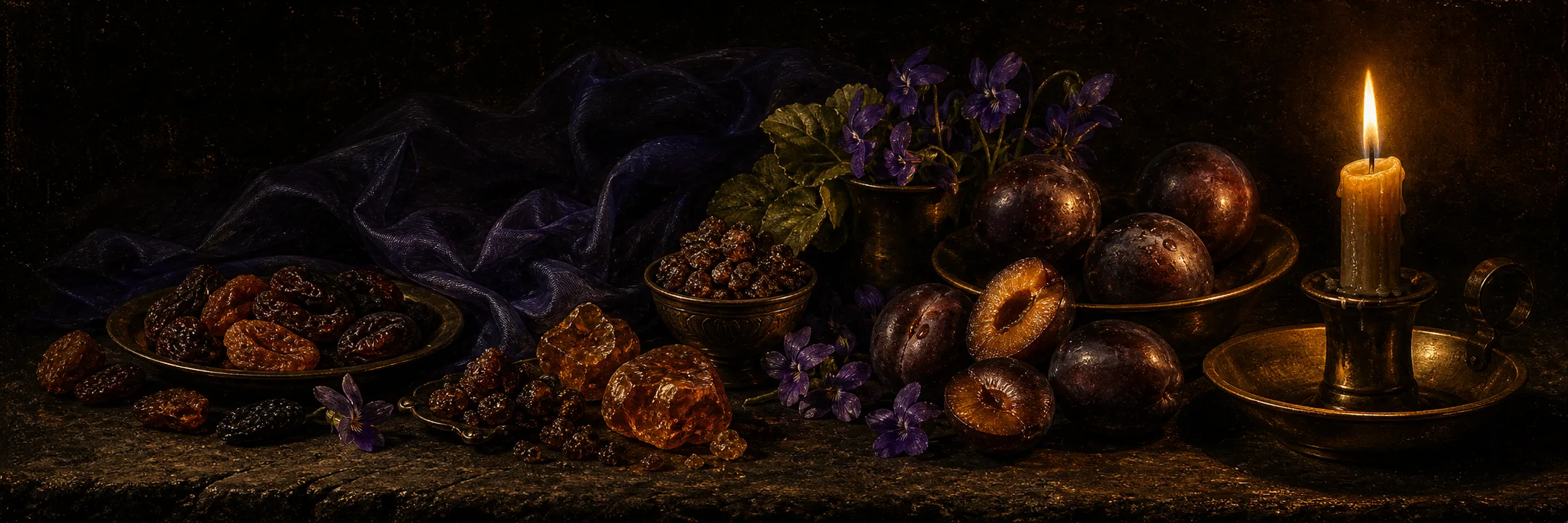
Violet Disguise is the debut fragrance from Portland indie house Imaginary Authors, perfumer Josh Meyer’s 2012 riff on the idea of a violet that isn’t really about violet at all - the name is the whole concept. What it actually delivers is a plush, dry, dusty plum-and-amber scent with only a violet flourish, wrapped in the house’s signature literary conceit of a fictional author and invented backstory. Its distinctiveness lies in a “dusty,” cold-metal accord that tempers the fruit’s sweetness and gives the whole composition an antique-wood, autumnal warmth. It is now discontinued, which has made it a minor grail among collectors of the house.
Scent Profile
The wear unfolds in two distinct acts. The opening is a wet, cool, fruity burst - ripe plum, sometimes read as melon-adjacent, with a bright, syrupy violet on top and a sharp, metallic “cold spoon” facet that recurs across reviews as a signature of the perfumer’s style. This phase can run heady to the point of overwhelming for some wearers. Then, often described as an abrupt shift, the violet smooths and recedes while a resinous balsam and dusty amber take over, and the fragrance turns warmer, powdery, dry, and cozy - like putting on a favorite coat over cool autumn air.
The dominant impression for many wearers isn’t violet at all, but dry plum over dusty amber-wood - multiple people report getting little to no recognizable violet, which is precisely the “disguise” the name promises. Development is essentially two-part, built around a memorable cool-to-warm transition, with the signature accord landing as a dusty, resinous plum-amber carrying a metallic-violet shimmer.
Performance
This is indie EDP performance, and reports vary considerably by skin. The consensus lands on moderate: roughly five hours on skin for most wearers, with the dusty amber-balsam base outlasting the fruity-violet opening and occasionally surviving into the next morning on skin or clothing. Projection runs moderate to loud in the first hour or two, since the opening is genuinely assertive, before settling into a softer, more intimate skin scent. At least one detailed account found detectability barely exceeding an hour, suggesting real skin-chemistry variance is at play. The plum-amber-balsam warmth reads best in autumn, winter, and cool spring weather, and because the opening is the boldest phase, a moderate application is the sensible approach.
Wearing Context
The brand framed this as a versatile, invigorating everyday scent, but the way enthusiasts actually wear it skews toward cozy, cool-weather territory - autumnal woods, a crisp evening, an early-spring day with a chill still in the air. It works day or night and reads genuinely unisex, with a slightly feminine, romantic tilt in the marketing against a more androgynous character in actual wear. Socially it comes across as distinctive and a touch quirky rather than broadly crowd-pleasing - appealing to wearers who want something conversational and off the beaten path rather than an office-safe cipher or a loud evening statement.
Comparisons & DNA
The most authoritative comparison places Violet Disguise as a distant, much lighter descendant of Serge Lutens’ Feminite du Bois and Bois de Violette - the same plum-cedar-violet lineage, though notably less dark, complex, or expensive than those references. The more essential comparison is internal: Yesterday Haze, released two years later by the same house, functions as its explicit narrative and olfactory follow-up, sharing the same dusty, dry signature closely enough that owners of one often feel they don’t need the other. By Kilian’s Liaisons Dangereuses comes up for a similar plum-and-powdery-violet character, minus its creamy white florals, and Slumberhouse’s Kiste gets cited for comparable fruit depth. Overall, this reads as lighter and simpler than the Lutens references and fruitier, more violet-forward than Yesterday Haze’s fig-iris-walnut dustiness.
Reception
Among the house’s small but devoted following, Violet Disguise has always been polarizing - a fragrance the brand’s own reputation treats as a “try before you buy.” Positive sentiment credits the dusty accord with saving the composition from cloying sweetness, delivering what fans call a gorgeous, comforting, deeply purple fragrance experience. Since its discontinuation, collectors have openly lamented running low on backups and struggling to find any remaining stock. Criticism, where it exists, runs sharp: some wearers describe it as synthetic and physically uncomfortable, and mock its whimsical “evening air” note as unattainable marketing rather than a real olfactory element. Others simply find it faint to the point of being nearly undetectable on their skin, or too one-directional compared to the more complex dissonance the perfumer later built into its sequel.
The blind-buy question is largely moot now given discontinuation, but the historical consensus was always to sample first, given the divisive opening and skin-dependent performance.
Versions & Reformulation
This is a single composition released in 2012 as a 60 ml EDP, later also sold in a travel size, with no known reformulation. It is now confirmed discontinued by the brand and marked as such by several retailers. Within the house’s fictional universe, it’s framed as its founding author’s debut work, with a later release positioned as its direct narrative sequel.
Acquisition Notes
This fragrance is discontinued and no longer available through standard retail. When it was in production, it sat at an accessible indie-niche price point, well below the Serge Lutens references it draws comparison to. Remaining stock has largely sold through since discontinuation, and collectors report it is now genuinely difficult to source through any channel - decants and samples, when they surface, are the realistic path for anyone hoping to try it. Counterfeiting isn’t a meaningful concern for a release this under-the-radar; the real risks are scarcity and, for any older stock, degradation of the top notes over time.
Notable Facts & Lore
- The fragrance is credited, in the house’s fictional-author conceit, to an invented Californian novelist whose stories evoke plum orchards and canyon drives.
- Its name plays on a near-pun with “violent disguise,” a wordplay noticed early by fans and part of its ongoing appeal.
- The perfumer has described the composition as more plum than violet, sharing the same dusty character as its later, direct sequel.
- As the very first Imaginary Authors release, it established the house’s aesthetic and literary marketing template from the outset.
- Its discontinuation has become a recurring source of nostalgia among longtime collectors of the brand’s early work.