L'Occitane en Provence — Arlésienne
Essence
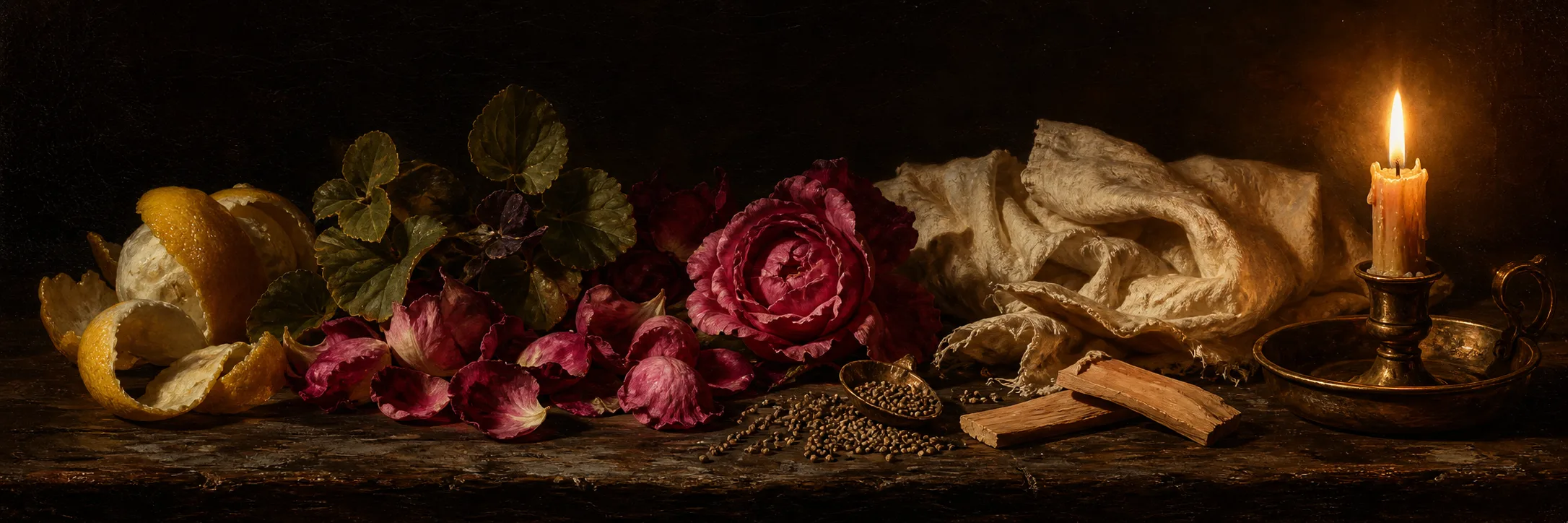
Arlesienne is L’Occitane’s rose-violet floral, named for the women of Arles and the Venus of Arles statue. The catalog entry here is the 2016 reformulation (perfumer Fabrice Pellegrin, classified as floral-woody-musk), which followed the beloved 2014 original (perfumer Karine Dubreuil-Sereni). It’s an old-school, “papery” rose - dry and translucent rather than dark and jammy - built on rose, violet, saffron, galbanum and a soft white-musk/sandalwood base.
Scent Profile
Note that the catalog notes for this 2016 entry (galbanum, bergamot, hawthorn / may-rose, violet-leaf, heliotrope / white-musk, sandalwood, ambrette) differ from the widely reviewed 2014 pyramid (mandarin, saffron / Grasse rose, lily-of-the-valley / violet, sandalwood, tonka). The two formulas are genuinely different scents, so reviews must be read against which version the writer had. The opening is a tart-sweet citrus-green flash: bergamot (and, in 2014, mandarin) lifting into crisp green galbanum, with saffron adding a peppery, slightly leathery warmth that several wearers found surprisingly assertive. Hawthorn in the 2016 contributes a faint almond-milk nuance - The Happy Sloths noted the 2016 reads “lighter, sweeter, and almost a bit gourmand” with “a hint of almond milkiness.” The first impression on most skins is “very obviously rosy.” The heart is the rose-violet duet that defines the fragrance. Bois de Jasmin’s Elisa Gabbert described a “papery, pink rose, not a dark, rich red one,” paired with “a big dose of violet” - powdery but “not so powdery as to scare off powder-haters,” lifted by muguet (lily-of-the-valley) and threaded with “a distinct note of honey” carrying a faint animalic edge. The violet has strong presence “without veering into powdery territory,” and the rose is “noticeable without being sweet.” Saffron and violet leaf give a green-spicy frame.
Performance
Performance is modest - typical of L’Occitane. Multiple wearers report the original dissipating “completely on me after 3 - 4 hours of wear.” Maddy Loves: “it doesn’t last very long. dissipating completely on me after 3-4 hours.” Projection is light-to-moderate - close and intimate rather than room-filling - and sillage is gentle, a soft personal aura. The 2016 is described as having “presence” despite being light.
Wearing Context
Arlesienne is a spring/summer daytime rose - cheerful, “acidulated but not sour,” well-suited to office and casual wear precisely because it’s soft and inoffensive. Bois de Jasmin’s Elisa wore samples expecting little and was “pleasantly surprised,” praising its light lemony eau-de-cologne feel. It excels as an easy, comforting, “smell so clean” signature - one devotee said it’s the kind of scent “where people want to just hug you.” It can falter in strong summer heat, where the saffron/ambroxan turns heavier and “more mature” than some young wearers want, and its modest projection means it won’t perform as a statement evening fragrance. Powder-phobes are largely safe; true rose-haters should skip it, as the rose is intense.
Comparisons & DNA
Arlesienne sits in the rose-violet tradition. Bois de Jasmin explicitly compared it to Yves Saint Laurent Paris (the airier, green DSH-style interpretation rather than the baroque original) and, by contrast, to Bond No. 9 Broadway Nite (Maurice Roucel’s “loud and extravagant. baroque oil painting” rose-violet) - Arlesienne is far closer to the former, lighter pole. Commenters and the reviewer also likened it to Chloe Love, Chloe (Arlesienne is the less strident of the two) and to Chanel Beige.
Reception
Bois de Jasmin (Elisa Gabbert) rated the original four stars, praising it as “one of L’Occitane’s best” and a welcome return of “old-school roses.” Reception is affectionate but dominated by one theme: the 2014 original is markedly better than the 2016 reformulation. Devotees of the original call it a “signature scent,” “cozy, sophisticated,” and unique (“nothing is similar to it”); they describe the reformulation as “soapy generic,” “weaker and insensible,” “like a rhinoceros who lost his horn.” Defenders of the 2016 still find it “very well-blended,” versatile, and beautiful - “probably the best L’Occitane fragrance for a long time. rosey, violet, saffron and galbanum.” Common praise across versions: the rose-violet-saffron balance, comforting wearability, realism (L’Occitane scents “smell exactly like the notes they’re meant to convey”).
Versions & Reformulation
This is the crux of Arlesienne lore. The 2014 original (Karine Dubreuil-Sereni; mandarin-saffron-rose-LOTV-violet-tonka) was reformulated into the 2016 version (Fabrice Pellegrin; galbanum-bergamot-hawthorn / may-rose-violet leaf-heliotrope / white musk-sandalwood-ambrette), classified slightly differently and widely judged inferior - “soapy,” “weaker,” more generic. The 2016 is also described by some as “lighter, sweeter, almost gourmand.” A Concrete de Parfum variant of 2014 also existed (a higher-concentration solid). L’Occitane additionally ran limited annual holiday Arlesienne editions.
Acquisition Notes
Designer/mass-prestige tier - affordable. The EDT was commonly sold in 75ml (and 2.5oz/~75ml) bottles, around C$48 - $75 / roughly $62 - 68 USD at retail. Because it’s discontinued, acquisition now means secondhand (eBay and resale, where wearers report finding bottles “for a steal”) and remaining boutique stock as it sold through.
Notable Facts & Lore
- Arlesienne is named for the Arlesienne - the woman of Arles in Provence - and inspired by the Venus of Arles, a 1.94m Hymettus-marble Roman statue that, per the Louvre’s account, “was found in 1651, by workmen who were digging a well,” was given to Louis XIV in 1681 to decorate the Galerie des Glaces at Versailles, and has been held at the Musee du Louvre since the Revolution.
- L’Occitane framed it as “the ideal of female beauty and the muse of artists” (Van Gogh, Picasso, Bizet, Christian Lacroix among those cited).
- The brand wrapped it in a sentimental narrative of a perfume a mother gifts her daughter at adulthood, which several wearers found genuinely affecting.
- Bois de Jasmin’s review is the notable critical document, situating Arlesienne within the early-2010s revival of “roses that smell like roses” after the calone-aquatic 1990s and the dark patchouli-oud roses of the 2000s - Elisa Gabbert’s “papery rose” framing became the defining descriptor enthusiasts reach for.
- The strongest cultural footprint, though, is the collective grief over the reformulation and discontinuation - a recurring “why why why?”