L'Occitane en Provence — Fleur d'Or & Acacia
Essence
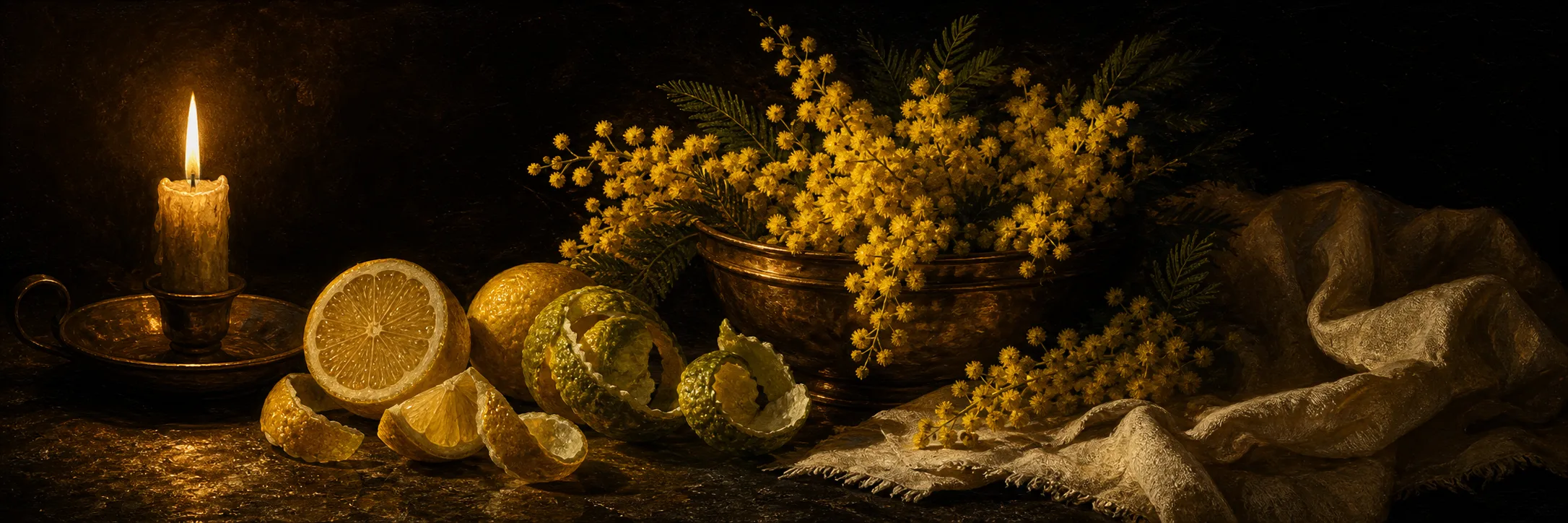
Fleur d’Or & Acacia is a 2013 yellow floral built around mimosa absolute from Grasse and acacia, the second wave of L’Occitane’s La Collection de Grasse. “Sunshine in a bottle” - a bright, honeyed, slightly powdery mimosa lit by a quick lemon-bergamot flash and grounded in clean white-musk woods. Distinctive less for complexity than fidelity: at its best a near-photographic golden mimosa.
Scent Profile
The opening is a brief citrus curtain-raiser: lemon and bergamot flare for the first few minutes but function, as Now Smell This put it, as a momentary “booster” for the florals rather than a true citrus top. Within ten minutes the mimosa-acacia accord seizes the stage. Early on it can smell genuinely natural - pollen-dusted, green-yellow, honeyed. This is the loud element; broom (genet) and black-locust are folded into the broader yellow-floral impression rather than reading as discrete notes. Through the heart the composition turns powdery, the mimosa sweeter and more cosmetic. This is where it polarizes: Now Smell This argued the authentic mimosa “vanishes, and that happens quickly,” replaced by an aggressively projecting synthetic acacia-mimosa whose “effect is similar to finding a beautiful acorn or piece of driftwood and spray painting it gold with inexpensive enamel.” Wearers split between soft/nostalgic powder and an “old baby powder” sourness. Honey and sweet accords are perceptible but restrained; not a gourmand mimosa. The drydown is a quiet musk-and-white-wood skin scent with lingering powder; the base notes are the least assertive part, a soft cushion. Minimal evolution overall: a largely linear mimosa soliflore with a citrus prelude and powdery tail. The signature accord is the golden mimosa-acacia heart. Note the irony flagged by wearers: despite the name, no obvious “acacia” distinct from mimosa is perceptible, because perfumery acacia/mimosa reads as one yellow-floral gesture.
Performance
Performance is the consensus weak point. Longevity is short: and wearers repeatedly report fading within 15 - 30 minutes to an hour on skin, with fans wishing it “lasted longer.” One “ On skin expect roughly 1 - 3 hours; on clothing it holds longer. Projection is light to moderate at first spray then collapses close-to-skin. Sillage is modest. The notable dissenter is Now Smell This, whose reviewer found a single test spray “outrageously powerful” and synthetic, and reported L’Occitane associates warning “DON’T SPRAY TOO MUCH!”
Wearing Context
A daytime, warm-season fragrance: spring above all, summer and mild early-autumn secondary. Wearers tie it to bright sunny mornings; it has a “smells like vacation” quality. Despite the perfumer’s Christmas-in-Grasse inspiration, it wears as spring/summer. Casual and uncomplicated - office, errands, brunch, gardens - and cheerful rather than seductive. Social-perception skew is firmly feminine and “clean/pretty”; inoffensive and approachable, unlikely to draw complaints in scent-sensitive workplaces because it stays close and fades.
Comparisons & DNA
Fleur d’Or sits in the mimosa-soliflore lineage. L’Artisan Parfumeur Mimosa pour Moi is the reference - greener, more delicate, a more refined natural rendering. Annick Goutal Le Mimosa is richer and sunnier with more body. Frederic Malle Une Fleur de Cassie is the luxury, complex, carnal mimosa - far deeper, spicier, longer-lasting; Fleur d’Or is its bright, simple, affordable cousin. Within La Collection de Grasse, Now Smell This contrasted it with sibling L’Occitane Ambre & Santal, judging the amber the more original while Fleur d’Or “lacked that jam-y originality.”
Reception
Sentiment is warm but bifurcated. Praise: a realistic, joyful, “heavenly” golden mimosa, very wearable, nostalgic, now mourned as discontinued (“please bring it back,” “it was literally heavenly, not exaggerating”). Criticism is consistent on two axes: poor longevity/sillage (“fainted after some minutes”), and a turn to powdery/synthetic territory in the drydown (“too powdery,” “old baby powder,” scrubber for a minority). Wearers find it pleasant but undeveloped and linear. Blind buy verdict: moot given discontinuation, but the honest recommendation would be to sample only if you specifically love powdery mimosa and accept short wear.
Versions & Reformulation
No documented reformulations; the EDT (75 ml) was the sole concentration, sold alongside a full ancillary range - shower gel, body milk, hand cream, soaps - which wearers used to extend and layer the scent. The fragrance is now discontinued, the only “version” event of note. Treat any bottle on the secondary market as the original 2013 composition.
Acquisition Notes
Originally a designer/affordable-premium tier scent. Per Now Smell This (Kevin, Nov 20 2013), “L’Occitane Fleur d’Or & Acacia and Ambre & Santal (both by perfumer Karine Dubreuil) are available in 75 ml Eau de Toilette, $75.” Now discontinued, it trades only on the secondary market (eBay and resellers), where prices have risen with cult demand and stock is irregular. Not a major decant-house staple given discontinuation; availability through Surrender to Chance / Scent Split / MicroPerfumes is inconsistent and should be checked case by case.
Notable Facts & Lore
- The most concrete documented detail is the perfumer’s stated intent.
- Karine Dubreuil-Sereni built the scent on a personal memory of Christmas in her childhood town of Grasse: per material relayed at launch, the accord of mimosa absolute and acacia “evokes that moment when the first Golden Mimosa trees come into blossom, and that orangey glow of the December light.”
- She recalled making bouquets from the yellow pompom flowers that filled her grandmother’s house.
- This Provencal-winter inspiration is the scent’s real story - and a quiet irony, since the finished fragrance wears as spring/summer (one It launched in late 2013 in the second wave of La Collection de Grasse, paired with a masculine counterpart, Cedre & Oranger.