Penhaligons — The Tragedy of Lord George
Essence
The Tragedy of Lord George (2016, Alberto Morillas) is the flagship masculine of Penhaligon’s narrative Portraits collection - a boozy, soapy fougere-amber depicting Lord George, the respectable-but-secretly-scandalous Victorian aristocrat patriarch. It opens on a warm brandy/rum splash and clean shaving-soap, then settles into a creamy, lightly powdery tonka-and-ambrox base with dry woods.
Scent Profile
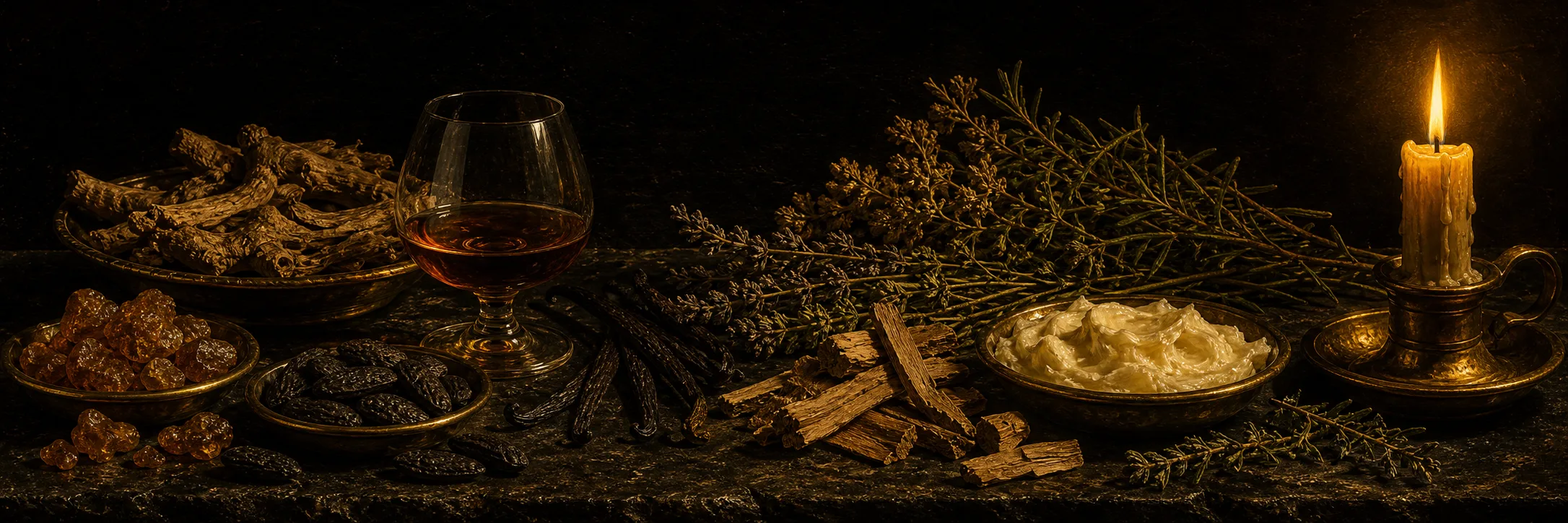
The opening is a brief “booze bomb”: a warm, mature brandy/rum splash - boozy but not boisterous, a “faint memory of the previous evening’s indulgence” - over a clean, soapy shaving-cream accord that immediately conjures an old-fashioned barbershop. The brandy reads as aged spirit (one detailed reviewer evoked solera-aged Spanish brandy in American oak); a minority perceives the booze as closer to amaretto or rum than brandy. This alcoholic top is fleeting, “almost gone in the first few minutes.” Alongside it, several wearers get a lavender/aromatic fougere facet and even a “very mild grape note.” The heart (one to three hours) is dominated by the shaving-soap-and-amber pairing: clean, slightly powdery, gentlemanly, with ambrette/ambrox lending a stately ambered warmth. A dry, smoky woodiness emerges underneath - “pencil shavings,” possibly cedar or guaiac - that gives the soapiness backbone. This soapy-boozy-woody barbershop accord, warmed by amber, is the fragrance’s signature and defining character. Tonka begins threading through as a plush, biscuity creaminess. The drydown (3+ hours) is where it’s “far superior to the opening” for many: the aromatics pull back and a creamy, lightly sweet tonka-bean note becomes prominent - “dark caramel or treacle,” “biscuity,” never cloying - fused with ambrox and dry woods. The result is a comforting, cozy, warm-woody-amber close. Of the listed/described notes, brandy, shaving-soap, amber/ambrox, tonka, and woods are all perceptible; brandy fades fastest, soap and amber define the heart, tonka and ambrox the base. Opinion splits on whether it’s linear or evolving: many call it “linear and easy to wear,” a steady sweetened-woods hum; others (including a reviewer) find it “surprising every time,” shifting unpredictably. Either way the core experience is a refined, clean, boozy barbershop fougere sliding into creamy tonka-amber. NST’s Robin Krug captured it as “a smooth, ‘green’ amber-scented brandy cocktail served with a splash of tonka bean syrup,” the amber-tonka combo soon dominating alongside a touch of peppy wood (guaiac).
Performance
Performance is good but not enormous, and reviews diverge. NST’s Robin Krug found “sillage and tenacity are good (dear ole Ambrox lasted through a hot shower)” - ambrox/ambroxan being notoriously persistent. wearers rates longevity strongly (a qualitative rating), with one reviewer logging all-day wear and compliments, and decanters noting that with an “ample amount sprayed on you should get decent longevity.” But a vocal minority finds it weak: “put 10 sprays on one wrist and after 2 hours it’s barely even a skin scent,” and the brand’s general reputation (per a Penhaligon’s-focused reviewer) is that the house “will not cut the mustard” for those wanting strong projection and long sillage trails. Net: projection is moderate (a few feet early, tapering to close-wear), sillage moderate, skin longevity realistically 6+ hours with the ambrox base hanging on longest, and good clinging persistence on clothing. It’s an autumn/winter and cool-evening performer - its warmth and woody-amber character amplify in cold and can feel heavy or muted in heat. Best applied to pulse points and reasonably generously, leaning on the tenacious ambrox/tonka base for staying power.
Wearing Context
A fall and winter scent, “perfect for autumn evenings or crisp winter days,” and broadly reserved for cooler weather where its boozy-woody warmth reads cozy rather than cloying. Occasions: it’s “appropriate for the office and daytime wear,” works for date night (though “better suited to a more mature gentleman” - “more classy than schmexy”), and suits any setting calling for understated refinement; the barbershop-clean character makes it professional-safe. It shines as a sophisticated, mature cool-weather signature and a comfort scent; it falls flat for those wanting a bold projection monster, a summer fresh, or anything youthful and trend-driven - and at the luxury price its restraint frustrates value-seekers. Socially it skews mature and “classy” - “smells sophisticated and mature,” even “ages you 30 years in 3 seconds” per one wry reviewer. Strongly masculine-leaning by design but worn unisex by some, who argue the warm, slightly-sweet elegance transcends gender categories.
Comparisons & DNA
Blenheim Bouquet and Sartorial explain the Penhaligon’s barbershop lineage, but Lord George is warmer and more ambery. Pinaud Clubman gives the shaving-soap reference in plainer form. Tom Ford Beau de Jour shares a clean masculine polish without duplicating the boozy-tonka base.
Reception
Fans call it the Portraits gentleman benchmark; detractors find it tame, generic, and expensive.
Versions & Reformulation
Single composition, no known reformulations.
Acquisition Notes
A high-priced Portraits EDP in the stag-capped bottle. Decants are strongly recommended because the concept is refined but deliberately moderate in projection.
Notable Facts & Lore
- The Portraits collection is Penhaligon’s “olfactory fiction” - a tongue-in-cheek Victorian aristocratic family saga launched in 2016 to inject modernity and storytelling into the 1870-founded house (then newly invigorated under Puig).
- Lord George is the patriarch, “faithful to king and country,” a “wealthy and respected.
- archetypal patriarch“ embodying noble values - but, in the subversive twist, harboring “secret dalliances,” chiefly an affair with his mistress Clandestine Clara (who bears his illegitimate son, Roaring Radcliff), while his wife Lady Blanche plots to poison him.
- Each character wears an animal-head bottle cap denoting personality: Lord George is a stag/buck; Lady Blanche a panther; Clara a peahen/peacock; Radcliff a lion; the Duke a Great Dane.
- Penhaligon’s framed the collection as “a tribute to the good old English spirit: stiff upper lip, caustic humour, and a knack for provocation.”