Penhaligons — The World According to Arthur
Essence
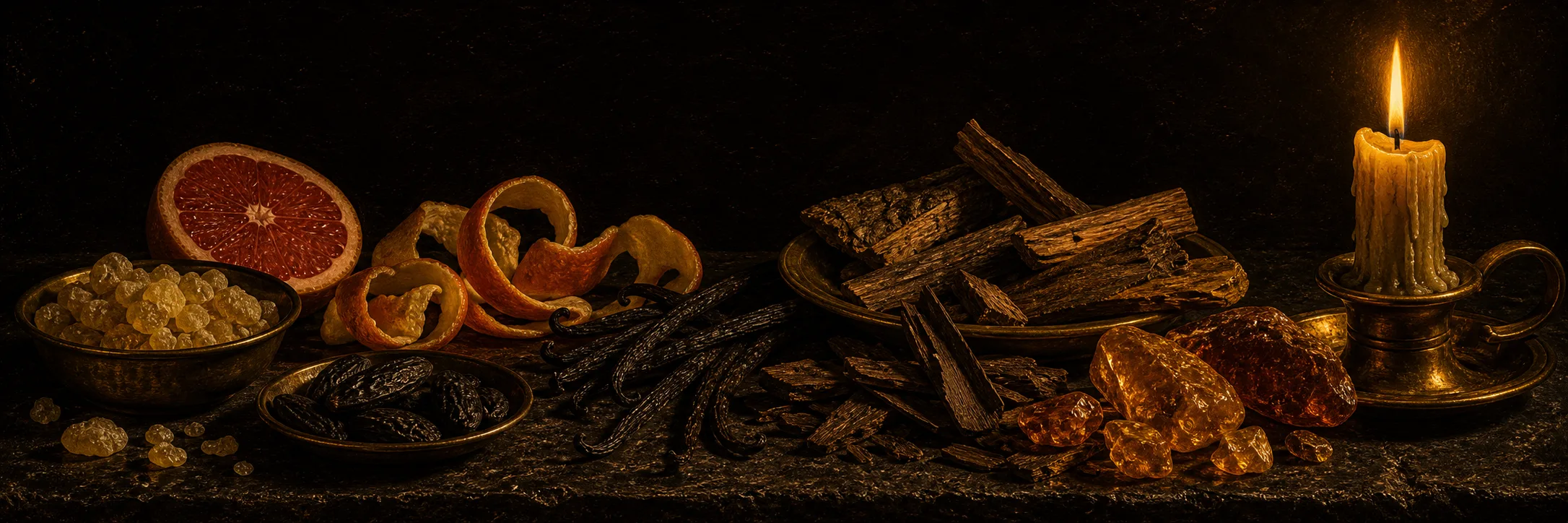
A British incense-vanilla in the Penhaligon’s “Portraits” collection, dressed up with a gold dragon-head stopper and a tongue-in-cheek aristocratic backstory. Perfumer Fabrice Pellegrin built it around three complementary qualities of frankincense, softened by tonka and Tahitian vanilla and lifted with a flash of grapefruit.
Scent Profile
The opening (first 10 - 20 minutes) is the most dynamic stretch: a bright grapefruit zing strikes against resinous frankincense, while Tahitian vanilla arrives almost immediately to round the edges. This is not the smoky, austere ecclesiastical incense of an Avignon-style scent; the frankincense here reads fresh and resinous rather than ashy, and the grapefruit supplies what Penhaligon’s calls a “British sharpness.” Within minutes the citrus recedes and the composition tips toward sweetness. The heart (1 - 3 hours) is where clary sage and ambrette quietly do most of the talking. The clary sage lends a soft herbal-aromatic muskiness; the ambrette contributes a powdery, slightly fruity musk that diffuses the blend into a skin-close haze. Several wearers describe a fleeting “winey earth” or grape-mold facet that briefly adds interest. The listed grapefruit is largely submerged by this point, and the incense thins to a background hum rather than a dominant note. The drydown (3+ hours) settles into the signature accord: toffee-ish vanilla carried mostly by the creamy, tobacco-adjacent beige warmth of tonka bean, with frankincense returning faintly for a smoky edge. It is best described as sweet smoked woods - vanilla and tonka over a soft resin. The scent is broadly linear after the opening: once the grapefruit burns off, it holds a steady sweet-incense-tonka pose with minimal further evolution. Perceptible notes in wear: vanilla, tonka, ambrette musk and (early) grapefruit. Submerged or supporting: the incense is lighter than the name suggests, and clary sage works structurally more than as an identifiable note. The signature accord is creamy tonka-vanilla wrapped in fresh-resinous incense - a sweet gourmand-leaning incense rather than a smoky one. Critics divide sharply: some find the blending elegant and “never too dense,” others find the vanilla milky to the point of “sickly,” diluting the dramatic dragon concept into something that “doesn’t know what it wants to do.”
Performance
Critical and wearer reports converge on a clear weakness: this is a quiet fragrance. Projection is light-to-moderate, staying fairly close to the skin after the first hour and rarely filling a room; multiple reviewers single out performance as where it “falls massively on its face.” Persolaise’s verdict crystallizes the consensus - he admired the opening and “the finesse with which the initial tendrils coil themselves around you” but felt “it ought to announce its presence a touch more forcefully… it retreats into the shadows too quickly.” Sillage is intimate. Longevity is the better metric: roughly 6 - 9 hours on skin for most, with several reporting longer, and it clings noticeably to clothing and scarves beyond a day. As a rich, balsamic-resinous EDP it performs better in cool, dry air; cold weather and evening wear flatter it, while heat does little to boost its modest projection. Best applied generously to skin and fabric - this is a scent that rewards over-spraying rather than restraint, and dry skin benefits from a moisturizer base. Do not expect a “beast mode” incense; expect a soft, lingering veil.
Wearing Context
This is a cool-weather, low-key scent: best in fall and winter, and strongest in the evening or for quiet indoor occasions where its close-range warmth can be appreciated. It shines as a cozy, sophisticated comfort scent - one Asian reviewer movingly tied it to Lunar New Year memories of lit incense, fruit offerings and almond cookies, “a clean gourmand that’s perfectly balanced.” It works as an office-safe or intimate signature precisely because it doesn’t shout. Where it falls flat: anyone seeking a dramatic, smoky, projection-heavy incense to match the fiery-dragon presentation will be disappointed - it is too demure and too sweet for that brief, and underwhelming in hot, open-air settings where it disappears. Marketed unisex and genuinely wearable by anyone, though wearer and Puig’s own framing skew it slightly masculine/regal. Socially it reads as expensive, polished and inoffensive - a “nice” scent more than a statement one.
Comparisons & DNA
Diptyque Eau Duelle is the closest vanilla-incense cousin, lighter and less tonka-creamy. Spiritueuse Double Vanille is boozier and denser; Eau de Baux is rougher and more affordable. Halfeti is much heavier, darker and rose-oud centered.
Reception
Pleasant sweet incense to admirers, too tame and quiet for detractors at Portraits pricing.
Versions & Reformulation
Single composition, no known reformulations. Released 2021 as an EDP only, in the dragon-stoppered Portraits bottle (75ml and 100ml sizes documented). No concentration variants or vintage-vs-current distinction applies.
Acquisition Notes
A dragon-stoppered Portraits EDP in luxury pricing. Decants are advised because the scent is easygoing but performance expectations can clash with the bottle drama.
Notable Facts & Lore
- Perfumer Fabrice Pellegrin documented his specific intent for this scent in an industry interview: “for Penhaligon’s The World According to Arthur EDP [2021], my challenge was to create a magnificent incense scent.
- To do that, I selected different qualities of incense.
- In total, I selected three types of incense, whose olfactive profiles are complementary“ - described as the freshest, most resinous and most “dazzling” facets.
- This three-incense construction is the technical heart of the fragrance.
- The same year as Arthur’s release, Pellegrin was awarded the 14th Francois Coty Prize on December 2, 2021 at the Hotel Lutetia in Paris (jury chaired by interior designer Tristan Auer; Christopher Sheldrake received the Honorary Award the same evening).