Penhaligons — Vaara
Essence
Vaara is a 2013 Bertrand Duchaufour composition for Penhaligon’s built around a quince-and-rosewater opening that segues into a dual-rose (Moroccan + Bulgarian) heart over a clean, musky, lightly honeyed base. What makes it distinctive is its specific brief: it was commissioned by His Highness Maharaja Gaj Singh II of Marwar-Jodhpur to commemorate the 2011 birth of his granddaughter Vaara, and Duchaufour traveled to Jodhpur to absorb the place.
Scent Profile
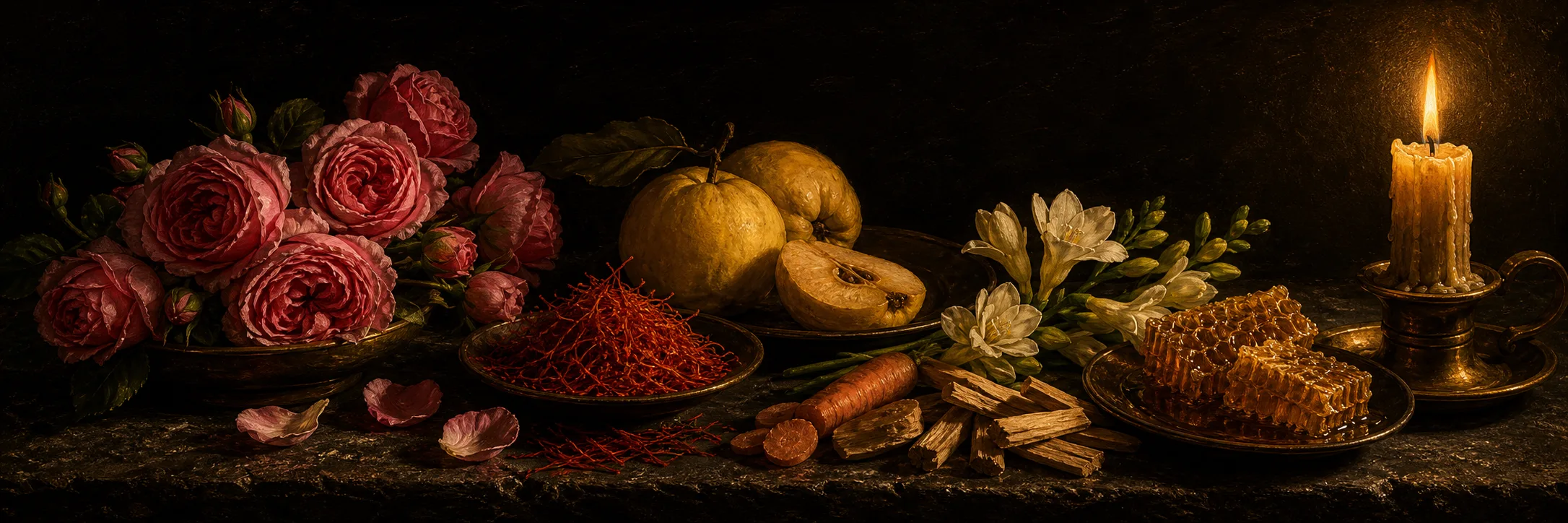
The opening is the most praised passage: a tart, mouthwatering quince paired with sweet rosewater and a “good dollop of saffron cream,” which several reviewers describe as a delicate floral-milk or loukoum effect. Coriander and carrot seed add a vegetal, slightly spicy lift; the carrot seed in particular gives the rose a carroty, iris-adjacent undertone. The heart is dominated by a complex rose drawn from two sources, with iris, magnolia, peony and freesia present as supporting players you have to focus to detect rather than distinct soliflores. The drydown is where opinion divides sharply: it settles into a clean, raspy-woody, “laundry musk” base with honey and a whisper of benzoin/tonka warmth - soft, soapy, white-musky, and noticeably lighter than the spice-market opening promises. Reviewers consistently call it linear-ish after the first hour: a sustained honeyed-spiced rose that gradually recedes into musk and faint sandalwood. The signature accord is the quince-saffron-rose triad up top; the base is the more generic part. Notably, Scent Grail’s 2024 review argues the base leans on synthetics rather than the listed naturals: “what I found is a high dosage of Iso E Super which can mimic javanol… without Iso E Super this fragrance would be completely gone from the skin in one to two hours” - a reviewer’s technical read rather than a confirmed formula.
Performance
Performance reports are genuinely mixed and this is the fragrance’s most-cited weakness. Multiple wearers report only 3 - 5 hours of longevity and describe it as a relatively close-wearing scent; one notes it “does not last longer than 4-5 hours on my skin” and found that disappointing for an EDP at this price. Persolaise flagged comparable “shortevity” concerns in the Penhaligon’s pair he reviewed. Conversely, a detailed wearer review reports “longevity very good at around 11 hours on skin” with “average” projection, and some wearers report all-day wear with good sillage. The consensus reading: sillage is modest-to-decent, projection is average and fades to a skin scent fairly quickly, and longevity is skin-chemistry dependent and unpredictable (one reviewer: “it will last all day one day and 30 minutes the next”). Practical strategy that emerges from the reviews: apply generously and treat it as an intimate, daytime floral rather than a room-filler. Best in mild/warm conditions where the quince and saffron sparkle.
Wearing Context
This is a spring/daytime fragrance by wearers read - reviewers repeatedly associate it with “Springtime, Easter, April sunshine,” graduation, garden parties and sunny, joyful settings. Persolaise framed it as a freshly-graduated young woman heading to a summer ball - cerebral but bright. It reads as feminine-leaning unisex despite the official unisex positioning; several reviewers note the base intensifies in a more unisex direction (honey, musk, saffron) while the overall impression stays soft and “ultra-feminine.” It would feel under-powered as an evening statement or in cold weather, and its clean drydown means it won’t read as exotic or opulent despite the India narrative. Good for office and casual daytime; not a seduction or power scent. This contextual reading is partly inferred from the documented scent profile rather than a hard consensus.
Comparisons & DNA
Neela Vermeire Mohur is the unavoidable Duchaufour-relative: deeper, more opulent and spiced where Vaara is cleaner and lighter. Pichola is a softer orange-blossom-adjacent cousin. Dior Poison is a distant rose-fruit structural echo rather than a close match.
Reception
Loved for its quince-saffron rose opening, divided by a cleaner drydown, performance variability, and price.
Versions & Reformulation
Single composition; no widely documented reformulation of the scent itself. It was sold in 50 ml and 100 ml EDP. The fragrance has since been discontinued by Penhaligon’s (consistent with the house’s pattern of cutting slower sellers), which is the most significant change to its availability rather than its formula.
Acquisition Notes
Vaara is discontinued, so decants are the sensible first step. Sealed bottles now trade on the secondary market, where prices reflect scarcity more than performance.
Notable Facts & Lore
- The lore is unusually concrete and well-documented: Vaara was commissioned by Maharaja Gaj Singh II of Marwar-Jodhpur to mark the 2011 birth of his granddaughter, Princess Vaara, and to honor the family’s connection to Jodhpur.
- Per Perfume Shrine’s Elena Vosnaki (July 2013), “the name Vaara means both ‘blessing’ and ‘breeze’ and stands for the granddaughter of His Highness Maharaja Gaj Singh II.”
- Duchaufour traveled to Jodhpur - historic forts, palaces, gardens and markets - for inspiration, and the fragrance was exclusively available in India at the Umaid Bhawan Palace shop in addition to Penhaligon’s boutiques.
- It launched in 2013 alongside Penhaligon’s Iris Prima (an Alberto Morillas ballet-themed scent), and critics frequently grouped the two as a pair.
- The recurring critical talking point - that it reworks Duchaufour’s own India-inspired Neela Vermeire work - is itself part of the fragrance’s lore.