Robert Piguet — Bandit
Essence
Bandit (1944) is one of the foundational leather chypres in perfume history - the first of Germaine Cellier’s two masterworks for couturier Robert Piguet (the other being the tuberose monument Fracas). It is a brutal, bitter, green-leather chypre built on a famously high dose of isobutyl quinoline, conceived as the dark, rebellious counterpart to Fracas’s white-floral light. Eight decades on, it remains the benchmark against which leather chypres are measured - Luca Turin gave the modern version strong praise - and a famously polarizing “love it or hate it” experience.
Scent Profile
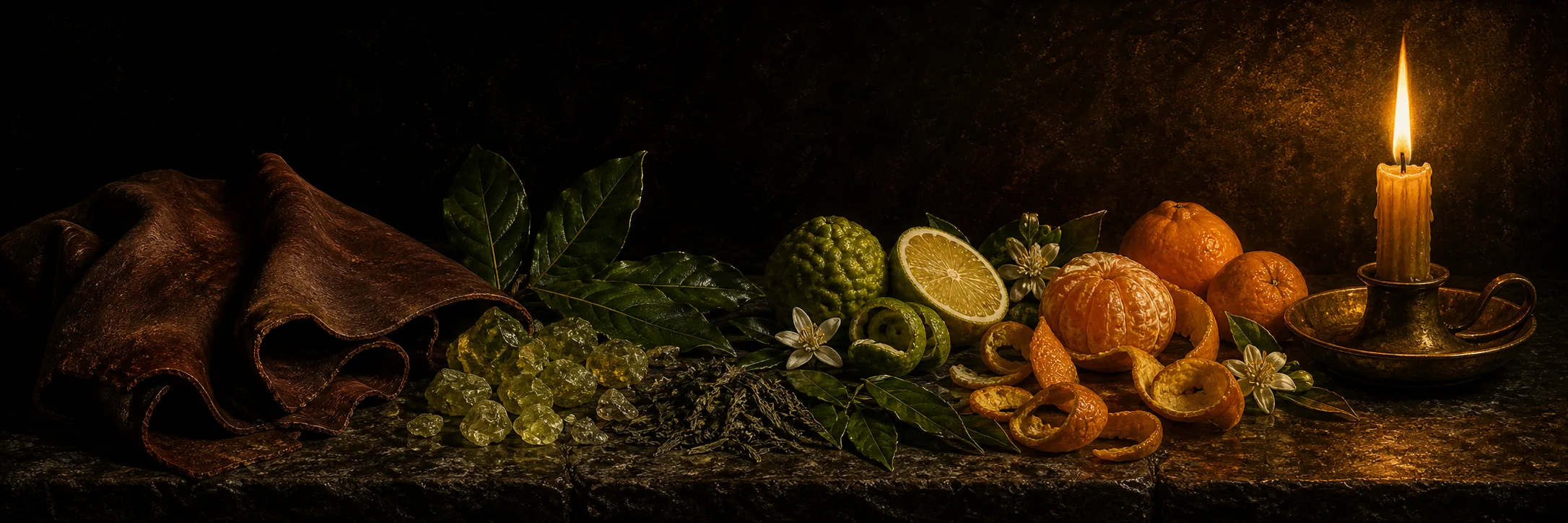
Bandit opens sharp and green - galbanum hitting “hard, bitter, almost harsh,” lifted by aldehydes and clean citrus into something “bright and fizzy,” over a backbone of dry, bitter leather. The leather here is the isobutyl quinoline accord Cellier pushed to a then-shocking 1% concentration, giving the composition its “tar,” “burnt rubber” and ashtray facets. Bois de Jasmin captures its character as bitter, rough Mexican-leather rather than “the buttery stuff of expensive Italian handbags.” Beneath the leather lies a genuine floral chypre heart - carnation, jasmine, violet root, tuberose, rose - but it reads abstract and severe rather than pretty, what Now Smell This calls “a lovely floral blend with hints of spice” that the leather dominates throughout. The drydown is the classic chypre engine: oakmoss, vetiver, patchouli, civet and musk forming an “earthy-mossy accord that vaguely recalls a full ashtray.” Guy Robert’s “beautiful but brutal” remains the most apt two-word summary. The modern EDP eventually segues into a pretty white musk, a softening the vintage lacked. It is moderately linear in spirit (leather-green-moss from open to close) but with a clear evolution from a galbanum-sharp opening to a smoother, mossier base.
Performance
Performance is reported as robust and long-lasting across versions. The Raiders of the Lost Scent comparison notes “the leather drydown stands for at least 6-7 hours” and, unusually, that “Bandit is one of those perfumes performing very well on any surface: paper, skin, and fabric” - with “no difference between EdT and EdP: longevity and sillage are the same.” Vintage parfum is the most concentrated and tenacious. The modern parfum, by contrast, drew a complaint from one experienced collector as “extremely mild and actually not really long lasting,” while the modern EDP is “definitely sharper.” Practical read: expect strong projection in the opening and 6-8+ hours of leathery base, with the EDP generally the sharper, more assertive choice and the modern parfum the softest. Apply conservatively - the galbanum-leather opening is potent.
Wearing Context
Bandit is a cool-weather, evening, statement fragrance for the confident - explicitly not a crowd-pleasing skin scent. Wearers and blogs frame it as uncompromising and “a bit aggressive when it needs to be,” suited to people who “don’t really care about” mass approval. It works in autumn/winter and for evenings or occasions where a bold, intellectual, slightly dangerous signature is welcome; it would feel wrong in a conservative office or hot, casual daytime setting. Though marketed feminine in 1944, it is thoroughly unisex-to-masculine-friendly by modern standards - Luca Turin lists it among the “best feminines for men,” and one wearer calls it “an androgynous bomb.” Social-perception skew: it signals edge, art-history literacy and self-possession; it can read as “punk, drag, BDSM” theatrical to some and as timeless sophistication to others.
Comparisons & DNA
Bandit sits in the pantheon of leather chypres alongside Caron Tabac Blond (1919), Chanel Cuir de Russie (1924) and Knize Ten (1924), the usual peer references. Its closest sibling is Cellier’s own Balmain Jolie Madame (1953), which Bois de Jasmin explicitly calls “Bandit reinterpreted, with more floral accents” (violets). Cellier’s Balmain Vent Vert shares the galbanum-green DNA. Among approachable modern reference points, wearers suggest fans of Paloma Picasso, Lancome Magie Noire and Clinique Aromatics Elixir will recognize the dry, bitter-green chypre style. The 2020 in-house remake Bandit Supreme (Aurelien Guichard) is the most direct comparison: reviewers describe it as softer, rounder and more wearable, with monstrous longevity, “significantly softer, rounder, and more pleasing” than the bitter original. The delta: vintage Bandit is sharper, dirtier and more animalic; modern versions and Supreme progressively smooth the fangs.
Reception
Bandit is canonized by critics and fiercely debated. Luca Turin awarded it strong praise in Perfumes: The Guide (2008) under the descriptor “bitter chypre,” and his review of the modern version reads: “I’ve owned several versions of the original Bandit over the years and this is not it…. But the magic is all there: bitter, dark yet fresh, beguiling without any softness, and still several unlit streetlights ahead of every other leather chypre around.” Bois de Jasmin and Now Smell This both treat it as a stunning, important composition (NST: “Bandit is just glorious stuff. Do try it if you can”). Praise centers on its audacity, history and uncompromising character. Criticism is mostly about wearability (“I love the audacity… however I can’t wear it”) and the cooler reception of the modern EDP/EDT versions relative to vintage. The deepest polarization is the love-it-or-hate-it galbanum-leather opening. Blind-buy verdict: a confident yes for chypre/leather lovers and perfume-history students, but sample first - it is not a safe crowd-pleaser.
Versions & Reformulation
Bandit has a long, tangled reformulation history that materially affects what’s in the bottle. Created by Germaine Cellier at Roure Bertrand Dupont (now Givaudan) in 1944, it relied on numerous pre-packaged perfumery “bases” - many now discontinued - which is why faithful reproduction is so difficult (Turin: modern reconstructions are “a work of translation”). Ownership passed to Alfin Fragrances (1985), whose early-’90s black-bottle EDT with “BANDIT” in all caps is prized by collectors as a faithful throwback; then to Fashion Fragrances & Cosmetics (FF&C) in 1995, which relaunched in 1998 with an “original formula, certified by Givaudan” label. A widely noted 1999 reissue (variously credited to Givaudan’s Delphine Lebeau; Aurelien Guichard later became the house’s in-house perfumer and reworked the line). A further reformulation came at the end of 2012 due to IFRA oakmoss restrictions. In 2020 the house launched Bandit Supreme (Guichard) as a modern remake; the original Bandit was briefly feared discontinued but returned to the brand’s site and to Harrods. Concentrations: modern Bandit is sold as EDP and Parfum (the brand makes no modern EDT, per Kafkaesque); vintage EDT exists on the secondary market. There is also a flanker, Bandit Supreme (2020).
Acquisition Notes
Current Bandit (EDP/Parfum) is sold through the Robert Piguet website, Harrods and niche/department retailers at accessible niche prices. Vintage hunting is the connoisseur’s path, with meaningful caveats. Decants are the sensible way to test before committing and to compare vintage versus modern.
Notable Facts & Lore
- Bandit’s 1944 couture launch reportedly used masked models carrying toy revolvers and knives.
- Germaine Cellier made Bandit and Fracas as deliberate opposites: dark green leather and white flowers.
- Its high-impact isobutyl quinoline leather accord influenced the leather-chypre genre.