The House of Oud — Crop 2016
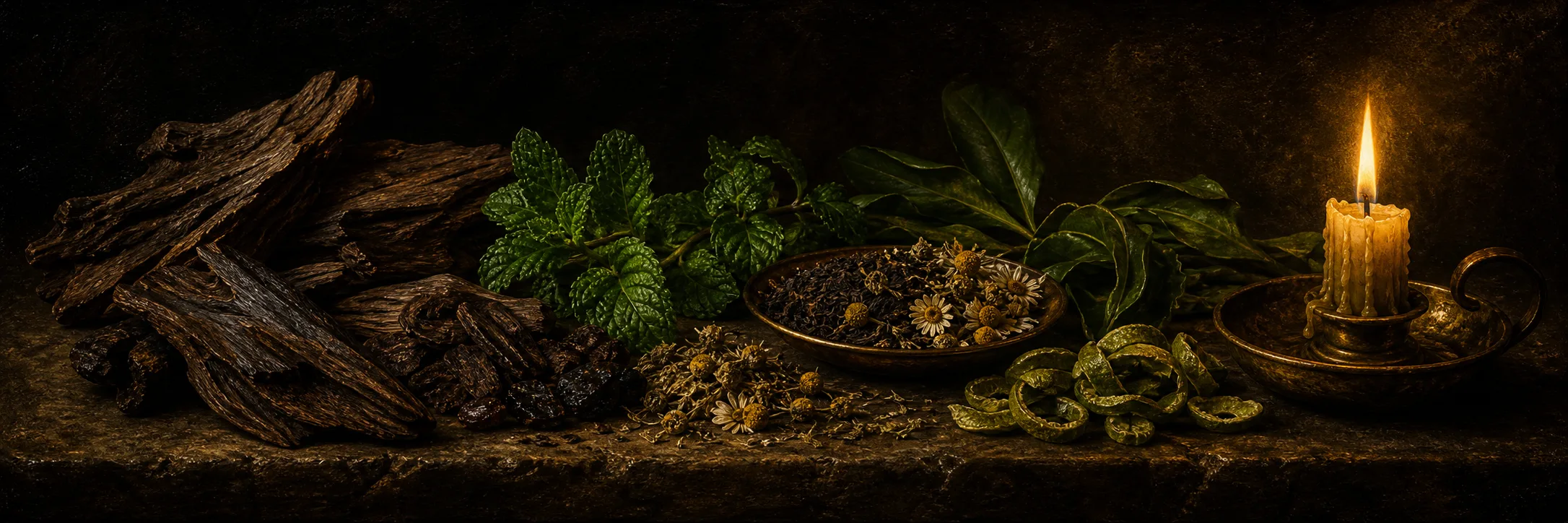
Essence
Crop 2016 is the inaugural release of The House of Oud’s annual Crop limited edition - a numbered-bottle, single-harvest-oud project in which one batch of pure Kalimantan oud oil per year is composed into a one-time fragrance that will never be reissued. Andrea (Thero) Casotti, the Italian co-founder, develops the concept; Mohammed Abu Nashi, the Jakarta-based oud-oil specialist and other co-founder, supplies the oil. The 2016 inaugural pairing was a smoky-green Kalimantan oud against fresh mint and dry tea - a far-from-traditional oud framing that published coverage’s reviewer Sergey Borisov called “a mint-chocolate woody fragrance” and which a published coverage wearers user, more memorably, compared to “Girl Scout thin mint cookies with a powerful yet subtle smoky oudiness.” Produced in roughly 250-300 numbered bottles depending on the source; discontinued by design, no reissue possible.
Scent Profile
Catalog notes list only the base: oud, mint, tea. That minimalism is accurate - Crop 2016 is a three-pillar construction, not a layered pyramid. Borisov’s published coverage review describes the structure as one in which “the layers disappear successively without blending. The mint evaporates first and leaves you with a tart and dry, powdery woody accord ), which then yields to calm and opaque oud.” The opening is cold-bright mint over the first whisper of oud. Reviewers consistently describe the Kalimantan oud as green-tart-smoky rather than warm-resinous-fecal - the antithesis of barnyard/Hindi oud, closer in feel to what some compare to Dusita Oudh Infini’s sour-green direction, though Crop 2016 reads less aggressive than that. The mint is fresh and slightly leafy, not toothpaste-cool; it creates a cold-air sensation against the oud’s smokier warmth that gives Crop 2016 its signature opening shock. The “thin mint cookie” comparison from the published coverage wearers is striking and apt - the green chocolate-y mint impression that emerges from the mint-oud interaction is the fragrance’s calling card. The middle phase is where the tea note becomes legible. Borisov describes it as “tart and dry, powdery woody” - a dry-tea-leaf impression, almost like sniffing a tin of loose green or oolong leaves, that holds the centre of the composition while the mint fades and before the oud fully takes over. This middle stage is the most distinctive part of Crop 2016 and the part most reviewers single out as the reason the perfume is memorable rather than just “another oud.”
Performance
Above-average longevity and sillage per the published coverage aggregate, which on wearers-scaled numbers means roughly 8+ hours skin time and projection that fills a room initially before settling into a 1-2 foot bubble. One published coverage reviewer reported atypical short skin behaviour - “Scent on me was linear. Lasted about two and a half hours” - but this is the outlier in the data. Pure-oud-oil-based compositions can vary substantially with skin chemistry and application; Crop 2016’s pure-natural construction (the line is marketed as 100% natural) likely magnifies that variance. Cool weather flatters it; the green-mint opening reads colder and crisper in winter air. Hot weather makes the oud-tea drydown denser.
Wearing Context
This is a connoisseur piece, not a daily driver. The mint-oud opening can read polarizing in shared spaces (the toothpaste/thin-mint impression is divisive), but the drydown is a clean, contemplative wear. Best suited to cool to cold weather, evening, intentional wearing - a fragrance you put on because you want to experience it, not because you want to fit a social occasion. Social-perception read: this is a niche-enthusiast scent that won’t be recognized by general audiences and will be recognized as serious by other oud-heads. Office contexts depend heavily on tolerance for oud in your environment; in oud-familiar cultures and regions (Gulf states, parts of Asia) it reads as appropriate; in oud-unfamiliar contexts it’ll read as unusual and slightly assertive. The genderless construction is real - multiple reviewers from published coverage and published coverage describe wearing it across genders without issue.
Comparisons & DNA
Within The House of Oud’s own line, the Crop series itself is the closest comparison set. Each year’s release uses the same Kalimantan-oud-plus-one-or-two-other-notes framing: Crop 2017 (oud plus licorice/anise/resins), Crop 2018 (oud plus palo santo), Crop 2019 (oud plus coconut water), Crop 2021 and onward. A published coverage wearers reviewer who owns the full set notes the a qualitative assessment oud profiles are similar; the framing accords are what differentiate. Outside the line, the closest cited comparison for the green-tart-smoky oud profile is Dusita Oudh Infini, which published coverage reviewers explicitly invoke (“supposed to be a special kind of oud from Borneo - green and tart instead of warm and resinous, which throws me off in a similar way Dusita Oudh Infini did”). Both are non-traditional non-fecal ouds in the green-tart register. For the mint-tea-oud combination specifically, no direct comparison exists in mainstream perfumery - this is part of what makes Crop 2016 distinctive. Atelier Cologne Oud Saphir sits in an adjacent green-clean-oud space but without the mint. Maison Francis Kurkdjian Oud Cashmere Mood is denser and warmer. The “thin mint cookies” comparison is more honest as a sensory-experience analogy than a perfumery-DNA analogy. specialist coverage and specialist oud-forum coverage of Crop 2016 specifically is thin in publicly indexed sources, despite the line being squarely in their interest area; this likely reflects the limited 250-300-bottle production.
Reception
Critic-tier coverage exists primarily through published coverage editorial (Sergey Borisov’s two pieces - the 2016 launch coverage including a direct exchange with Casotti about parting with one of the last bottles, and the broader Crop-collection retrospectives). Borisov’s framing - “chocolate you would not expect,” “mint-chocolate woody fragrance,” “the mint evaporates first and leaves you with a tart and dry, powdery woody accord ), which then yields to calm and opaque oud” - is the most-cited critical read. wearers reception runs polarized along familiar oud lines. Pro side: distinctive, beautifully constructed, real natural oud, unique mint-tea-oud framing, collectible numbered bottle, premium presentation with hand-painted unique caps. Con side: expensive for the wear time some users get, linear in a way that disappoints some, mint-and-oud combination is not for everyone, the “successive layers” structure feels less integrated than fans of blended ouds want. published coverage coverage is positive but brief (“Clean, smooth, creamy, crisp. It’s an excellent and very wearable Oud”).
Versions & Reformulation
Single composition by design. The Crop collection’s defining premise is that each year’s release is a one-time numbered limited edition that will never be reissued or reformulated. 2016 saw approximately 250 bottles produced (per specialist retail’ product listing, citing the brand) or 300 (per Borisov’s published coverage piece, citing Casotti directly); the 2017-2021 releases produced different quantities (250, 347, 547 in various editions per published coverage’s Crop 2021 launch coverage). Discontinued by design once stock sells through. No flankers, no concentration variants.
Acquisition Notes
This is now a hunt-and-pay-up item. Original 2016 retail was in the niche-premium tier - Crop 2018 was retailing at $400 USD (specialist retail) to EUR 480 in Italy / GBP 480 in UK per Borisov’s coverage, and Crop 2016 sat in a similar range. Post-discontinuation, surviving bottles trade through niche resellers, decanters, and occasional specialist retail listings; provenance matters, and the certificate-of-guarantee that originally accompanied each numbered bottle is the authenticity marker. Common bottle size was 75ml EDP. Decant availability is limited but exists through specialist niche-decant sellers; check specialist retail, specialist retail, and dedicated oud-wearers decanting groups (specialist coverage’s market threads can sometimes surface samples of out-of-production Crop releases). No batch-code decoding system is documented for The House of Oud on whitelisted sources beyond the numbered-bottle and certificate system.
Notable Facts & Lore
- The Crop project’s launch in 2016 was a genuine perfumery experiment - Mohammed Abu Nashi sourcing one specific batch of Kalimantan oud oil per year, Andrea Casotti building one composition around it, producing a numbered limited edition that becomes a “tribute to the season that generated it.”
- Borisov’s piece quotes Casotti at length on the parting-with-a-bottle moment (“It is a rare case when I am happy seeing a flacon go.
- When you sell them, you do not know who and how they will use and take care of them.
- We made only 300 bottles of this perfume in 2016, and there will be no more.
- It is important to me to know to whom I give my perfume to, and in this case I know“), framing Casotti’s relationship to the project as parental.
- The economic context matters: Borisov noted that in 2016 a gram of high-grade oud oil was “worth more than a gram of gold,” which is why the Crop releases command niche-premium pricing despite small production runs.