The House of Oud — Sacred Groove
Essence
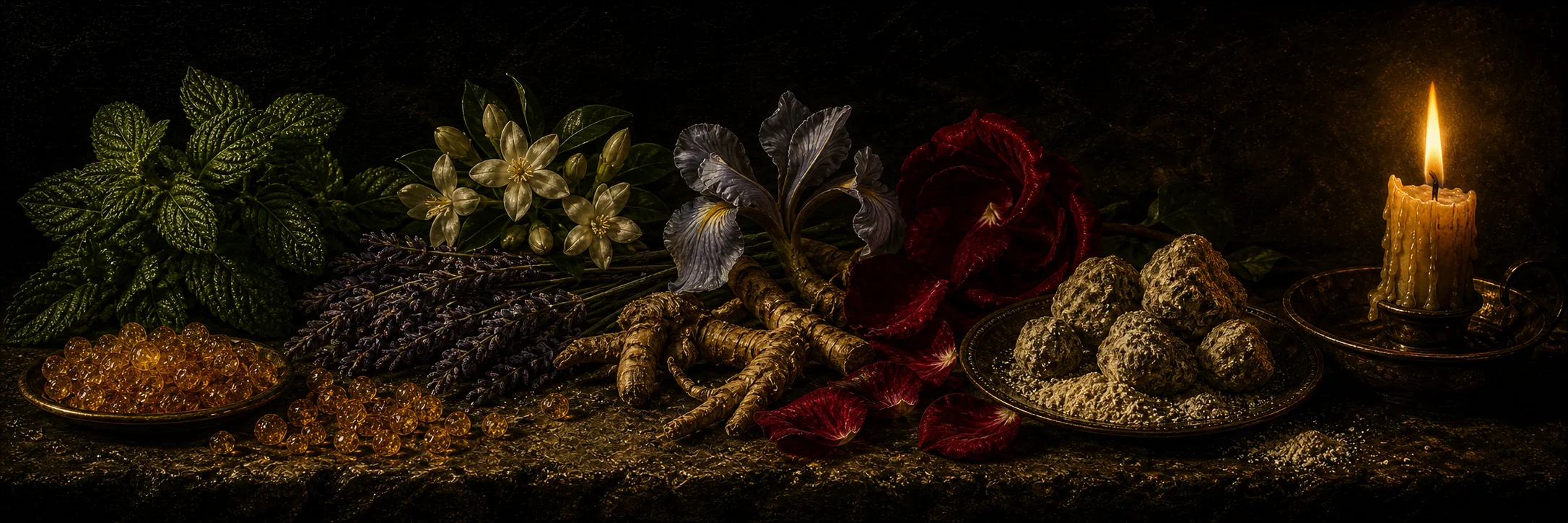
Sacred Groove is the rare niche release where the conceptual brief actually shows up in the bottle. Launched in May 2022 as a “four-handed” collaboration between perfumer Cristian Calabrò and the Italian “paper poetess” Domitilla Biondi - an artist who carves white paper with a scalpel - the fragrance was built to smell, improbably, like paper: white, airy, fibrous, with a faint spicy-green irregularity standing in for the texture of the carved sheet. Biondi described it grandiosely as “the reference to the most intrinsic and spiritual qualities of the Self, made of Music, Dance, Poetry, Harmony,” but the actually-interesting idea is the materials translation: orris and coumarin for whiteness, lavender for lift, angelica for the porous green edge. It sits in the brand’s later “Colorful Collection” / Arts grouping - as published coverage’s Sergey Borisov put it, “instead of expanding their Desert Day Collection and Klem Garden Collection, the brand found other new beautiful ideas…
Scent Profile
The arc is the most discussed thing about it. It opens sharp, green and bitter - angelica root doing the heavy lifting, with bitter orange providing a brief juicy citrus flash that quickly turns airy. published coverage’s Sergey Borisov nailed the structure: “classic white materials: spicy carnation, white powdery ionones, orris and coumarin, on a transparent woody-ambery background, tinted in sunset golden colors with myrrh and labdanum.” That sunset-white framing is apt - this is not the cold, clean white of ambrette/carrot-seed minimalism but a warm, golden white. The lavender is repeatedly described as having “a back bone” - herbal and grassy rather than barbershop-soft - and it threads through a powdery iris-rose heart before the composition settles into a coumarin-tonka, myrrh-labdanum, patchouli-musk drydown that reads as oriental-fougère more than the floral-woody-musk label suggests. Borisov’s verdict: “It could have made a good oriental chypre - the perfumer stopped a couple of steps away from it.” A recurring wearers observation is non-linearity: one published coverage reviewer wrote that “every few minutes I perceive one of the fragrance notes more strongly than the others… each note gets to lead the field in a loose rotation.”
Performance
Performance reports are genuinely bimodal, which is worth flagging as a chemistry-dependent fragrance rather than a simple “weak” or “beast.” On one end, multiple wearers report extreme tenacity: comments describe 12-plus hours on skin with “a very ethereal sillage,” and several note that it is “best on clothing… it stays for days on end.” Others - including a published coverage reviewer - flatly call the performance “pretty poor.” The likeliest reconciliation: the airy iris-lavender top and the heavy myrrh-labdanum-tonka base diverge, so close-wearers may find it quiet while fabric holds it for days. Treat sillage as moderate-to-soft and longevity as high-but-skin-close, with strong substantivity on clothing.
Wearing Context
Unisex in the truest sense - the lavender-angelica-iris spine keeps it from tipping either masculine or feminine, and wearers consensus lands on it as genuinely shareable. The warm-white, powdery-resinous character makes it a transitional-season and cool-weather pick (autumn and white winter), though several wearers successfully push it into warm evenings because the opening is so airy. It is a “stand out from the crowd,” low-recognition signature scent rather than a crowd-pleasing compliment magnet; the unusual angelica-lavender opening is divisive enough that it will not read as safe-designer. Best for someone who wants something cerebral and a little odd.
Comparisons & DNA
The most useful named comparison comes from a published coverage reviewer who pegged the opening as “very much like Lanvin’s discontinued Avant Garde with a burst of Bergamot, Dihydromyrcenol (Lime-Lavender effect), sweet Tonka and a mild spiciness,” before the floral heart pushes it “to a more traditionally feminine territory: think of Coco Mademoiselle with its patchouli fruitiness base.” That lavender-tonka-coumarin spine is exactly why a lavender-iris-tonka cross-reference is apt: it shares conceptual DNA with the powdery-aromatic, iris-lavender-fougère family, though it is sweeter and more resinous than the bone-dry classics. Within Calabrò’s own House of Oud catalogue it is an outlier - far more aromatic and less gourmand than his Almond Harmony or Dates Delight. A wearers note on published coverage deconstructs the “groove” effect as an angelica-coumarin-clearwood interplay that produces a “pseudo-oud-like” woodiness without any actual oud.
Reception
Reception is polarized but tilts positive among those who give it time. The single most-repeated piece of advice is patience: “When I first smelled this I was disgusted, then I decided to let it sit… that is where the magic happens.” Enthusiasts reach for striking language - one called it “unbalanced, gangly, but terrorisingly beautiful and addictive,” suggesting it should have been named “Siren.” Detractors object to balance, not quality: one wrote that the powerful plants “trying to dance with each other” never resolve, “something is totally out of balance and there is one or two scents in there which mess it all up.” This is a known signature of the fragrance - a high-concept composition that some find harmonious and others find disjointed.
Versions & Reformulation
Single composition, no known reformulations. Released in 2022 as a 75 ml EDP (and a 7 ml travel size); still in the active catalogue. Note the brand markets it under its Arts/Colorful conceptual grouping rather than as part of a “Sacred Wood” line - there is no evidence Sacred Groove belongs to any “Sacred Wood” collection; the shared “Sacred” word is coincidental.
Acquisition Notes
A full 75 ml retails around the EUR 220 / $220 mark on niche channels, though grey-market discounters routinely list it well below that. Given the strongly chemistry-dependent performance and the divisive opening, this is a near-mandatory sample-before-buying fragrance - the 7 ml travel size is the sensible entry point. Authenticity risk is low; it is widely stocked across niche e-tailers. No reported batch-variation issues.
Notable Facts & Lore
- The fragrance’s entire identity is a collaboration with paper artist Domitilla Biondi, whose scalpel-carved white-paper works inspired the “smell of paper” brief; House of Oud frames each such release as a “four-handed game” between the artist’s concept and Calabrò’s composition.
- Calabrò himself, in a 2022 interview with the German blog Das Duft-Tagebuch, did not single out Sacred Groove but spoke to the house’s broader method of translating “suggestive images…
- into liquid form“ - the same conceptual approach visible here.
- Despite “Oud” in the house name, Sacred Groove contains no oud, which has surprised more than a few buyers.