The House of Oud — Hidden Shades
Essence
Hidden Shades is a deceptive fragrance whose name is also its thesis: it presents as a soft, sweet, powdery-creamy cherry-blossom-and-plum floral, then reveals an unexpected aromatic-herbal “hidden shade” underneath - an earthy, cistus-driven, faintly “wet clay” facet that catches most wearers off guard. Part of The House of Oud’s artist-collaboration “Colorful Collection,” it was built with Milan-based ceramic artist Iris Roth as a scent-translation of ceramic craftsmanship, contrasting the “soft lines of fine ceramics” (cherry blossom, benzoin, plum) against “the idea of depth and matter” (sandalwood, patchouli, cistus). Whether that duality reads as sophisticated or “uninspired and overpriced” is the central debate.
Scent Profile
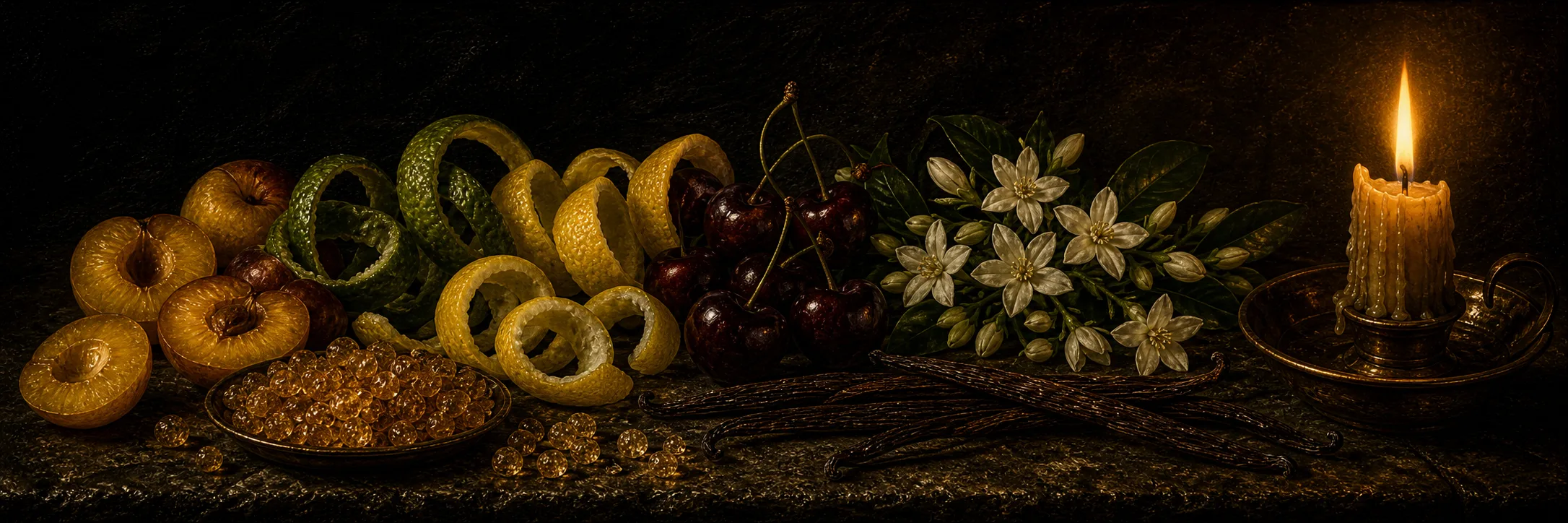
Per published coverage’s own reviewer Sergey Borisov (“moon_fish”), the fragrance opens not as a straightforward floral but as a “sweet-n-salty cream caramel, similar to Baileys cream liqueur” - buttery, with an “implicit citrus roughness” from lemon and bergamot and a shy mirabelle-plum sweetness. He attributes the effect to likely use of the captive material Exavanilla (caramel-vanilla, salty-marine, musky) and/or Cashmeran. The heart brings cherry blossom (rendered naturalistically - light, fleeting, “as one would find it in nature” per one published coverage reviewer) and jasmine, but the dominant surprise is an aromatic-herbal drydown: multiple reviewers independently flag a cistus/angelica/fenugreek-like “salad” or herbal facet, likening it to “Amouage Lineage with the spices removed.” The base is a soft, creamy tonka-vanilla-sandalwood-benzoin-musk blend with patchouli grounding it. Perceptible: creamy sweet caramel-vanilla open, cherry blossom, and the herbal-cistus twist. Submerged: the listed jasmine and labdanum are quiet; the “wet clay / fresh concrete” accord Borisov describes is a textural impression rather than a discrete note. Linearity: it evolves meaningfully from sweet-creamy top to aromatic-herbal-woody drydown, which is why the name “Hidden Shades” is called clever. Signature accord: creamy powdery sweetness fronting an unexpected dry, herbal cistus.
Performance
Below-average by wearers consensus. Multiple published coverage reviewers rate performance “just below average” or “average.” A published coverage reviewer offers the most useful framing: the sillage is “both strong and weak” - it doesn’t project forcefully but, like Pierre Guillaume’s fragrances, can be perceived over a long time in intermittent “scent bursts” despite apparent weakness, with the intensity reportedly building over time within the cherry-blossom theme. Retailer-reported wear time of 6-9 hours should be treated cautiously as it comes from a product page. Net: an intimate, close-wearing scent, not a performer.
Wearing Context
Spring and autumn (some say summer); a delicate, everyday, daytime scent. Universally wearable but leans feminine in perception. Occasions skew soft/personal - “reflective afternoons, creative sessions,” comforting rather than commanding. Its softness and the divisive sunscreen/musk facets make it a considered personal-taste wear rather than a crowd-pleaser or statement piece.
Comparisons & DNA
The recurring reference is Amouage Lineage - reviewers describe Hidden Shades as “Lineage with the spices taken out,” sharing the aromatic-herbal cistus/fenugreek quality at lower intensity. Borisov ties it to The House of Oud’s own What About Pop (both suspected to use the Exavanilla captive for a sweet-salty-musky creaminess). The soft “scent-burst” diffusion is compared to Pierre Guillaume / Parfumerie Générale compositions. Several wearers note a “sunscreen” or coconut-milk-and-citrus impression on skin, aligning it loosely with creamy-solar musks. Its cherry-blossom naturalism is positioned against the more candied, synthetic sakura fragrances common in the category.
Reception
Genuinely mixed-to-negative on the wearers boards, which its defenders explicitly push back against. On published coverage the “acquired taste” verdict recurs - the herbal drydown reads as “salad,” “bitter, too floral, super musky,” or “sunscreen.” On published coverage, ratings are low enough that at least one reviewer wrote specifically “to counter the impression left by the current ratings,” arguing the cherry-blossom theme is subtle and rewards patience. Praise centers on the naturalistic cherry blossom and the understated-yet-eye-catching duality; criticism centers on incoherence (“the notes don’t get along and kept fighting on my skin”), cloying sweetness, and value (“I usually know THoO to be more refined; here it’s overpriced average”). No documented-2 print critic review located; the most authoritative coverage is Borisov’s published coverage review.
Versions & Reformulation
Single composition, no known reformulations. Minor note-list discrepancy across sources: published coverage and most retailers list cherry blossom / jasmine / labdanum as the heart with cistus in the base narrative, while the brand’s own heart-notes listing sometimes substitutes cistus for labdanum in the heart - the same material (labdanum = cistus/rockrose resin) described at different pyramid positions.
Acquisition Notes
Niche pricing: per published coverage’s Sergey Borisov, it launched on the brand’s official website at EUR 220 for 75 ml EDP, with a 7 ml travel bottle at EUR 35; US retail runs about $240 (per specialist retail). Sold through niche stockists (ZGO, and various EU/international retailers). Decants and the 7 ml travel are the sensible entry given the polarizing profile and below-average performance - this is a strong “sample first” candidate. As a smaller Italian niche house, mainstream counterfeiting is limited, but buy through authorized niche channels. Bottles use a red/white color design echoing the ceramic inspiration.
Notable Facts & Lore
- Hidden Shades is a talent-collaboration with Iris Roth, a Milan-based ceramic artist and interior designer, and sits in The House of Oud’s collaborative “Colorful Collection” (alongside cross-disciplinary projects with bartenders, confectioners, graffiti artists, and opera performers).
- The house itself is framed as the story of a friendship between Italian perfumer Andrea Casotti and Jakarta oud producer Mohammed Abu Nashi; the project was reportedly discontinued for a period before relaunching across three lines (the oud-based Crop Collection, the jewel-inspired Royal Stones Collection, and the artist-collaboration Colorful Collection).
- The composition is credited to perfumer Maurizio Cerizza.
- The conceptual conceit - clay “polished and malleable, skillfully shaped until it loses its eternal fragility revealing itself in all its strength” - is meant to mirror the fragrance’s soft-to-substantial arc.