The Merchant of Venice — Byzantium Saffron
Essence
Byzantium Saffron is a saffron-and-suede oriental fragrance that combines spicy brightness with a smooth leather effect. Among The Merchant of Venice releases, it is often discussed as one of the line’s more distinctive compositions because it balances saffron’s medicinal-spicy facets with softer floral and suede elements rather than pushing fully into heavy leather territory.
Scent Profile
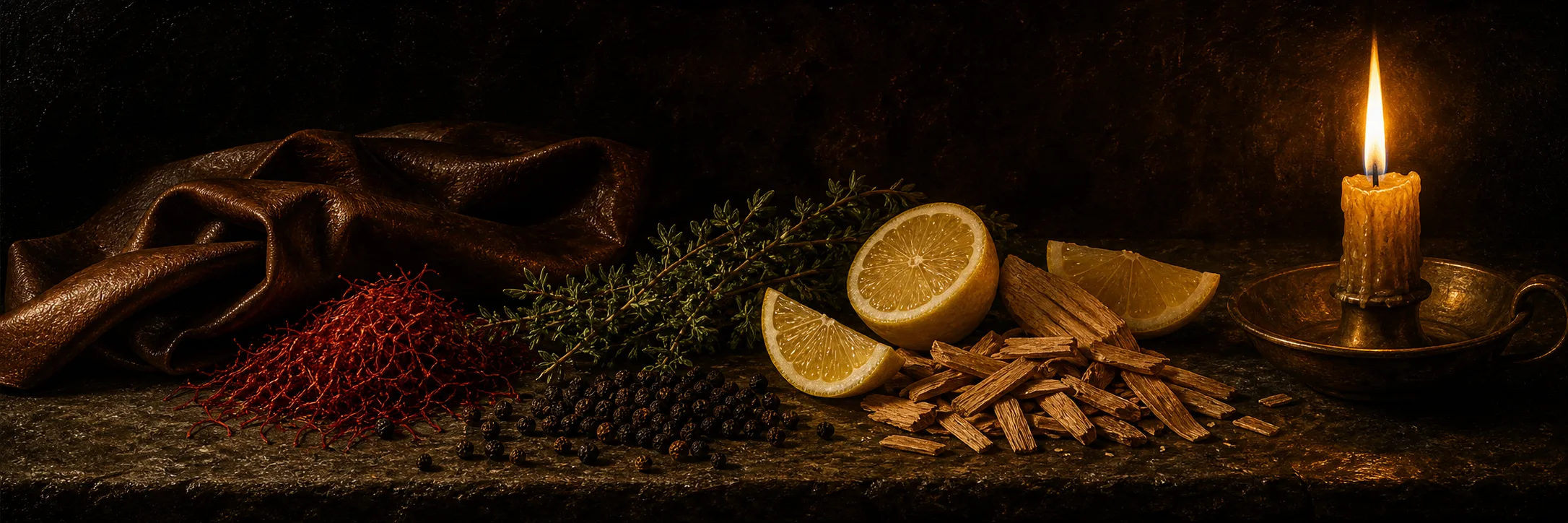
The opening presents saffron immediately, supported by black pepper, thyme, and lemon. wearer feedback often describe the saffron as prominent from the start, giving the fragrance a warm, slightly medicinal-spicy character. The lemon acts primarily as lift rather than as a true citrus-fragrance component, and thyme adds an herbal dryness that keeps the opening from becoming purely sweet. As the composition develops, suede becomes the defining feature. Unlike harsher leather fragrances, the leather impression here is generally described as soft, polished, and somewhat powdery. Cedar adds structure while lily and lilac contribute a floral smoothness rather than a bouquet-like floral identity. The rhubarb note is a useful point of tension in the heart: it can read as a tart, slightly green accent against the warm saffron and suede. It is not usually described as a dominant rhubarb fragrance, but it helps prevent the heart from becoming flat. The base of patchouli and amber reinforces the oriental framing. Patchouli gives a darker earthy-woody floor, while amber adds warmth and roundness. The drydown remains spicy-leathery rather than becoming a vanilla amber or a heavy resin perfume. The signature accord is saffron over soft suede, with herbal-peppery opening facets and an amber-patchouli base.
Performance
available wearer coverage is thinner than for mainstream designer fragrances, but available commentary generally suggests moderate to good longevity. The saffron and suede accord tends to remain perceptible after the brighter opening fades. Projection appears moderate rather than massive. Byzantium Saffron is not usually discussed as an overpowering leather fragrance; its presence is more polished and controlled. Cooler weather appears to suit the fragrance best. Heat may amplify saffron’s medicinal edge and amber warmth, while autumn and winter allow the leather-spice structure to feel more natural.
Wearing Context
Byzantium Saffron reads as a cooler-weather fragrance for evenings, dressed casual settings, dinners, and situations where a distinctive spicy-leather scent feels appropriate. It is more refined than rugged: the suede note gives it polish rather than biker-jacket aggression. Office use is plausible with restraint, but the saffron-leather profile is more assertive and unusual than a typical workplace fresh scent. It is better suited to someone comfortable wearing niche-leaning orientals. Social perception likely skews sophisticated, spicy, and slightly exotic. It is not a transparent citrus or clean musk; it announces taste through saffron, suede, and amber warmth.
Comparisons & DNA
The closest broad family is the saffron-leather lineage associated with fragrances such as Maison Francis Kurkdjian Oud Satin Mood’s saffron-rose-oud ambience, Tom Ford Tuscan Leather’s saffron-leather impact, and Byredo Black Saffron’s saffron-fruit-leather styling. Byzantium Saffron is not a direct clone of any of these: it is softer than Tuscan Leather, less jammy and rose-heavy than Oud Satin Mood, and less fruity than Black Saffron. Its DNA is more suede oriental than aggressive leather. The thyme, rhubarb, and pale floral notes make it drier and more faceted than a simple amber-leather composition.
Reception
wearer reception is positive but relatively niche. Enthusiasts who enjoy saffron, suede, and polished orientals tend to respond well to it. Praise centers on its elegant balance of spice and leather, the quality impression of the suede accord, and the fact that it feels distinctive without becoming abrasive. Criticisms usually involve the saffron note. Some wearers find saffron medicinal, metallic, or overly sharp, particularly in the opening. Others find the fragrance too restrained if they expected a dense, high-impact leather or amber perfume. Blind-buy suitability is mixed. It is safer for people already comfortable with saffron-leather fragrances; it is risky for wearers who mainly enjoy fresh, gourmand, or clean-musky profiles.
Versions & Reformulation
Single composition, no known reformulations.
Acquisition Notes
Byzantium Saffron sits in the niche/designer-luxury pricing tier associated with The Merchant of Venice. It has appeared in full-bottle retail channels and through decant sellers, though availability varies by region. No strong available evidence was found for widespread counterfeiting specific to this fragrance. Because The Merchant of Venice bottles can be visually distinctive and relatively expensive, secondary-market purchases should be checked against ordinary authenticity cues, but no special batch-code lore or known fake-wave pattern emerged from reliable wearers sources.
Notable Facts & Lore
- The fragrance’s name and material choice connect it to a Byzantine and Venetian trade-route imagination: saffron, suede, spice, and amber evoke luxury goods rather than a modern urban leather.
- Documented independent lore beyond that thematic framing is limited; its enthusiast reputation rests mainly on the saffron-suede execution rather than a famous critical review, celebrity association, or viral moment.