The Merchant of Venice — Venetian Blue
Essence
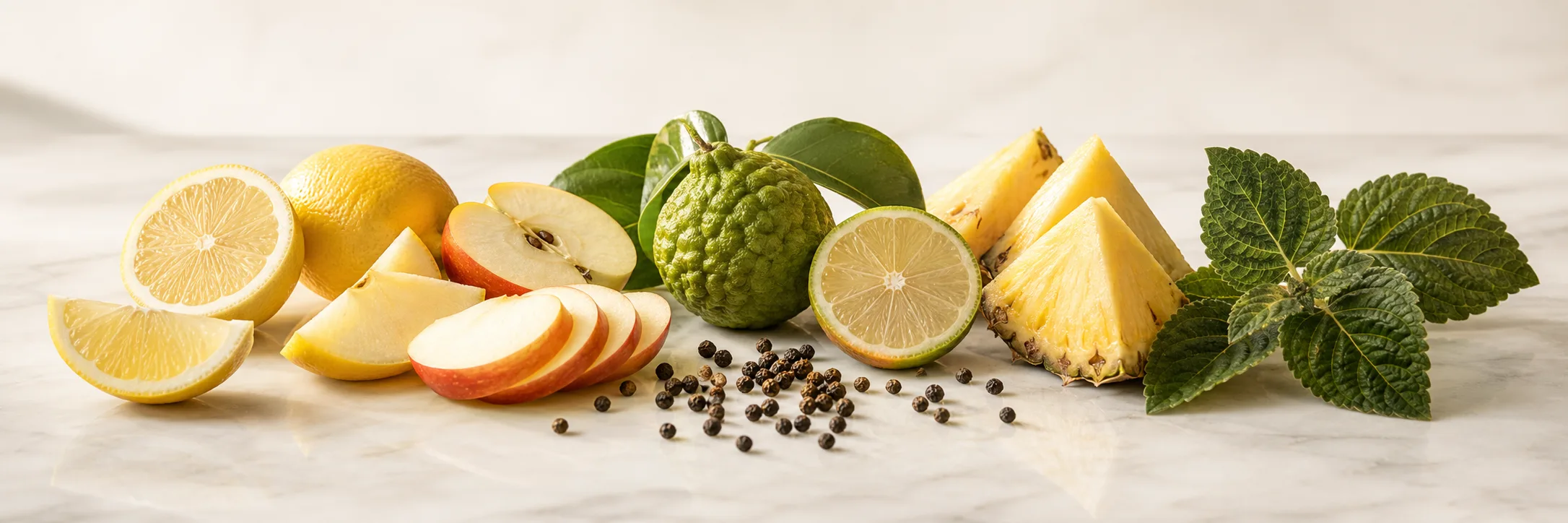
Venetian Blue is The Merchant of Venice’s entry in the crowded blue-masculine genre, and more specifically one of the era’s many Creed Aventus-inspired fruity-woody fragrances, dressed in a strikingly beautiful Murano-glass-inspired bottle. Released in 2016 as part of the brand’s Nobil Homo collection, it pairs a fresh, fruity citrus opening of green apple, lemon and bergamot with a smoky-mossy birch-and-patchouli base that openly evokes Aventus while leaning greener, more aromatic and more Italian. The consensus identity is a competent, pretty, citrus-fruity-woody crowd-pleaser whose gorgeous bottle and Aventus DNA are both its main selling points and the source of its harshest criticism.
Scent Profile
The opening is a fresh, fruity burst: green apple, sometimes read as tart, with lemon and bergamot and a marine-ozonic edge that many catch immediately. Black pepper supplies a coarse, freshly-ground spicy lift, likened by one wearer to pepper from the mill creating a mild fire.
The heart moves into birch, black pepper and patchouli, with the birch contributing the smoky facet that drives the Aventus association. The base is where it diverges from its inspiration: a dry, mossy, ambery finish of oakmoss, ambergris and musk, described as damp and smoky, turning balmy and mossy a few hours in before settling to a skin scent.
Notably, the original 2016 version lacks the pineapple so central to Aventus — a key reason some find it close but not a true clone. The development runs from a citrusy aromatic top through a patchouli-and-vetiver frame to a balmy mossy-ambery drydown around three to four hours, becoming a skin scent past the six-hour mark. Linearity is moderate, with the smoky-woody-mossy character as the throughline.
Performance
Reports are mixed and skew toward decent but not a monster. Longevity is often called merely average, though one detailed account logged six hours with solid projection and noted it lasts longer in heat, while another tracked it becoming a skin scent after about six hours. Several describe it as not a projection monster but with decent longevity, a perfect-weight summer cologne, while the disappointed camp calls projection weak. The honest synthesis is moderate longevity of roughly five to seven hours, more in warmth, with moderate sillage that settles close after the first hours. The 2018 Intense flanker is the stronger, denser, longer-lasting option. Spray generously and treat it as a daytime warm-weather scent.
Wearing Context
This is squarely a spring and summer, daytime, casual-to-smart-casual fragrance, framed by the brand as a fresh scent inspired by an Italian summer. Its fresh-fruity-aquatic profile suits office wear, daytime errands and hot weather, and one wearer noted it works for women too, reflecting its broadly approachable, not-aggressively-masculine character despite the masculine marketing. The Intense version is the better cold-weather and evening choice. Social perception skews mainstream-masculine and inoffensive — a safe, pleasant, smells-expensive daily option rather than a signature statement.
Comparisons & DNA
The single dominant comparison, repeated endlessly, is Creed Aventus, with Venetian Blue regarded as one of the better Aventus-inspired takes. Wearers describe it as greener, spicier and woodier, more birch-y in the drydown, lacking Aventus’s pineapple and leathery twist and a touch softer. Terre d’Hermes is another reference point, with one wearer finding it almost identical only a bit softer, and it also brushes Bleu de Chanel territory. The house’s own framing positions it in the wake of Aventus and Hacivat while holding onto a citrus, green-apple and patchouli heritage. Cheaper Aventus-DNA alternatives are widely noted as occupying the same lane.
Reception
Reception is polarized, almost entirely around originality and value. The positive camp praises it as elegant, clean, fresh and well-made Italian craftsmanship, a beautiful summer cologne with a stunning bottle, with one wearer calling it the most beautiful fragrance they had ever smelled. The negative camp is blunt, dismissing it as another Aventus-like clone with poor performance. The Murano-glass bottle is near-universally admired even by detractors, feeding a common verdict that only the bottle dazzles while the scent disappoints. The central axes are derivativeness, performance, and price-to-performance, with many concluding it is overpriced at full retail given cheaper alternatives. As a blind buy it is acceptable for those wanting the Aventus vibe in a gorgeous bottle at a discount; skeptics wanting originality or strong performance should sample first.
Versions & Reformulation
Two distinct products are frequently confused. The original Venetian Blue from 2016, the subject here, is the lighter, greener, citrus-aromatic version without pineapple. Venetian Blue Intense from 2018 is a denser, heavier flanker that adds pineapple and elemi, pushing it closer to Aventus and lasting longer, often cited as the more beast-mode option for cooler weather and evenings. Both sit in the Nobil Homo collection. No reformulation of the original itself is documented; the Intense is a separate flanker rather than a reformulation.
Acquisition Notes
This is mid-niche pricing that is heavily discounted, a key acquisition fact. While retail sits around 130 euros for 100 ml, it and its Intense flanker routinely sell dramatically below list, sometimes a fraction of retail. The practical advice is unanimous: do not pay full boutique price when it is so widely available cheaper from reputable sellers. The standard size is 100 ml EDP. Counterfeiting is not a prominent concern for this brand; the bigger caution is simply confirming whether you are getting the original or the Intense, as they smell and perform differently. Samples and decants are available for testing the Aventus resemblance before committing.
Notable Facts & Lore
- The Merchant of Venice was founded in 2013 as a niche art project by Mavive, the Venetian Vidal family behind the 1950s men’s cologne Pino Silvestre.
- The family co-founded the Perfume Museum in Venice’s Palazzo Mocenigo in 2013.
- The brand’s concept invokes Venice’s centuries-old perfume trade with the East via the historic maritime routes, and the name nods to Shakespeare’s play.
- The bottle is the signature artifact: a blue flacon inspired by traditional Venetian Murano glass and fabric, topped with a silver wind-rose cap that even critics praise.
- Within the genre, its lasting reputation is as a recurring exhibit in the endless best-Aventus-alternative debate.