The Merchant of Venice — Fenicia
Essence
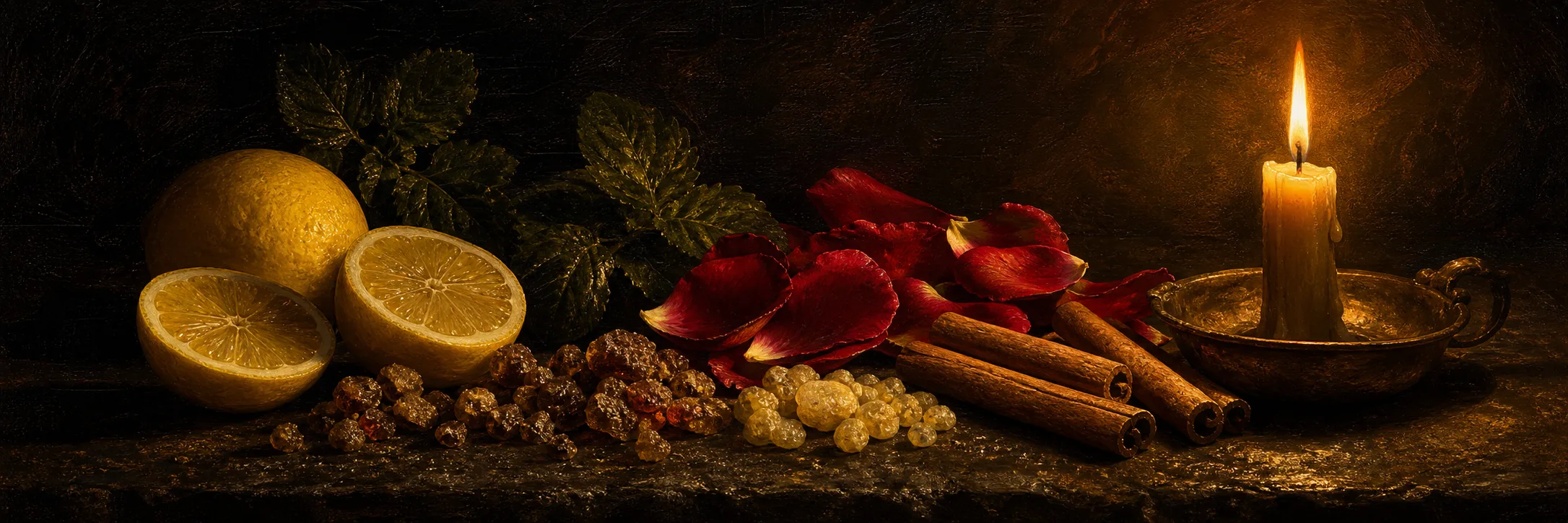
Fenicia is an opulent, dry, spicy-resinous oriental from Italian niche house The Merchant of Venice, part of its high-concentration Murano Exclusive collection housed in hand-blown Murano glass. Released in 2015, it pairs a Calabrian-lemon-and-elemi opening with a heart of rose, myrrh, frankincense, nutmeg, clove and cinnamon, settling into a powdery base of tonka, benzoin, saffron, sandalwood and patchouli. Its identity is a Renaissance-Venice trade-route fantasy - spices and resins carried from East to West - and wearer consensus is that it’s a beautiful, well-blended but notably linear “church-meets-spice-market” oriental whose main draw, beyond the scent, is one of the most admired bottles in niche.
Scent Profile
From the catalog notes, Fenicia is built as a citrus-lifted spicy-incense oriental, and wearers noses confirm the arc closely. The opening is a bright lemon-and-elemi pairing - “Elemi and lemon is a lucky marriage,” one wearer wrote - that several found briefly reminiscent of the citrus-resin start of Guerlain’s Habit Rouge. From there it moves into its core: a warm, dry blend of nutmeg, clove and cinnamon softened by rose, with myrrh and frankincense lending what reviewers repeatedly call a “church”/incense mysticism. Saffron adds a leathery-spicy gold thread, and the base turns powdery and slightly sweet via tonka and benzoin over sandalwood and patchouli, with some reviewers picking up a faint chocolate/praline nuance. The dominant structural observation is linearity: the most-cited wearers review notes “It is the same one I applied 5 hours ago… Nutmeg, cinnamon, allspice, rose, saffron, sandal, tonka bean… all there from the beginning till the end,” and one wearer echoed “very good with (too) little evolution.” It’s temperature-reactive - “a gentle oriental rose with citrus in colder temperatures” but more “myrrh and balsamic… reminiscent of a church” in heat. A minority report a metallic or soapy facet in the drydown, and there’s a gender-perception split: marketed unisex, but several find it distinctly feminine.
Performance
wearers performance reports are strong but genuinely polarized by skin chemistry. The majority report excellent longevity: wearers longevity score sits around strong reception, and detailed reviewers cite “more than ten or twelve hours,” with wearers reporting “12+h” and full marks for longevity. Projection is described as potent (wearers sillage around strong reception) - “very strong projection… It is so high in concentration that it glistens on your skin when you spray it. Don’t overspray if you are wearing this to work.” As an Eau de Parfum Concentree, reviewers consistently warn it’s powerful and reward restraint. A dissenting minority, however, report weak performance - a Turkish wearers review flatly states “the scent is very nice but the performance is terrible,” and one buyer reported only ~4 hours. The honest read: most wearers get 10-12+ hours with strong opening projection, but a skin-chemistry-dependent minority get far less. Best in fall, winter and cool spring; the resins bloom in warmth but it can feel heavy in high heat.
Wearing Context
A practical reading backed by wearers sentiment: Fenicia is a cool-weather, evening or considered-daytime scent for those who like dry, spicy, incense-laced orientals. Its “church incense plus spice market” character suits autumn and winter, formal or atmospheric settings, and colder climates where the resins glow rather than smother. It would feel heavy and potentially cloying in summer heat or tight indoor spaces (hence the “don’t overspray… to work” warning). Despite the unisex billing it skews slightly feminine to several wearers via the rose and powdery tonka. Social-perception skew is rich, mysterious and “expensive-smelling,” with a slightly retro, old-world character that some find elegant and others find dated.
Comparisons & DNA
Fenicia draws several specific named comparisons. The most repeated is Amouage’s Epic Woman - one wearer called it “a savory gourmand a la Epic Woman from Amouage,” and wearer similarity engine corroborates the pairing; the delta is that Epic Woman is darker, drier and oud-backed, while Fenicia is brighter, citrus-lifted and softer/sweeter via tonka. wearer most in-depth reviewer flagged a Guerlain Habit Rouge resemblance in the citrus-resin-spice opening only, with the similarity fading by the heart. A critical wearers contrasted it unfavorably with Ormonde Jayne’s saffron-forward work, finding Fenicia drier and “like a draft that hasn’t been finished yet,” and likened its “elegant but nothing exciting happens” quality to Xerjoff’s Richwood. one wearer compared it to DSH Perfumes’ Cimabue, judging Cimabue stronger and sweeter-spiced. Within the house, it sits among the well-regarded Murano spicy-orientals alongside Arabesque (often compared to Tom Ford Tobacco Vanille) and Vinegia 21. The honest framing: Fenicia is a citrus-lifted spicy-resinous-incense oriental in the broad neighborhood of Amouage’s spicier florals and classic resinous orientals, distinguished by its bright lemon-elemi top and powdery tonka-saffron base; no designer clone is documented.
Reception
Wearer reception leans positive-but-qualified. Available reception is positive but qualified, with praise outweighing a small set of reservations. Praise centers on the beautiful, well-blended spicy-rose-resin composition - “Citrusy-rosy start, spices and incense follow… a really great combo, long-lasting, unique, beautiful!” - and on warmth (“spicy-rosy cuddle scent”). The Murano glass bottle earns near-universal admiration. Criticism is consistent on a few axes: (1) linearity/lack of development is the dominant complaint; (2) some find it “boring,” “old-fashioned” or “a bit retro,” with one reviewer noting “The list of notes sounds better than the result that reaches my nose”; (3) harshness for some, where “floral and citrus notes are buried under the weight of spices and resins”; and (4) the occasional metallic/soapy drydown and the performance minority noted above. Value for money is the weakest recurring reception point. One isolated, anomalous wearers review trashed it as “industrial, automotive, and cleaning chemicals,” well outside the otherwise positive field. Blind-buy verdict: a reasonable blind buy IF you like dry, spicy-rose incense orientals and don’t need dramatic development - riskier if you want evolution/complexity or are performance-sensitive; the deep grey-market discounts lower the risk considerably.
Versions & Reformulation
Fenicia is sold as an Eau de Parfum Concentree in the Murano Exclusive line, 100ml, in the hand-blown blue-and-gold Murano glass flacon (its pattern inspired by palm leaves used in Venetian religious ceremonies). No distinct concentration variants or major reformulations are documented. Note the house has a large, frequently-reorganized catalog and a separate “Discontinued Fragrances” grouping; Fenicia’s status is ambiguous (see Acquisition Notes) but it does not appear to have been formally reformulated.
Acquisition Notes
Fenicia carries a Murano Exclusive boutique list price around €290 for 100ml (siblings in the line launched around €250), placing it firmly in the upper-niche tier. In practice it is heavily discounted on the grey market - wearer price widget shows it at $114.99 (Jomashop), $119.00 (Maxaroma), $142.99 (FragranceNet) and $199.75 (FragranceX), so it can be acquired for well under half of boutique list. Discontinuation status is ambiguous: there is no reliable confirmation of formal discontinuation, the brand’s own site still carries a Fenicia product page, and it remains widely available at discounters - treat it as “in distribution but deeply discounted.” Given the wide price spread and the polarization on development/performance, sampling or buying from a discounter is the sensible approach. No reliable counterfeit-prevalence or batch-code decoding guidance specific to Fenicia was found. Common size: 100ml EDP Concentree.
Notable Facts & Lore
- Fenicia’s concept is explicitly historical: it’s named for Phoenicia and inspired, per the house, by “ancient fragrance recipes from Venice in the Renaissance era,” when the independent Republic of Venice controlled much of the East-West spice and resin trade.
- The Murano Exclusive line as a whole is built around the “Mude” - Venice’s ancient maritime trade routes - with each fragrance evoking the precious raw materials Venetian merchants imported from the Orient.
- The bottle is a deliberate piece of Venetian craft: hand-blown Murano glass in the house’s signature blue-and-gold, with a palm-leaf motif drawn from religious ceremony and architecture, topped with a cap bearing the wind rose.
- One enthusiast captured the intended romance vividly, imagining “taking a gondola ride in the canal and smelling the baking cakes/Italian chocolates in the shops nearby mixed with earthy woody smell of gondola boats.” No celebrity associations or viral moments are documented.