The Merchant of Venice — Gyokuro
Essence
Gyokuro is a tea fragrance with a split identity: on paper it is named after one of Japan’s most prized shaded green teas, but in wear it is usually experienced as a soft peach-green-tea floral with wellness-spa elegance rather than as a literal umami-rich gyokuro study. That tension is part of the fragrance’s appeal and its criticism. wearers reviews like it most when treated as a fresh, refined, peachy tea scent; tea enthusiasts become more skeptical when they measure it against actual gyokuro, whose real-world profile is famously shaded, thick, sweet-savory, and umami-rich.
Scent Profile
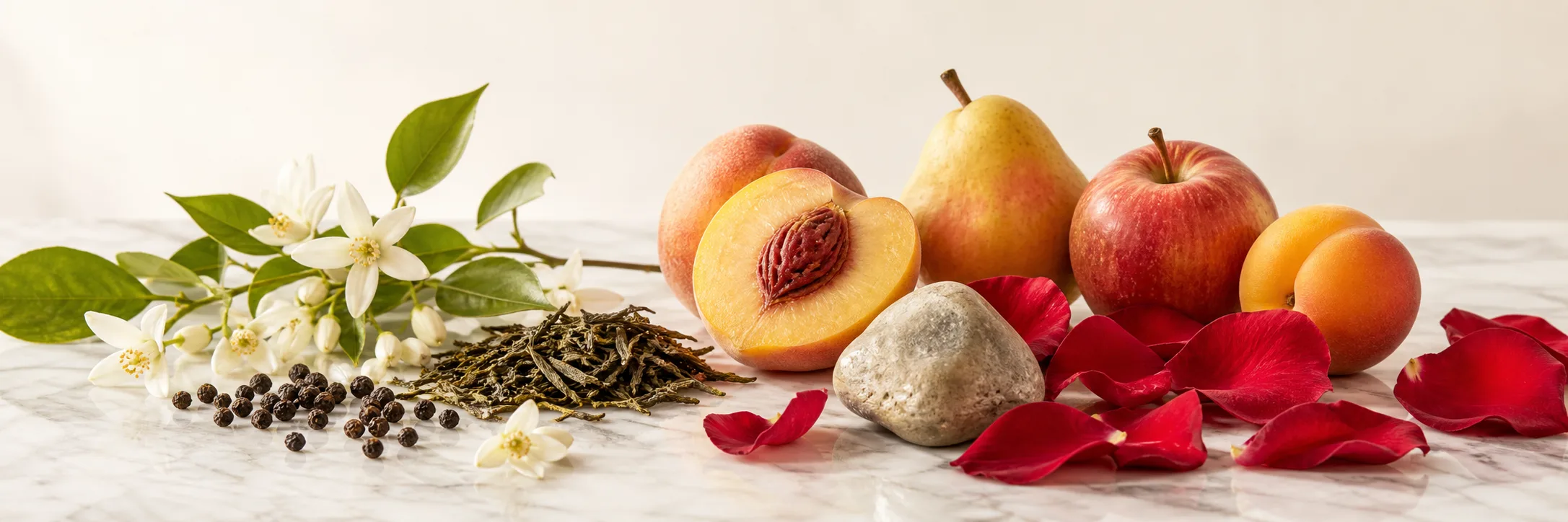
The opening is generally described as bright, clean, and gently sparkling rather than bitter or ceremonial. multiple sources confirm the exotic-fruit, neroli, and black-pepper top, and reviewers usually smell that as fresh fruit and light florality rather than obvious spice. Very quickly, the fragrance settles into the main accord everyone talks about: green tea with peach. Depending on the wearer, that reads as fresh green tea leaves with a peach accent, peach iced tea, jasmine tea in a garden, or a chic “Arizona Peach Green Tea” abstraction polished into niche format. The tea itself is usually present, but not in a severe matcha-like or umami-heavy way; it is airier, smoother, and more floral than that.
The floral side is more supportive than dominant, though skin chemistry matters. Some users do clearly smell tuberose or a feminine floral lift, but wearers reviews often say the tuberose never takes over and that the tea-peach pairing remains the point. Vetiver appears as a quiet grassy-shadow note rather than a smoky root note, and the base is usually described as soft sandalwood, light amber warmth, and a clean, comforting fade. A few reviewers report more fruit-floral than tea, or say the tea only whispers in the background, which is consistent with the fragrance’s broader pattern: it often smells more like an idealized peach green tea perfume than a documentary rendering of Japanese gyokuro.
Performance
Gyokuro appears to perform in the middle range, with some pleasant upside. available ratings land around 7.0 for longevity and 6.5 for sillage, and several in-depth reviews put real wear around six to eight hours with good early presence that later sits closer to the skin. reader comments broadly fit that range, though with some scatter: one user thought it was strong enough to scent the shipping box, while others found it gentler or less substantial.
That makes practical sense for the style. It is not a tea bomb in the loud Nishane sense, but it is not a vanishing cologne either. Expect a few good hours of visible freshness and then a softer tea-floral-woody trail. Clothing may help, and the fragrance seems especially effective as a refreshment scent rather than as a formal all-night performer.
Wearing Context
This is one of the clearest sections because the consensus is unusually stable: spring and summer, daytime, everyday, calm settings, and relaxed polished wear. Reviewers repeatedly describe it as clean, chic, kind, gentle, wellness-like, athletic in a luxe way, or simply ideal for heat. It reads particularly well for brunches, office wear, weekends, tea-shop moods, post-shower use, garden walks, and travel.
What it does not really do is gravity. If you want deep ceremony, smoky bitterness, or a dark meditative tea scent, Gyokuro is probably too peach-lit and soft. It is also not an obvious blind buy for people who dislike peach, fresh florals, or slightly feminine-leaning tea compositions. But as a daily-wear fresh tea scent, it lands very naturally.
Comparisons & DNA
Two comparison tracks matter. First, wearers track: many reviewers openly compare Gyokuro to Arizona Peach Green Tea, jasmine tea, or fruit tea rather than to a sober Japanese tea ceremony. That is not an insult in context; it is a way of naming the fragrance’s peach-green-tea sweetness and easy drinkability. Second, the perfume track: wearers place it loosely near Nishane Wulong Cha and The Merchant of Venice’s own Blue Tea, but with a softer, peachier, more floral profile and less tart citrus snap than Wulong Cha.
The one comparison it cannot escape is to real gyokuro tea itself. Actual gyokuro is known for shade-grown richness, sweetness, and umami, and several wearers commenters argued that the fragrance does not really capture that dense, savory, seaweed-tinged personality. So the best way to frame the DNA is not “realistic gyokuro,” but “luxury peach-green-tea floral inspired by gyokuro.” That is more consistent with how it is actually received.
Reception
Reception is broadly positive. wearer strong reception and wearer positive reception suggests a warmly received release, and the dominant praise centers on balance: tea, peach, and florals blended cleanly enough to feel elevated but still easy. People call it one of the better fresh tea scents, praise the bottle, and describe the fragrance as calm, pretty, versatile, and quietly addictive.
The main criticism is not that it smells bad, but that it is not “gyokuro enough.” Tea-literate commenters wanted more of the real tea’s umami-dark-green specificity and found the house’s interpretation too pretty, too peachy, or too broadly Asianized. Other routine critiques are lighter: some wearers get more fruit-floral than tea, some find vetiver or creaminess distracting, and some think the performance is only moderate. The blind-buy verdict is therefore fairly favorable if you want an approachable peach-tea fragrance, but more cautious if your goal is literal Japanese green-tea realism.
Versions & Reformulation
Single composition, no known reformulations. The relevant release context is that Gyokuro belongs to The Merchant of Venice’s Venezia & Oriente tea-themed line and followed Blue Tea rather than spawning concentration variants of its own.
Acquisition Notes
There is unusually clear reliable pricing information here. launch coverage said Gyokuro arrived in 100 ml EDP format at €189 in 2022, while a later wearers review put recommended retail around €200 and noted that discounted pricing below €100 could sometimes be found with patience. That places it in the entry-to-mid niche range rather than in ultra-luxury territory. No strong reliable evidence surfaced on counterfeit prevalence or batch-code decoding.
Sampling still makes sense, though not because the scent is especially difficult. It is more because the name can misdirect: if you are buying “Gyokuro” in search of savory, dense, umami realism, you should test first. If you are buying a well-made peachy green-tea floral with a polished bottle and comfortable wear, the acquisition case is much stronger.
Notable Facts & Lore
- The launch story is unusually well documented.
- wearer 2022 coverage presents Gyokuro as the second chapter in the tea-inspired Venezia & Oriente line after Blue Tea, tying it to Venice’s historic links with Asia and to Marco Polo’s travel mythology.
- That same coverage also notes the name’s “jade dew” meaning, mirroring the literal translation of gyokuro.
- One relevant catalog discrepancy should be noted: the catalog lists perfumer as unknown, while wearer source-backed page credits Violaine Collas.
- The more culturally interesting friction is that several commenters admired the perfume but still argued that its fragrance and bottle aesthetic felt prettier and more generalized than the specific Japanese tea it references.