Comptoir Sud Pacifique — Barbier des Isles
Essence
Barbier des Isles is an early (1978) Comptoir Sud Pacifique men’s woody-spicy scent from the brand’s pre-vanilla era - long before CSP became synonymous with sweet gourmands like Vanille Abricot. It is a dry, aromatic, incense-and-vetiver “barbershop”-adjacent composition that the wearers most consistently frames as a more subdued, cheerful cousin of Caron Yatagan. Discontinued and sparsely reviewed, it’s a connoisseur’s curiosity: an old-school spicy-wood that several long-time wearers prize precisely because it predates “the lamentable vanilla rabbit-hole” the house later went down.
Scent Profile
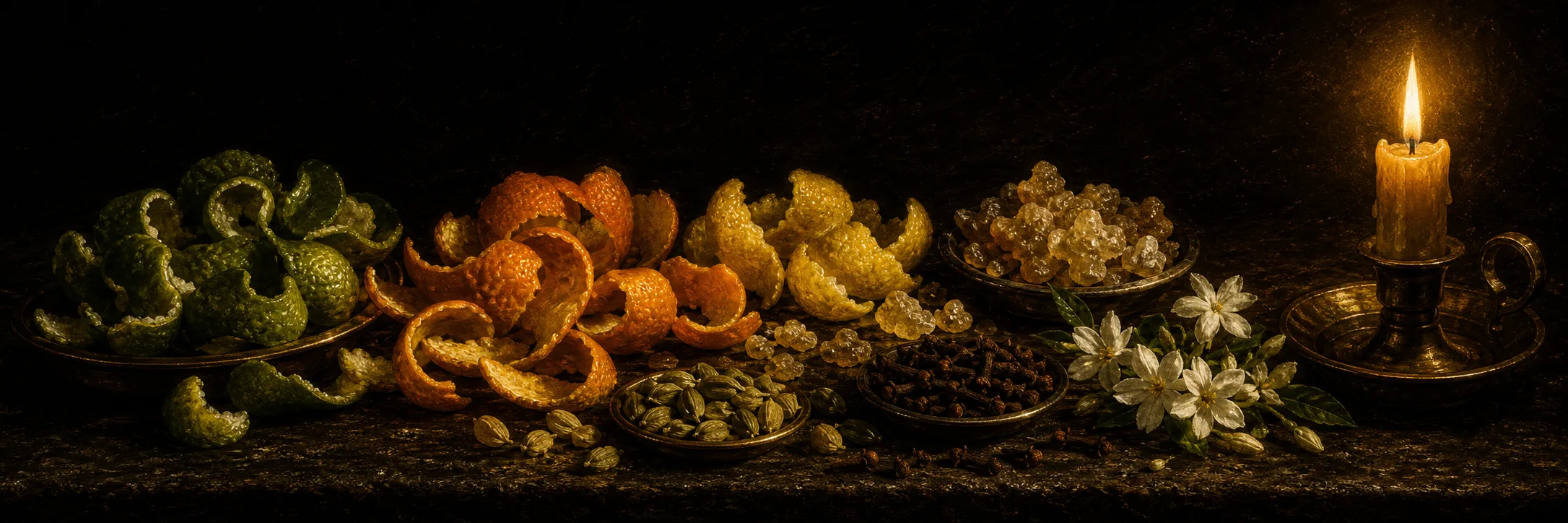
Catalog notes (bergamot, orange, lemon over incense, cardamom, clove, jasmine, on a base of vetiver, rosewood, patchouli, myrrh, musk) describe a citrus-topped, spice-and-incense-driven dry woody. In practice, reviewers report the citrus is fleeting or even hard to find - one disappointed wearer asked “where is the orange, where is my favorite bergamot?”, smelling instead “incense and some burnt spices.” The dominant impression is dry: a “bone dry vetiver” with incense, warm spice (cardamom/clove), and patchouli carrying the weight, jasmine adding a faint floral lift rather than prettiness. Perception varies unusually widely from person to person - one wearer reports reviewer catalogued how different wearers smelled patchouli/vetiver, dry vetiver, barbershop, burning wood on a beach, or even an oud-like facet (likely the myrrh reading as “aoud”). The throughline is “tailored,” crisp, and old-school masculine, with vetiver and incense as the signature accord and minimal sweetness. Skin vs. paper diverges too: one reviewer got an aromatic-wood opening on paper that resolved into a beautiful dry vetiver, but a different, heavier read on skin.
Performance
available performance data is thin and somewhat conflicting. wearer reports wearers metrics put longevity around the middle of the scale and sillage modest. Reviewers describe it as “much more subdued than Yatagan” with a respectable but not enormous lasting time - clearly less tenacious than Yatagan or Polo per direct comparison. The fairest summary: moderate longevity and moderate, non-aggressive sillage, fitting its “tailored,” refined character rather than a powerhouse. One reviewer recommended it specifically as “refreshing without being cloying” for warm climates, suggesting it holds up reasonably in heat.
Wearing Context
The dry, crisp, vetiver-incense profile reads as a warm-weather “tailored” scent to some - one wearer evoked “some stiff upper lippish Brit getting an old fashioned shave in Bermuda” and called it great for warm climes - while its spice and incense give it cool-weather, evening plausibility too. Practical reading (coverage is sparse, so this is inference from the documented profile and comparisons): a daytime, office-appropriate, distinctly masculine aromatic woody, best for someone who likes dry, old-school spicy-wood barbershop scents and wants something quieter and more wearable than Yatagan. Social-perception skew is unambiguously masculine; one reviewer was “astounded” it had been sold anywhere as a women’s fragrance, noting “the very name… bespeaks its masculinity.”
Comparisons & DNA
The defining comparison, repeated across wearer reports and wearer reports, is Caron Yatagan (1978) - Barbier des Isles is described as “a more cheerful Yatagan,” “much more subdued than Yatagan,” and in one wearer reports reviewer’s formula: “Imagine mixing 1 part Polo to 1 part Yatagan to 1 part ethanol: this comes close to Barbier des Isles. It is much more subdued than Yatagan.” That triangulates its DNA: the green-aromatic, dry-woody, herbal-spicy masculine family of late-1970s/early-1980s. Ralph Lauren Polo (Green) is the second-most-cited anchor. Jean Patou Pour Homme appears via MakeupAlley, where a reviewer found it “very similar” to pre-discontinuation Patou Pour Homme. Reviewers also reach for classic dry vetivers - Guerlain Vetiver, Route du Vetiver, Molinard - as reference points for its vetiver spine. Yatagan is the single best “if you like this, try that” pairing in both directions. No designer/clone alternatives are documented.
Reception
With a small review base, sentiment is genuinely mixed. Admirers call it “marvellous old-school,” “crisp and sharp and impeccable,” a “tailored” dry vetiver, and value it as a relic of CSP’s serious early period. Detractors find it “thick and heavy and dull,” lament the citrus vanishing under “burnt spices,” and one long-time CSP fan singled it out as the only CSP scent they disliked. The most interesting recurring observation is interpretive variance - reviewers explicitly marvel at how differently it reads across skin chemistries, which is itself the fragrance’s reputational signature. Blind-buy verdict: only for those who already enjoy dry, spicy-aromatic 1970s masculines (Yatagan, Polo) and accept the wide chemistry variance.
Versions & Reformulation
Documentation is thin. The fragrance dates to 1978 and was sold within CSP’s “Eaux de Voyage” framework; early CSP releases came in the brand’s signature light brushed-aluminum/metal bottles (miniature replicas of essential-oil shipping cans), which wearer reports users describe handling. The original concentration is best described as an EDT/cologne; a present-day reseller lists it as EDP, which should be treated cautiously as a possible relabeling of later stock rather than evidence of the original. No distinct vintage-versus-reformulated juice versions are documented for this specific scent, and no glass-bottle “makeover” is confirmed for Barbier des Isles individually, though CSP as a house later moved to glass. Discontinued; exact discontinuation date is undocumented.
Acquisition Notes
Discontinued and scarce. It surfaces through niche/vintage resellers and the secondary market; some specialist retailers have listed it (e.g., around $70, marked down from $85, for 100 ml), but availability is erratic and stock may be old. No available counterfeit-prevalence or batch-decoding guidance exists for this fragrance. Buyers should prioritize sealed condition and seller reputation given the age of any remaining stock, and be aware the metal-bottle format can make remaining fill levels hard to judge by weight.
Notable Facts & Lore
- The perfumer is genuinely unattributed - wearer reports, wearer reports, and wearer reports all leave the nose blank or credit only the house, and no credible source ties any named perfumer to it (the catalog’s “unknown” is correct; CSP house-wide perfumer rosters exist but none is linked to this release).
- Comptoir Sud Pacifique was founded in 1974 by Pierre and Josee Fournier after trips to the South Pacific, and Barbier des Isles (1978) belongs to the brand’s earliest, pre-vanilla output - a fact the wearers treats as part of its appeal, with one reviewer calling it a scent from “before they descended down the lamentable vanilla rabbit-hole.”
- The name (“Barber of the Isles”) and its barbershop-adjacent character are frequently linked by reviewers.