Comptoir Sud Pacifique — Eau de Biarritz
Essence
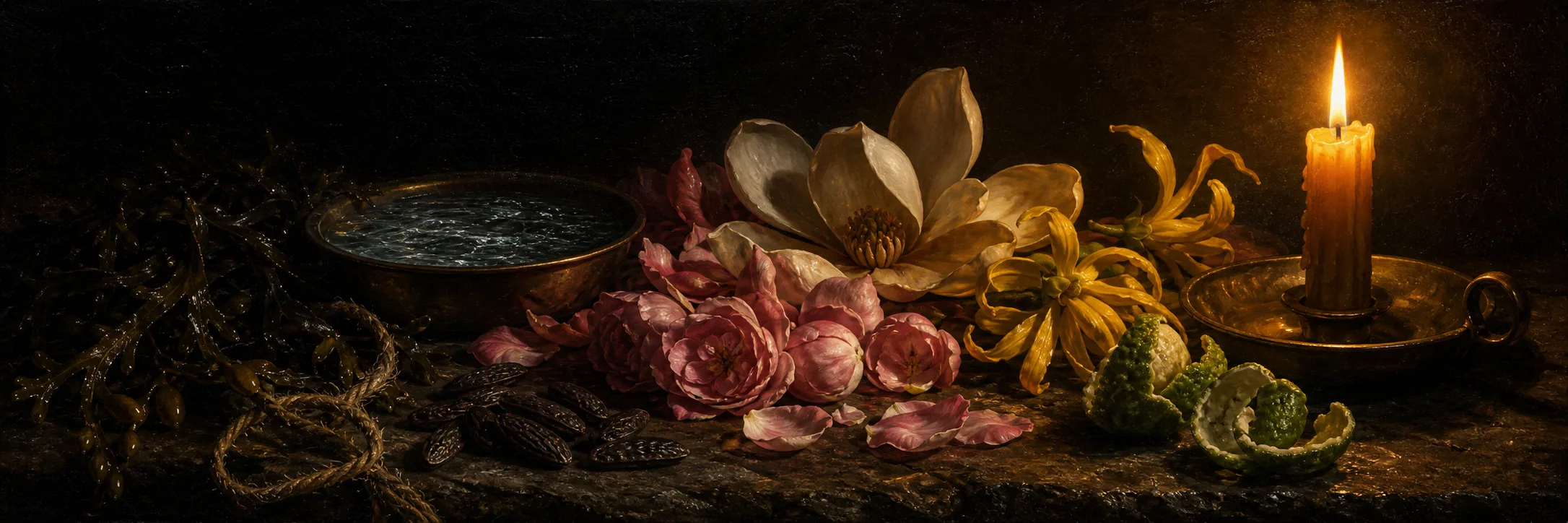
Eau de Biarritz is Comptoir Sud Pacifique’s attempt to bottle the Atlantic surf coast of France’s Basque country rather than the tropical lagoons the house usually chases. Where most CSP “Eaux de Voyage” evoke Polynesian coconut and vanilla warmth, Biarritz is a stranger, saltier proposition: an iodine-and-seaweed marine accord threaded through white florals - ylang-ylang, magnolia, rose - and finished with a warm, resinous benzoin-vanilla-sandalwood drydown. It belongs to a late-1990s “aquatic-floral-oriental” tradition almost no one attempts anymore, which is exactly what makes it distinctive: a beach scent with no sunscreen-coconut cliche, built instead on the briny reality of kelp washed up on cold sand.
Scent Profile
The opening is genuinely divisive and it is the crux of the fragrance: a strong, almost medicinal iodine note followed quickly by wet, brown seaweed. Wearers converge on this reading - a weird, strong iodine burst giving way to unmistakable algae - a signature marine accord that dominates the first phase. Underneath and around it, ylang-ylang and magnolia lend a soft, slightly indolic floral sweetness that keeps the composition from turning fully cold or synthetic, while rose stays quiet and mostly emerges later. As the marine intensity calms, the base takes over: warm benzoin becomes predominant for many wearers after a few hours, joined by a warm-not-heavy tonka-sandalwood glow and the abstract “hot sand” accord the house favors. It is a semi-linear fragrance, moving from marine-floral to warm-resinous, staying close to the skin and never turning thick or heavy. Salt, iodine, and benzoin persist throughout, while rose and vanilla stay in the background, felt more than announced.
Performance
Aggregate wearer sentiment rates longevity moderate-to-good and sillage soft-to-moderate, meaning it projects modestly before settling into a skin-scent that persists for several hours rather than filling a room. Some describe it as clingy in the best sense during the drydown - present up close without pushing outward. As an EDT, it behaves like a classic warm-weather EDT: it likes heat, which lifts both the iodine-marine opening and the benzoin base. Fans specifically praise how well it performs in genuine heat and how it avoids feeling cloying despite its sweet facets. This isn’t a room-filling powerhouse - it rewards close range and generous, deliberate application, including the house’s own suggestion to spray a scent cloud and walk through it to lightly scent clothing.
Wearing Context
This is best deployed in spring and summer, during the day, in warm or hot weather - a beach-day and vacation fragrance first and foremost. It suits casual coastal settings and relaxed daytime outings far better than the office or anything formal, working as an olfactory snapshot of the beach rather than a safe, blend-in scent. Its unusual iodine-marine character makes it more of a conversation piece than a crowd-pleaser, and despite feminine marketing, it reads to many wearers as more unisex and salty than conventionally pretty-feminine - some specifically feel it suits men just as well. It is not an evening or cold-weather pick, and its polarizing opening makes it a poor choice for scent-conservative environments.
Comparisons & DNA
The most important comparison, repeated constantly across reviews, is to Comptoir Sud Pacifique’s own Aqua Motu, originally launched as “Motu” in 1992-93. Longtime wearers see the two as close siblings within the same salty-iodine-immortelle marine family, and some specifically recommend Aqua Motu to anyone chasing the character Eau de Biarritz is believed to have lost through reformulation. One especially evocative account frames the pair as complementary landscapes: if Aqua Motu reads as a hot summer meadow, Biarritz is the tropical lagoon threaded with green vines and colorful blossoms. Outside the house, Biarritz sits in the broader late-1990s calone-driven marine-floral school, but reads warmer and more floral-resinous than most peers in that genre - wearers repeatedly note they’ve never encountered anything quite like it, and no clear designer clone exists.
Reception
Reception is polarized, with a small but genuinely devoted following. The central fault line is the iodine-and-seaweed opening: admirers value it as a distinct, sunscreen-free beach scent that earns compliments precisely because it avoids the usual coconut cliches; detractors find it harsh, soapy in the drydown, or worse. A second, sharper fault line concerns reformulation - the most emotional reactions come from longtime wearers who feel the current formula is a serious downgrade from the fragrance’s 1990s original, which they remember as a genuinely beautiful, feminine composition. The blind-buy verdict: this suits marine-curious buyers who already know they enjoy salty, iodine-forward accords; everyone else should sample first, since the opening is a real love-it-or-scrub-it gamble.
Versions & Reformulation
This is the single most important thing to know about Eau de Biarritz. It dates to 1995 and, according to multiple longtime wearers, has been reformulated over its roughly thirty-year life, with the current version widely considered a substantial downgrade from the 1990s original. The current EDT remains in production through the brand’s own boutiques and site. Note lists vary slightly between sources - some cite a fuller pyramid including tonka bean and magnolia in the heart, while the brand’s current copy trims it to bergamot-ylang-rose on top, seaweed-magnolia-tonka through the heart, and benzoin-sandalwood-vanilla in the base. It exists only as an EDT, with no flanker or higher concentration documented.
Acquisition Notes
This sits at accessible-niche pricing, in the mid-tier of the house’s overall range, and remains available directly through the brand’s own boutiques and e-shop, plus assorted stockists in Europe and the US. Decants and samples circulate through the usual channels. The main acquisition caveat is about version rather than authenticity: buyers specifically chasing the beloved vintage character should know the current formula is widely considered reformulated, and older bottles do surface on the secondary market for those seeking the earlier version.
Notable Facts & Lore
- Unlike the rest of the house’s catalog, themed around far-flung South Pacific and tropical destinations, Eau de Biarritz is named for a real, specific place: the famous surf beach of Biarritz on France’s Basque Atlantic coast.
- Its grounding in cold-Atlantic reality - iodine, brown algae, sea-spray, Basque villa hydrangeas - rather than warm-Pacific fantasy is the fragrance’s conceptual hook, and explains why it smells so different from its coconut-vanilla stablemates.
- Comptoir Sud Pacifique bills itself as a pioneer in niche perfumery since 1974 and one of the first French houses to explore oceanic scents, a lineage it traces to Aqua Motu’s 1993 introduction, placing Eau de Biarritz (1995) in the house’s earliest oceanic era.
- The perfumer of record for Eau de Biarritz is not publicly documented.