Crabtree & Evelyn — Azzemour
Essence
Azzemour is a softly spoken spicy oriental from the early 2000s, built less around spectacle than around warmth, texture, and refined restraint. It is not an Opium-scale bomb, and not a fruit-floral in oriental drag, but a floral-spice-amber scent that wears close and turns mossy and woody in the base. Perfume people remember it as one of those discontinued department-store oddities that turned out more characterful than its retail surroundings implied.
Scent Profile
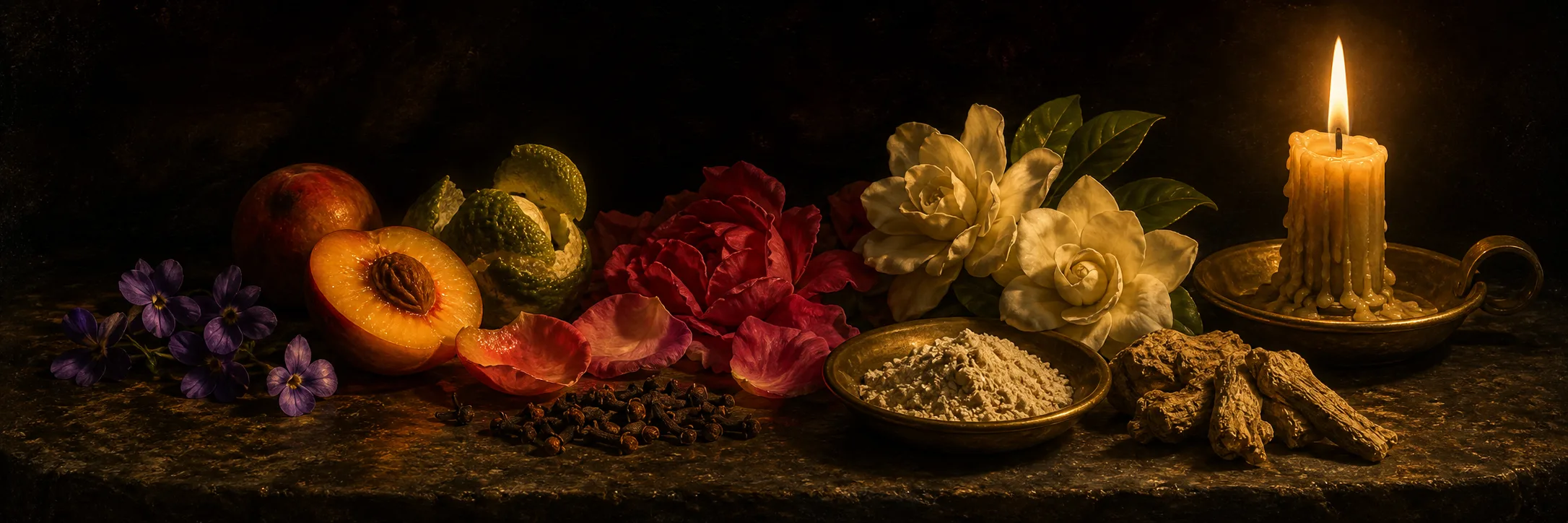
The opening is greener and stranger than the note list suggests: bright bergamot cut by violet into something close to warm fresh-cut grass, with nectarine softening the edges. Clove arrives quickly, and a brief sour cosmetic twist can flicker before the fragrance commits to its floral center. The heart is old-fashioned in a good way: a powdery, rosy, clove-tinted accord with gardenia and freesia adding creamy body, all of it slightly mossy. Moroccan rose and clove keep it dry and spiced rather than sweet, and one persistent facet reads as “lipsticky” — a cosmetic-powder quality that gives the middle its character. The drydown settles into sandalwood, musk, oakmoss, and amber, closing the scent down as a warm skin scent with orange-toned warmth underneath. The overall arc is a modest evolution rather than a dramatic one, and the base is where Azzemour does its best work.
Performance
Performance reads as moderate rather than powerful. Reports diverge: some find it lacks great sticking power and frame it as a gentle oriental, while others note that the amber-musk-sandalwood base clings strongly to clothes and hair. The most consistent reading is moderate projection with potentially better persistence on fabric than on skin — not a powerhouse, not a total ghost. A few extra sprays suit those who want it to register at arm’s length.
Wearing Context
This is a cooler-weather, intimate-use fragrance. The spicy floral amber profile, the skin-hugging behavior, and the gentler-oriental framing make it best for autumn, evening, dinner, or quietly dressed daytime wear rather than summer heat or loud nightlife. The social read skews mature and somewhat vintage, though it can also work as unisex on a confident man.
Comparisons & DNA
For orientation, a few useful anchors. Vintage Opium is the obvious family relation, but Azzemour is the choice when Opium feels too heady — softer, closer, less maximalist. Chanel Coco is the stronger pick if you want more impact and projection from the same broad genre. The lipsticky cosmetic-powder facet recalls Frederic Malle Lipstick Rose, sharing that rose-and-makeup texture. A harsher reading places it near an underdeveloped Mitsouko-or-Arabie direction. Taken together, the DNA is a lighter clove-rose-amber oriental with cosmetic-powder and mossy-woody undertones, rather than a full classic chypre or a full classic oriental.
Reception
Reception is positive but sparse, limited by how little of it survives. The praise centers on warmth, softness, unusual character, attractive bottle design, and oriental atmosphere delivered without overwhelming force. The criticisms are consistent: modest sillage, some linearity, and the sense that it is pleasant rather than groundbreaking. Because coverage is thin and the perfume is discontinued, it is not a blind-buy unless the buyer already knows they like softer, vintage-leaning orientals and is comfortable with scarcity.
Versions & Reformulation
The fragrance is clearly confirmed and is now discontinued. The concentration, however, is not stable across surviving sources: the catalog records it as EDP, while several references repeatedly call it an EDT, including a database submission and a review stating it was only available as an EdT. The identity is secure; treat the concentration as uncertain.
Acquisition Notes
Azzemour is discontinued and barely documented, so acquisition guidance stays conservative. There is no reliable data for current pricing, circulating bottle sizes, or batch decoding, and no official retail channel remains. The surviving record points to genuine scarcity — owners describe being glad to find a bottle and then worrying about ever sourcing another — which signals sporadic secondhand circulation rather than dependable availability.
Notable Facts & Lore
- Framed as Moroccan-inspired, named for the Moroccan coastal town of Azemmour.
- Remembered for ornate golden packaging — a sturdy bottle covered in golden curlicues described as “very Arabian indeed.”
- A discontinued Crabtree & Evelyn fragrance that outlived its retail life mainly in the memory of enthusiasts.
- Its decorative, North-African-inflected presentation is part of why it is recalled as more than a generic soft oriental.