Crabtree & Evelyn — Sarawak
Essence
Sarawak is Crabtree & Evelyn’s 2004 attempt at a “tropical Borneo” eau de toilette, named for and notionally inspired by the Malaysian state of Sarawak and its rainforest. In practice it is a light, zingy, barely-sweet cologne-style fragrance built around sparkling ginger, grapefruit and lemon citrus, and a green bamboo-and-rice backdrop, with the advertised ginseng and “rare orchid” largely conceptual. It is the kind of unpretentious, clean daytime scent C&E excelled at in its botanical-apothecary era, and it is remembered fondly precisely because it was discontinued and is now hard to replace.
Scent Profile
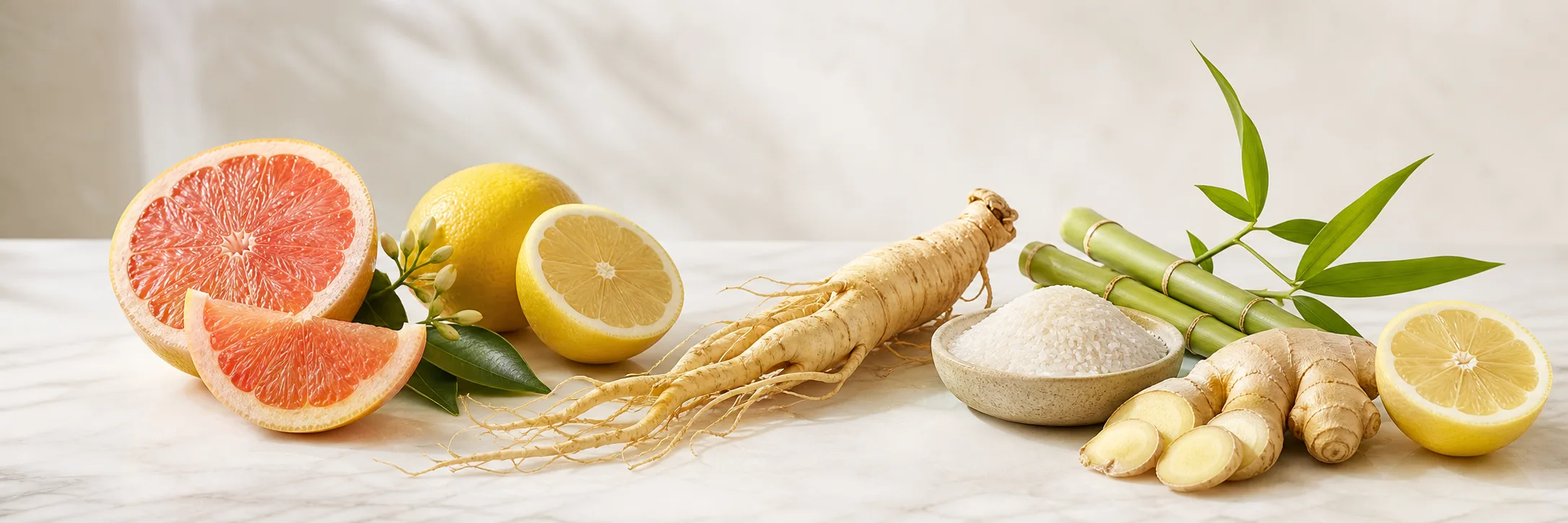
The opening is a gentle citrus blast — grapefruit and lemon, which some wearers read as lime — quickly joined by a soft, sparkling ginger that becomes the scent’s most distinctive and frequently-praised feature. The ginger here is dry and softly fizzing rather than the gingerale-sweet ginger of many spice scents. The heart and drydown turn green and clean. Bamboo provides a fresh, stemmy greenness while rice and rice-flower lend a soft, slightly milky-powdery smoothness. The much-advertised ginseng is essentially imperceptible, and the orchid in the base is similarly submerged; despite a “floral green” classification this is not really a floral. The arc is fairly linear: it opens fresh-spicy-green and settles into a mellow, clean, low-sweetness skin scent. The signature accord is grapefruit-ginger-bamboo — tart, green and refreshing.
Performance
This is a deliberately quiet fragrance, and its longevity and projection both run low. Several wearers describe it as so light that it rewards liberal, repeated application to register on skin, and one reports finishing a bottle in a few months for that reason. It performs best in heat, so it makes most sense as a warm-day and high-summer scent. A common tip is to layer it with the matching Sarawak body products to extend wear, a classic C&E strategy.
Wearing Context
This is a spring and summer scent for daytime and casual wear. Fresh, clean and leaning slightly feminine but easily unisex, it is office- and crowd-safe by virtue of its softness, and has worked well as a gift across ages. It is explicitly not a cold-weather fragrance — in winter it tends to fall flat. Think warm-weather errands, work, or a refreshing post-shower spritz rather than anything seductive or formal.
Comparisons & DNA
- Within its own house, Sarawak’s nearest relatives are C&E’s other clean botanical scents, which share its understated, nature-reproduction approach.
- Against the broader mid-2000s “spa fresh” green-aquatic idiom, it stands out as drier and more gingery than most of its peers.
- Versus typical aquatics it leans green-spicy-botanic rather than synthetic-marine; as one reviewer put it, “it’s not sharp ozonic like many aquatics.”
- No widely-cited one-to-one substitute exists, which is part of why its discontinuation is felt so keenly.
Reception
Sentiment is warm but wistful. Praise centers on the realistic, non-cloying ginger, the clean tart grapefruit, and the easy summer wearability. The recurring criticisms are weak performance and the missing ginseng note that the marketing promised. There is essentially no dispute about the quality or pleasantness of the scent itself; the only real axis of disagreement is strength. Coverage is thin, with no major perfume critic having reviewed it, though The Scented Salamander covered its 2004 launch. As value, it is judged reasonable for those who love light gingery citrus and accept that it is faint and now only available secondhand.
Versions & Reformulation
Single composition, with no known reformulations. The Sarawak name also spanned body butter, soaps and a home/room fragrance, but the eau de toilette itself was not reformulated before discontinuation.
Acquisition Notes
Sarawak is discontinued and increasingly scarce, now trading only on the secondhand market, where full bottles have ranged from the mid-double-digits up to roughly $288 for sealed examples. Ancillary Sarawak products (body butter, candles, room spray, soaps) also circulate secondhand and are likewise hard to find. A “type” recreation oil exists from a third-party reformulator, but it is a copy rather than original C&E juice and not an authenticity source. There is no notable counterfeit problem; the main risk is age and turned juice on old stock.
Notable Facts & Lore
- Sarawak launched in 2004 alongside Nadira, a Morocco-inspired sibling scent, as documented by The Scented Salamander.
- The house framed it as “inspired by the people of Malaysia and the tropical forest found in Sarawak.”
- Its advertised pyramid was grapefruit, lime and ginseng on top, wild ginger and rice flower in the heart, and bamboo and rare orchid in the base.
- Crabtree & Evelyn was American despite its English-apothecary image, founded by Cyrus Harvey in 1972 in Cambridge, Massachusetts.
- The brand was named for the 17th-century diarist-naturalist John Evelyn and the crabapple tree, and was known for headspace-captured botanical scents.
- Discontinuation amid the company’s repeated restructurings turned a modest summer cologne into a quietly mourned cult item.