Crabtree & Evelyn — Evelyn Rose
Essence
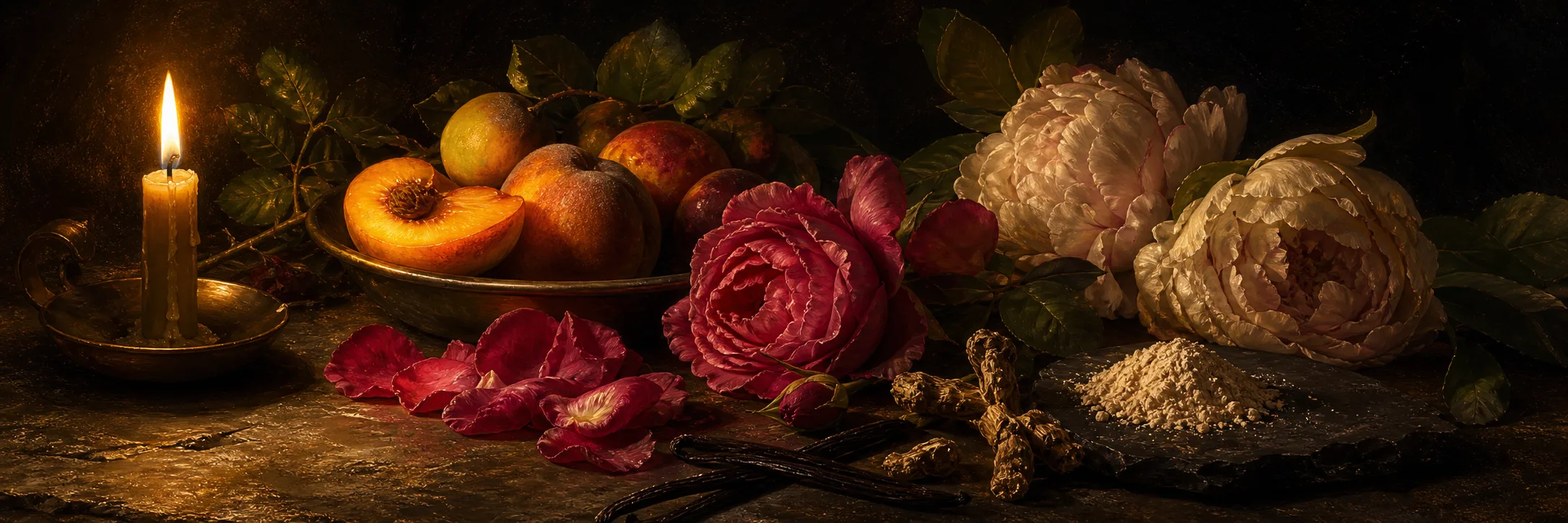
Evelyn Rose (2003) is the reformulated, renamed successor to Crabtree & Evelyn’s beloved 1993 fragrance Evelyn — a soft, English-style rose built around a real, purpose-bred bloom. The original was created in partnership with celebrated rosarian David Austin, who bred the apricot-pink “Evelyn” rose for the brand, and was composed by Daniel Molière of Mane using then-novel headspace technology to capture the living flower’s scent. The 2003 version is a peachy, green, powdery rose — pretty and demure rather than dramatic — and is now discontinued in this form, superseded by a much-changed modern “Evelyn Rose / Femme de Force.”
Scent Profile
The opening is a green, lightly citrusy freshness that some find pleasant and others read as ordinary, with a bergamot-orange top that does little to announce what follows. Within minutes it moves into the fragrance’s real subject: a soft, true rose paired with a well-matched peach note, the same peach-rose accord that animates classics like Lanvin’s Arpège and Lancôme’s Trésor. In the heart, the rose stays demure and close to the skin — “powdery, peachy, and rose-scented feminine goodness,” as one wearer puts it, comforting enough that “the fragrance just hugs you.” Peony and green facets keep it airy and garden-clean rather than jammy or dark. The drydown is deliberately modest: soft powder over a quiet base. Here version matters greatly. The original 1993 Evelyn was prized for a “marvelously enticing woodsy, musky” sandalwood drydown, which the 2003 reformulation muted and later versions removed entirely — so how much depth you smell depends heavily on which bottle is in hand.
Performance
Performance is modest and intimate, typical of Crabtree & Evelyn florals. The 2003 eau de toilette wears close to the skin with roughly three to four hours of longevity, while the earlier 1993 eau de parfum, with its sandalwood base, is remembered as lasting all day — a sign the older version simply performed better. Layering with the matching body lotion or shower gel meaningfully extends it. Expect a soft, close wear and reach for the layering products if you want more presence.
Wearing Context
This is a daytime, spring and warm-weather rose for someone who wants a soft, natural, non-projecting floral. It flexes across the day — gentle enough for casual afternoons yet pretty enough to read as a quiet evening rose at dinner — while staying demure throughout. It wears feminine, mature but not stuffy, and English-garden romantic. It is wrong for anyone wanting bold projection or a dark, dramatic rose, and right as a comfortable, pretty signature.
Comparisons & DNA
Within the rose-fruity-floral family it sits near Perfumer’s Workshop Tea Rose, sharing a citrus-bergamot-rose-amber spine, though Evelyn Rose comes across prettier, warmer and softer, where Tea Rose is bolder and more potent. Its peach-rose accord echoes Lanvin’s Arpège and Lancôme’s Trésor, but lighter and more close-wearing. Within Crabtree & Evelyn’s own range it is the harder-hitting rose against the softer Rosewater and Rainwater Rose. The original 1993 Evelyn stood further apart from typical rose soliflores thanks to its more pronounced woody-musky sandalwood drydown.
Reception
Reception is warm but small. Praise centers on the natural, soft peach-rose prettiness and nostalgic comfort, with the original 1993 Evelyn remembered as one of the finest roses in some wearers’ collections. The dominant complaint is reformulation decline: wearers track the 2003 rename, a further change around 2012, and a drastically different modern relaunch as Femme de Force, which one wearer pans as “brashy citrussy mature rose geranium … mature, stern, dry, tense,” with cheap-smelling ingredients, and which some liken to a floral industrial cleaner. The polarization axis is entirely vintage versus current. The verdict is to target the older clear-bottle versions rather than the modern Femme de Force; discontinuation makes sampling hard, but the profile is low-risk for rose fans who find an authentic older bottle.
Versions & Reformulation
The lineage is central to the identity. David Austin bred the “Evelyn” rose for Crabtree & Evelyn, introduced in 1991 (parentage Tamora crossed with a seedling), reportedly the product of eight years and 30,000 seedlings. The perfume launched as Evelyn EDT/EDP in 1993, composed by Daniel Molière using headspace technology, with a realistic peach-nuanced rose and a woody-musky sandalwood drydown. In 2003 it was reformulated and renamed Evelyn Rose, the subject here. A further reformulation appears around 2012, and the brand later relaunched the scent as the modern Evelyn Rose collection, Femme de Force — a deliberately woody, bold, deconstructed rose with citrus, frankincense, cassis, nutmeg, cashmere wood, vetiver, guaiac and musk, marketed against the “powdery floral” idea. For bottles: the 1993 and 2003 versions both used clear glass; later versions used a brown tin-style and then a matte-pink illustrated bottle.
Acquisition Notes
Discontinued in the 2003 form, with collector-driven and erratic pricing. Reports range from clearance finds at discount retailers (a few dollars for the modern Femme de Force, around twenty for a vintage clear bottle) up to inflated resale listings near three hundred dollars for a clear-bottle EDP. Common sizes were a 50 ml EDP and a 100 ml EDT, with matching body lotion, shower gel, soap and bath powder useful for layering. Authentication is by version and bottle rather than batch code: a clear bottle indicates 1993 or 2003, while a brown tin or matte-pink illustrated bottle indicates a later version. Identify which version you are buying before purchasing.
Notable Facts & Lore
- Crabtree & Evelyn commissioned David Austin to breed and name a rose, “Evelyn,” specifically for the fragrance and body range.
- The Evelyn rose is apricot-pink with a very strong fruity fragrance of peaches and apricots over Old Rose.
- The brand name nods to John Evelyn, the 17th-century English diarist and conservationist, source of its crab-apple-tree symbol.
- The 1993 fragrance was built using headspace technology, capturing scent molecules directly from the living bloom — a recurring point of pride.
- The modern Femme de Force relaunch reframed the same rose as “green stems and bark,” a deliberate break from the demure original that long-time fans largely resent.