Guerlain — Habit Rouge
Essence
Habit Rouge is widely considered the first true oriental perfume designed for men, created in 1965 by Jean-Paul Guerlain as a masculine counterpart to his grandfather Jacques’s 1925 Shalimar. The name refers to the red equestrian hunting jacket of French and English horsemen, and the perfume is a citrus-powdery-amber-leather composition that takes Shalimar’s bergamot-vanilla-leather DNA and reroutes it through rose, carnation, sandalwood and oakmoss into something built for a sixties male customer. Half a century on, it remains a touchstone of refined French masculine perfumery.
Scent Profile
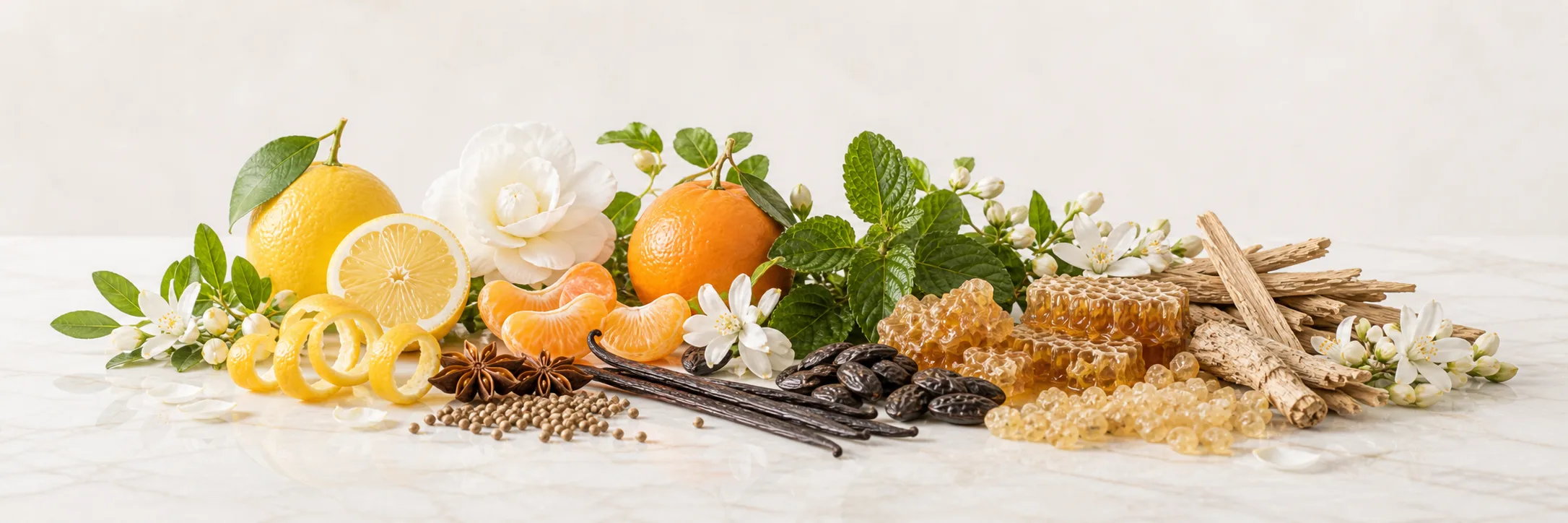
The opening, the first ten to twenty minutes, is one of perfumery’s great citrus blasts: a vivid lemon-bergamot-orange-tangerine-lime accord, structurally like a classical eau de cologne but laid over an immediately perceptible warm shadow. Brazilian rosewood and basil give the citrus an aromatic, slightly herbal texture and keep it from reading purely shampoo-fresh. The lemon dominates so emphatically at first that some describe it as lemon soda or even citronella, yet the vanilla-leather base is already perceptible underneath while the top is still bright.
The heart, from forty-five minutes to roughly three hours, is the most distinctive and most controversial phase: a rose-carnation-sandalwood floral-spice accord supported by cinnamon, jasmine, patchouli and cedar. The rose and carnation are openly powdery and dandified, almost a powdered-wig effect, and they are what cause younger wearers to call it old-fashioned on first sniff. Cinnamon and patchouli sit in the background as spice and earth rather than foreground.
The drydown, from three hours onward, is the payoff and a self-evident Guerlinade-leather oriental: vanilla, soft suede-and-hide leather, benzoin, amber, labdanum and oakmoss. The vanilla is dialed lower than Shalimar’s and the leather higher, while oakmoss adds a damp greenness now quieter than in older formulations. Persolaise has described this base as a papery dryness paired with a vanilla “so dandified, so feminine, and yet so very right.” It is famously long-lived.
Performance
Projection in the current EDT is moderate, about an arm’s length for the first hour and then close to the skin; this is not a beast-mode perfume. Longevity is solid for an EDT at six to nine hours on skin and twelve or more on clothing, sometimes substantially longer on wool. Behavior varies by formulation, with pre-2010 bottles projecting more than the post-2015 square-bottle version, though the latter still performs respectably. Hot humid weather can push the powdery-rose heart toward sharp or sour, while cold dry air is ideal. Three to five sprays across chest and forearms suit it, since the bright cologne-citrus opening burns off quickly.
Wearing Context
A four-season perfume by design: spring and autumn are canonical, summer works in lighter application, and winter is rich and excellent. It moves easily between day and evening, with a citrus opening bright enough for the office and a drydown sophisticated enough for formal nights. Best settings are business attire, dinner, daytime work and smart casual; it does not flatter sporty or athletic contexts. It skews older and traditional, read by younger wearers either as dressed-up elegance or as dated, and it carries a notable contingent of women who wear it as a unisex pick.
Comparisons & DNA
The single most important reference is Shalimar, of which Habit Rouge is the literal masculine counterpart: the same Guerlinade vocabulary, but with leather dialed up and vanilla dialed down, and the dominant iris swapped for rose-carnation-sandalwood-oakmoss. Mouchoir de Monsieur is the closer Guerlain masculine ancestor, sharing a lavender-civet-vanilla architecture with more animalic edge. Outside the house, Aramis 900 occupies overlapping rose-leather-oakmoss territory from a different angle, while Dior Eau Sauvage Parfum shares the citrus-amber masculine lineage at lighter weight. Within its own family, Rouge Privé (2023) is widely regarded as the standout modern flanker, a denser leather-and-iris reworking that bridges Habit Rouge and Shalimar.
Reception
Habit Rouge enjoys cult status among classic-perfume enthusiasts and Guerlain devotees, with consistently high regard. Persolaise has named the EDT one of the perfumes he would rescue from a burning house and called it as perfect as a scent could be, while Now Smell This, Colognoisseur and Bois de Jasmin have all treated it as a legitimate classic. Polarization runs on two axes: those who treat it as untouchable canon versus those who find the rose-powder heart dated or feminine, and veterans who prefer the oakmoss-rich pre-2010 formula versus those who accept the thinner modern one. Common praise covers its complexity, elegance, classical structure and long drydown; the recurring criticisms are the divisive heart, an old-church impression for some, and only moderate performance.
Versions & Reformulation
Habit Rouge launched in 1965 as an eau de cologne; the eau de toilette followed in 1988 with adjustments to projection and longevity. Major reformulations came around 2010, when IFRA oakmoss restrictions cut the base’s green-damp depth, and around 2015, when Guerlain moved its masculines into the square bottle and tightened the formula. The current square-bottle EDT is still recognizably Habit Rouge, if with a quieter oakmoss base and reduced real sandalwood. Alongside the EDT sit the denser EDP (2003), the discontinued L’Extrait (2008), and a substantial flanker line; the EDT remains the canonical reference.
Acquisition Notes
Designer-luxury tier, and widely distributed through Guerlain boutiques, the brand’s own site, and major department stores. As of 2025 to 2026 the 100 ml EDT runs roughly 130 to 170 dollars at full retail, with the 50 ml around 90 dollars and the EDP and flankers higher. Decant access is robust through the usual sample services. Counterfeits are a moderate concern, so verify the bottle shape, era-correct cap, and the digit-letter-digit-digit batch code against the bottle style when buying.
Notable Facts & Lore
- It is widely credited as the first true amber oriental composed specifically for men.
- The name evokes the scarlet equestrian hunting coat, and the bottle’s silhouette echoes a riding-crop handle.
- Jean-Paul Guerlain has called it his personal favorite and most-worn perfume, unusual for a perfumer of so many flagship women’s scents.
- Persolaise has written a decades-long love letter to it, including an account of returning to his bottle and feeling that he was home.
- It descends directly from Shalimar and in turn shaped Guerlain’s later masculines like Heritage and L’Instant pour Homme.
- It has remained a word-of-mouth perfume for sixty years, with no major viral moment.