Guerlain — Vetiver
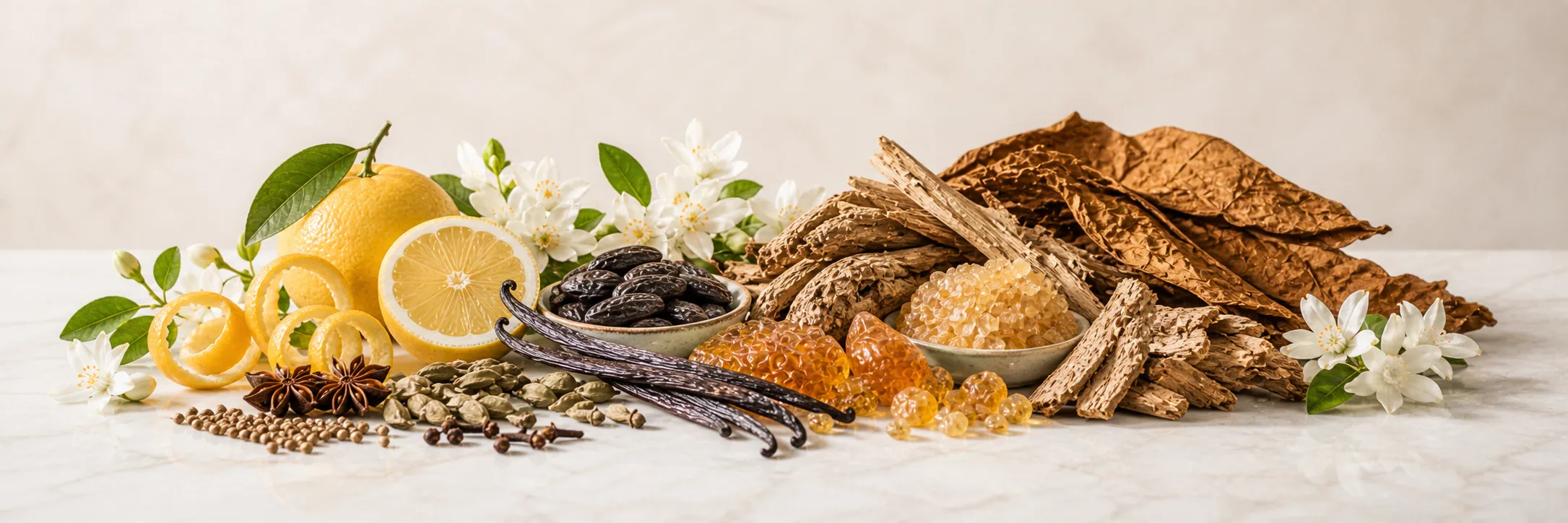
Essence
Guerlain Vetiver is the reference vetiver, the fragrance against which virtually every other vetiver is measured. Created by Jean-Paul Guerlain as his first solo composition and released around 1959 to 1961, it took the difficult, temperamental vetiver root and built a balanced, elegant abstraction around it rather than letting it dominate: bright citrus on top, the green-earthy-smoky root at the center, and a quietly warming base of tobacco, nutmeg and tonka. Its enduring idea is clean masculinity grounded in nature rather than chemistry — a barbershop-adjacent, soapy-green classic that reads like a gentleman in a crisp linen shirt.
Scent Profile
The opening is a bracing burst of citrus — bergamot, lemon, mandarin and neroli with a dusty buzz of coriander — that can read almost camphoraceous, even mentholated, in the very first minutes.
This quickly gives way to the heart, where green, grassy, slightly rooty vetiver takes the spotlight, supported by black pepper, nutmeg and a whisper of carnation. The signature accord is the green-bar-soap, barbershop cleanliness many wearers cite — a crisp, starched-linen freshness rather than a cheap soapiness.
In the drydown, tobacco emerges, more pronounced in older formulas, with cedar, oakmoss and tonka lending a dry, faintly sweet, woody warmth and the subtle “guerlinade” smoothness. The composition is widely called linear: it states its theme early and holds it, and it sits more smoky and earthy than the bright modern vetivers.
Performance
Longevity typically runs around six to eight hours on skin, with long-time wearers reporting all-day persistence and a pleasant scent bubble after the first couple of hours, and considerably longer wear on clothing. Projection is moderate, never a beast — persistent yet gentle, announcing itself softly. An important caveat is that post-2018 batches are widely reported as noticeably weaker, sometimes only a few hours, part of a broader sense that concentration was reduced. It performs well in summer heat yet is equally praised for fall. Application advice is restrained, roughly three to four sprays for the office and more for casual outdoors, since the natural materials are air-permeable and rarely cause headaches.
Wearing Context
Vetiver is a true four-season all-rounder that skews toward spring, summer and fall, day and office wear. It is repeatedly called the ultimate office fragrance — hygienic, professional, never boring or offensive — and works equally for casual weekends or evening. Its social read is mature, distinguished and self-assured rather than old, defended as age-appropriate by wearers in their thirties and forties even as they acknowledge it is not a sweet compliment-getter. Though nominally masculine, it has been worn by women for decades and reads as effectively unisex.
Comparisons & DNA
As the genre’s progenitor, most vetivers are positioned relative to it. On the clean, bright side sit Tom Ford Grey Vetiver, soapier and more modern, and Hermès Terre d’Hermès, flinty and mineral with an orange-peel bitterness. On the smoky, dark side sit Chanel Sycomore, dramatic and wood-varnished, and Lalique Encre Noire, ashy and melancholic. Frédéric Malle Vetiver Extraordinaire is the lush, amplified modern reinterpretation. The honest framing is that Guerlain sits squarely in the middle of the vetiver spectrum, defining the balance point — clean but earthy, refined but rugged — while Carven’s 1957 Vetiver holds the historical first-claim.
Reception
Vetiver is one of the most beloved and respected masculines in existence, near-universally called a reference, a benchmark, and the godfather of vetivers. Luca Turin names it the reference vetiver and awards it four stars in Perfumes: The Guide, even while his write-up is dismissive of the current formulation. Praise centers on impeccable balance, quality for the price, versatility and timelessness. The criticisms are consistent: some find it merely nice or too linear, certain batches of the bergamot top read as bug-spray, and the strongest recurring complaint is the weakening of recent reformulations. Some younger wearers find it dated or soapy. Polarization is mild, since even detractors concede its historical importance. It is widely endorsed as a safe, low-risk blind buy, with the caveat to seek older batches or the Parfum for more strength.
Versions & Reformulation
Vetiver has been extensively reformulated and repackaged across six decades. It launched at eau de cologne strength, was relaunched in 2000 with a new bottle and a more acid-green juice, saw a reported 2015 reformulation, and was repackaged in 2016 into the current green-cap square bottle. Reformulation is attributed both to IFRA restrictions and to decisions following the LVMH era. Numerous flankers exist, including Vétiver Extrême (2007), the feminized Vetiver pour Elle (2004, now rare), Aqua Allegoria Nerolia Vetiver, and a darker, smoky, licorice-tinged Vetiver Parfum by Delphine Jelk in 2024. Collectors prize pre-2000 and pre-reformulation bottles.
Acquisition Notes
Vetiver sits in the affordable-luxury tier and is repeatedly cited as one of the best value-for-quality masculines available, with full bottles often found well below typical Guerlain pricing, around $40 at discounters. Standard sizes are 1.7 oz and 3.4 oz EDT in the tall green-cap square bottle, and decants are widely available. Counterfeiting is low-risk. Guerlain’s letter-numeral batch codes can be decoded to date bottles, which matters mainly to vintage hunters seeking pre-reformulation juice.
Notable Facts & Lore
- It was reportedly inspired by Jean-Paul Guerlain’s memory of a gardener, fusing tobacco with the damp, tilled earth he worked in.
- It was Jean-Paul Guerlain’s first solo composition, reportedly created with the South American market in mind.
- It is romantically linked to Sean Connery’s James Bond era, though Connery reportedly wore Guerlain’s Jicky instead.
- Carven’s 1957 Vetiver holds the historical first-claim as the first vetiver-centered masculine.
- The launch year is genuinely ambiguous, with sources citing both 1959 and 1961, reflecting the cologne origin versus the later EDT relaunch.