Guerlain — Jicky Eau de Parfum
Essence
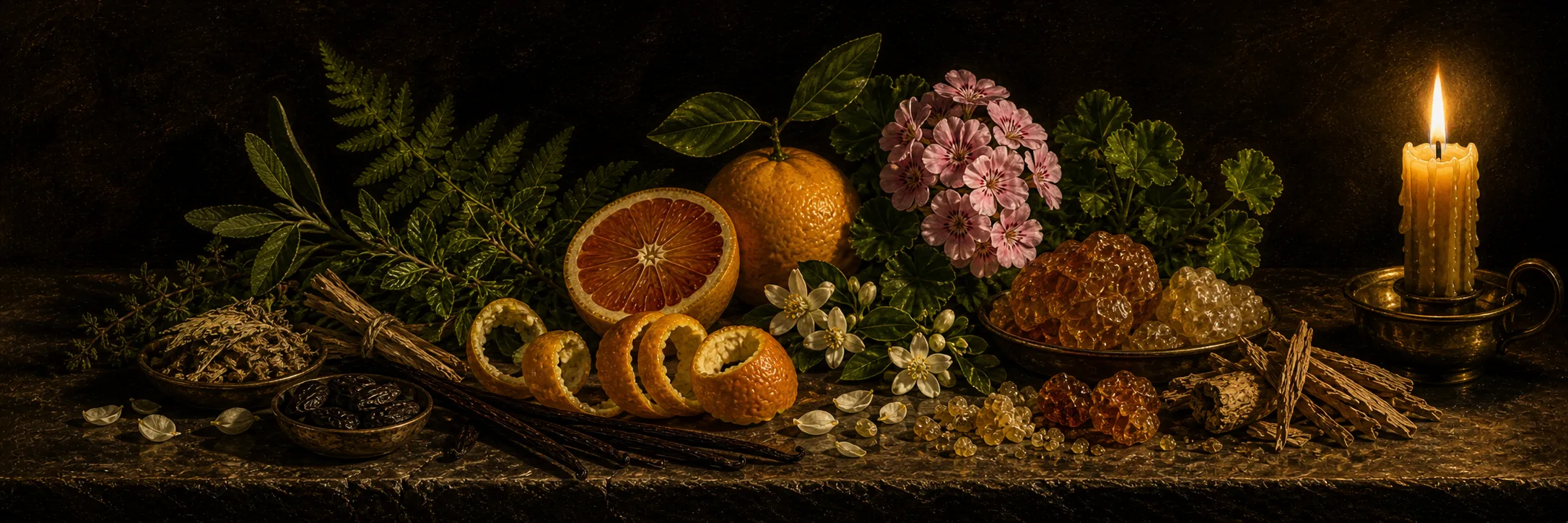
Jicky, composed by Aime Guerlain in 1889, is widely cited as the first modern perfume - the founding document of perfumery’s transition from soliflore reproduction to abstract emotional composition. It is the oldest continuously produced fragrance in the Western canon, the prototype oriental-fougere, and arguably the first deliberately unisex perfume. Built on a then-radical pairing of lavender and bergamot up top with vanilla (using newly available synthetic vanillin), coumarin, and a generous dose of civet, Jicky inaugurated the practice of using synthetic molecules alongside naturals to create scents that evoke mood rather than imitate flowers.
Scent Profile
The opening, for the first ten to twenty minutes, is a startling collision of a vivid herbal-citrus accord - lavender, bergamot, rosemary, lemon - against an unexpectedly dirty, milky, almost faecal undertone already detectable from spray one. The lavender is the dominant naturalist signal: cool, slightly camphorous, French-Provence-pristine. Bergamot supplies the brightness that Guerlain has always used as the entry to its orientals (Shalimar’s opening flows from the same source). Rosemary and the herbal undertone give it a barber-shop, almost aromatic-fougere crispness. Within seconds, however, the civet-coumarin-vanillin signal pushes through, and the dissonance - Take One Thing Off’s Claire Vukcevic calls it “a clash of citrus/aromatics with the creamy civet-tonka” - is Jicky’s defining trick. Some wearers describe a brief “baby vomit” indolic-bergamot note in the EDP first five minutes; this is a known characteristic.
Performance
EDP projection is moderate - closer than Shalimar in EDP, about an arm’s length for the first hour, then settling to a one-to-two-foot halo. Sillage is moderate. Longevity is good for the EDP: eight to twelve hours on skin, fifteen-plus on clothing. The EDT projects slightly more in the citrus opening but fades faster, with many wearers reporting two to four hours from it; the extrait wears closer to the skin still but with longer tenacity on cloth. Hot, humid weather amplifies the civet and the indolic bergamot, so Jicky can read overtly skanky in tropical heat; cool, dry air is its native environment. Best application in the EDP is two to three sprays on neck and inner arms, layered over unscented lotion if the civet feels too forward - it rewards restraint rather than overspraying.
Wearing Context
A cool-weather perfume by inclination, though wearable year-round in modest doses. Best in autumn, winter, and cool spring. Day or evening; the EDP is rich enough for evening and refined enough for daytime if applied lightly. Settings where it shines: literary, intellectual, cultural contexts - concerts, museums, dinner parties, fireside, slow walks.
Comparisons & DNA
Jicky’s closest house cousin is Mouchoir de Monsieur (Jacques Guerlain, 1904) - a more masculine, more lemon-pledge, more openly civet variation on the same themes; the shorthand is that Mouchoir is timid Jicky, or Jicky is bolder Mouchoir. Shalimar (1925) is Jicky’s direct descendant: Jacques Guerlain rebuilt the lavender-civet-vanilla architecture into the dense orange-bergamot-vanilla-leather oriental we know today, and Habit Rouge descends from the same lineage a generation further. Outside Guerlain, the genre-foundation reference is Houbigant Fougere Royale (1882), the first fragrance to use coumarin as a central note and the perfume Aime Guerlain studied before composing Jicky - together they established the modern oriental and fougere genres. In the later lavender-vanilla-animalic family, Caron Pour un Homme is the more polished, sweeter descendant, while Yves Saint Laurent Kouros pushes the animalic side much harder.
Reception
Jicky enjoys the unusual status of a perfume that is universally critically revered and personally divisive - its importance is near-universally agreed, yet a substantial minority cannot personally wear it. Luca Turin treats Jicky with reverence and remembers childhood Jicky as “raunchier, more curvaceous, less stately” than the modern version. Persolaise has reviewed both the modern extrait and the Osmotheque-reconstructed 1889 original, concluding “the spirit of Jicky is alive and thriving” in Thierry Wasser’s current formulations, and Claire Vukcevic at Take One Thing Off names the current EDP as the version that finally made the perfume click for her after years of struggle. The recurring praise is for its historical importance, its complexity, and the precise balance of clean herbs against dirty animalics. The recurring criticism is the screechy civet-lavender clash some find in the modern EDP, a quality that reads dated to some noses, and the loss of vintage sandalwood and animalics to reformulation. The single axis of polarization is civet tolerance: noses averse to faecal-skanky undertones simply will not wear it. It is a sample-first scent for the perfume-literate, not a blind buy.
Versions & Reformulation
Jicky has been continuously produced since 1889 - the longest unbroken run in modern perfumery - and has been reformulated repeatedly over its history, with concentration variants differing significantly. The vintage parfum/extrait (pre-1990s) is the gold standard: glowing real-Mysore sandalwood, denser civet, a leather facet from birch tar before IFRA restrictions, and a deeper Guerlinade base. The current Wasser-era extrait is smoother and denser than the EDP, with civet that stays close to the skin. The current EDP, part of the Les Legendaires reissue, is richer and longer-lasting than the EDT, more lavender-prominent and more linear. The EDT is the lightest and brightest, the most lavender-citrus-forward, with the weakest civet and shortest longevity. The post-2010 IFRA cycle is the watershed change - real civet is now synthetic and sandalwood is reduced - and the 2018-2021 modernization across the Les Legendaires line is generally viewed as respectful.
Acquisition Notes
Jicky sits in the designer-luxury tier - higher than mass designer, lower than niche exclusive. The current EDP runs roughly $170-230 for 100 ml at Guerlain boutiques and guerlain.com, around $130-160 for 50 ml, and the extrait about $300 and up for 30 ml; the EDT is widely available at department-store counters at lower prices. The Les Legendaires bee bottle is the current packaging. Decants are the recommended entry point because the EDP, EDT, and extrait differ enough that committing to a full bottle without comparison wears is a gamble. For vintage, packaging-era cues and the ten-year-cycle batch code help dating, and established dealers are safer than anonymous sellers.
Notable Facts & Lore
- Composed by Aime Guerlain in 1889, the year of the Paris Exposition and the Eiffel Tower’s completion, it is widely cited as the first modern perfume and one of the most important ever made.
- It drew on three then-new aromachemicals - synthetic vanillin, coumarin, and linalool - combined with bergamot, lavender, and civet to evoke a mood rather than imitate a flower; Smithsonian Magazine framed it as “the first perfume designed to stir emotions, rather than just recall flowers.”
- The name has two origin legends: a lost love Aime knew while studying in England, or, now considered more likely, the family nickname of his nephew Jacques Guerlain, future creator of Shalimar and L’Heure Bleue.
- Marketed to women in 1889, it met poor reception - period accounts say it “smelled like feet” to Victorian noses - was then adopted by men, and settled as arguably the first deliberately unisex fragrance.
- A persistent but undocumented piece of lore claims it was the signature scent of Sean Connery’s James Bond.
- The Osmotheque holds a reconstruction of the original 1889 formula; Jicky’s cultural life remains intellectual and slow rather than viral.