Guerlain — Shalimar Eau de Parfum
Essence
Shalimar is the textbook “first true oriental” - a 1925 Jacques Guerlain composition that took the lavender-civet skeleton of Guerlain’s own Jicky (1889) and detonated it with a massive overdose of ethylvanillin, producing the first vanilla-leather-bergamot trichord in fine fragrance. A century later it still defines the category: smoky, animalic, sweet without being edible, dressed in citrus at the top and tar at the bottom. Wearing it is less like wearing a perfume than wearing an opinion - about glamour, about femininity, about what perfume is supposed to do.
Scent Profile
The opening of the current EDP is a deliberate slap: bergamot and lemon used in conspicuous excess, sharp to the point of bitter, almost dirty. There is none of the candied citrus of modern releases - this is bergamot as solvent, as nail-polish-adjacent volatility, designed to clash with what follows. Within ten to twenty minutes the citrus calms and the iris-jasmine-rose heart begins to bridge the gap, but the heart is famously submerged: the florals operate as connective tissue rather than as a distinct movement, with iris adding a powdered, waxy carnality that pre-figures the leather.
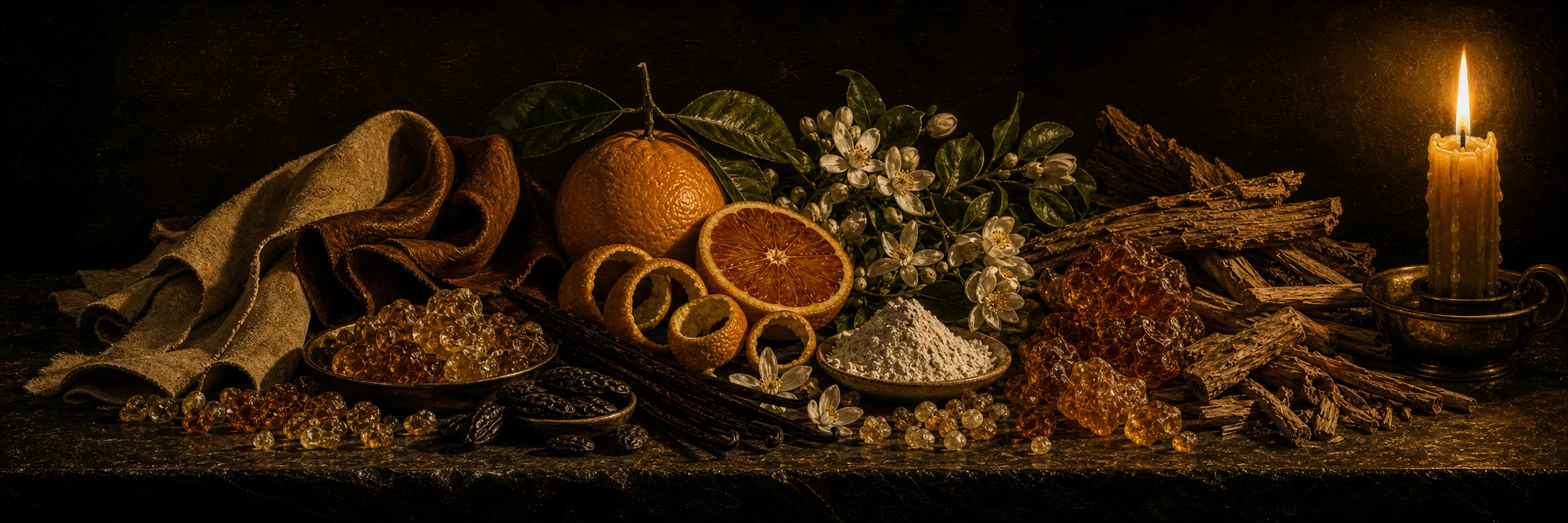
By the one-hour mark Shalimar reveals what it actually is: a vanilla-leather-incense base of unusual density. The vanilla here is not the milky vanilla of contemporary gourmands but ethylvanillin - drier, more resinous, with a smoky undertone that some wearers read as “burnt sugar” and others as Band-Aid. Around it sit opoponax, tonka, and a leather note that in the current EDP reads as smoky-rubbery rather than truly animalic.
The drydown is Shalimar’s secret weapon. Patchouli, sandalwood, and a sustained vanilla-incense duet slowly powder into something that smells like the inside of a velvet-lined antique compact. The signature accord is unambiguous: bergamot-vanilla-leather-incense, a four-cornered tension that no other mainstream feminine has ever quite replicated. Evolution is dramatic in the first ninety minutes, then largely linear.
Performance
Projection in the first hour is loud - a Shalimar wearer announces herself across a room - then it pulls in to roughly arm’s-length sillage and holds there for the duration. Longevity on skin is reliably eight to twelve hours from three sprays; on clothing and hair, the next morning. The EDP punches harder than the EDT, which leans powder-citrus, and is lighter than the modern extrait. Heat is its enemy in the opening, turning the bergamot acrid; cold, dry weather adds depth. Two sprays is plenty; three is for confident wearers. Apply to pulse points and walk away.
Wearing Context
Shalimar is an evening fragrance and a cold-weather fragrance, full stop. Autumn through late winter is its native habitat. Daytime office wear is risky; the leather-vanilla-smoke profile is too declarative for shared air. It is best at dinner, the theatre, formal evening events, or the deliberately retro register of a cocktail bar, and it shines on someone older than thirty. It falls flat anywhere freshness or modernity is the social currency: gyms, beach holidays, summer brunches.
Comparisons & DNA
Guerlain Habit Rouge (1965) is its direct masculine cousin - same DNA, more leather, less vanilla, citrus and powder where Shalimar has smoke; the two layer beautifully and are intentionally related. YSL Opium (1977) is the closest descendant in the oriental-vanilla family, taking Shalimar’s structure and adding clove and resinous spice for a denser, more aggressive reading. Coty Emeraude (1921) is the spiritual older sister Shalimar reportedly drew from - vintage Emeraude reads as Shalimar without the leather. On the vanilla-and-smoke axis, Tom Ford Tobacco Vanille (2007) sits in a similar register but skews modern-gourmand: sweeter, denser, less leathery, no animalic facet. Molinard’s Habanita (1921) is essentially a forgotten sister - same era and vanilla-leather backbone, more vetiver.
Reception
Shalimar’s status as canon is uncontested. Luca Turin praised it in Perfumes: The Guide (2008) and called it the “reference oriental,” describing it as “an intricate machine designed to project an olfactory effect remote in both time and space” and specifically crediting Guerlain’s raw materials - “Their vanilla absolute is sensational, their civet tincture is unique.” Victoria Frolova at Bois de Jasmin considers the modern EDP the best of the reformulations, “velvety and soft, a delight to be sure.”
Wider sentiment is more polarized. Praise centers on the composition’s structure and longevity; the dominant criticism is that the modern EDP is a shadow of the vintage parfum, with civet and oakmoss-adjacent depth lost to IFRA compliance. The recurring advice is consistent: this is not a blind buy, especially for anyone under thirty - sample first and wear it three times before forming an opinion.
Versions & Reformulation
The version history of Shalimar is the most complex of any fragrance still in production. The pure parfum, EDP (introduced in the 1990s in its current form), and EDT have always been distinct compositions, not concentration variants of a single formula: the EDP is the smokiest and most leather-forward, the EDT brighter and more citrus-and-powder-led, the EDC the lightest. Reformulation has been continuous since the 1980s - birch tar oil was removed over carcinogen concerns, oakmoss progressively restricted, civet now synthetic. The current post-2013 EDP is widely considered the floor of these changes but still recognizably Shalimar. Numerous flankers exist, including Shalimar Light, Parfum Initial, Souffle de Parfum, and the 2025 centennial Shourouk Rahiem limited edition.
Acquisition Notes
Pricing tier is mainstream luxury, not niche. The 90 ml EDP retails around $170 USD at department stores; 50 ml around $130; the 30 ml is the entry size. It is widely available at Sephora, Saks, Nordstrom, Macy’s, and Guerlain boutiques, with a robust decant ecosystem given its age and ubiquity. Counterfeit prevalence is moderate, so authenticate via the box-and-bottle batch code and glass quality.
Notable Facts & Lore
- The name and concept honour the Shalimar Gardens of Lahore and the Shah Jahan / Mumtaz Mahal love story that produced the Taj Mahal.
- Per Guerlain’s own LVMH-published account, the perfume was born when Jacques Guerlain poured ethylvanillin into a bottle of Jicky (1889); its structure clearly inherits Jicky’s lavender-civet-vanilla skeleton.
- The Baccarat-crafted bottle, designed by Raymond Guerlain and modeled on the basins of the Shalimar gardens, won the Decorative Arts Exhibition prize in 1925.
- The original 1925 formulation is preserved in the archives of the Osmotheque, donated by Jean-Paul Guerlain.
- As of 2017 it was Guerlain’s second best selling fragrance behind La Petite Robe Noire, with roughly 108 bottles sold every hour.
- Helmut Newton’s 1997 campaign and the 2013 Natalia Vodianova “Legend of Shalimar” film cemented its modern image.
- The 100th anniversary in 2025 brought the Shourouk Rahiem Metier d’Art limited edition of 58 numbered, hand-set crystal bottles.