Le Labo — Iris 39
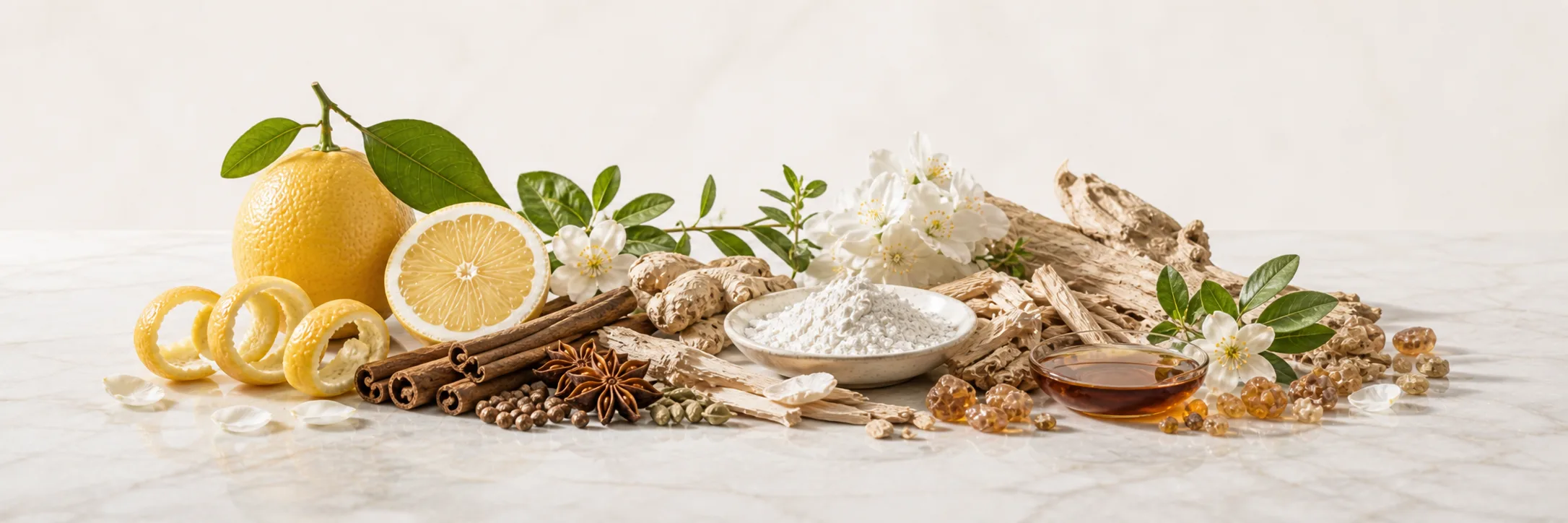
Essence
Iris 39 is Le Labo’s chypre-leaning take on iris, built less as a soliflore than as an angular, slightly chemical-feeling violet-iris-patchouli study laced with citrus-ginger sparkle and a low pulse of civet. Within the iris canon it sits well outside the Iris Silver Mist / Hiris / Iris Poudre axis: rooty without being cold, powdery without being makeup-like, and stubbornly unfeminine in cast. Frank Voelkl’s signature here is tension-a “good chemical” lift over wet-earth materials-which is why people who like it tend to love it and call it weird in the same breath.
Scent Profile
The opening is the loudest part of the perfume and the one most disconnected from the rest. Lime, ginger and cardamom arrive in a tight cluster-fizzy, slightly soapy, with a green edge that several wearers consistently flag as “wet hay,” “ozonic” or “papery.” The lime reads as zesty rather than juicy, and the ginger registers more as a dry rasp than a kitchen note. Underneath that fizz, violet is already pushing through; a recurring split in reviews is whether the perfume is more iris or more violet from the first spray. Katie Puckrik called it “a backwards echo of bread and violets,” which captures the slight yeasty quality the cardamom contributes. Civet is barely perceptible at this stage but already pre-warming the base. By the 30 - 90 minute mark the citrus and ginger have burnt off and the heart settles into its actual job: a cool, rooty iris pressed flat against a sweet, dusty violet, with a thread of ylang-ylang that is more textural than floral-it adds creaminess rather than tropical sweetness, and almost no one names it on a blind sniff.
Performance
Projection is moderate, settling close to the skin after about 90 minutes-roughly an arm’s length for the first hour, then a tight halo of 20 - 30 cm. Sillage is more interesting than the projection suggests because the iris-violet character is recognizable from across a room even when the cloud is small. On skin longevity runs 8 - 10 hours for most wearers, with a small minority reporting 12+ hours of the patchouli-civet base; on clothing and especially wool/cashmere it is genuinely tenacious, often noticeable into the next day. In heat the patchouli and civet amplify and can tip the fragrance toward skank; in cold the violet-iris core comes forward and the perfume reads more powdery, which is why most wearers prefer it in fall and cool spring.
Wearing Context
Iris 39 shines in cool, damp weather-gray fall days, rainy late-winter mornings, cool spring evenings-and falls flat in tropical summer heat where its earthy facets turn musty rather than mossy. It is a daytime fragrance more than a night one, and reads as introverted rather than sociable: it does not announce itself across a bar but holds its own in close conversation. Office wearability is moderate to good in temperate climates because of the close projection, but the civet drydown means it is not safe for fragrance-sensitive workplaces. Social-perception skew is interesting: despite the chypre-floral classification and the violet-iris heart, Iris 39 is read as ambiguously gendered or even slightly masculine by most who encounter it; it does not signal “perfume” in the conventional sense and tends to draw “what is that?” rather than “you smell nice.” Best with raw textures-wool, linen, denim, leather-and against minimal styling.
Comparisons & DNA
The conversation around Iris 39 is dominated by three reference points. Serge Lutens Iris Silver Mist is the closest cousin in the rooty-iris camp; Iris 39 is warmer, less metallic, less austere, and crucially does not turn “dirty hair” on the skins that betray Iris Silver Mist-a point Now Smell This made explicitly when calling 39 the more reliable wearer. Hermes Hiris is similar in trying to soften iris with greenness, but Hiris is cleaner, more carroty, and less complex; Iris 39 is the more textured, less polite version. Frederic Malle Iris Poudre is the opposite pole: opulent, aldehydic, lipstick-like and proudly feminine, where Iris 39 is dry, civic and unisex.
Reception
Critical reception was strong from launch. Bois de Jasmin’s 2006 review praised it as a reliable iris that “has never soured” on Frolova’s skin, contrasting it favorably with Iris Silver Mist and Hiris. Now Smell This’s Angela called it her go-to iris and one of the few that reliably translates across skin chemistries. Katie Puckrik (Smells) was more ambivalent, calling it “a little guarded” and preferring the dirtier Mon Numero 8 school, but explicitly recognized the perfume’s craft.
Versions & Reformulation
Iris 39 exists in three concentrations on Le Labo’s menu: the standard 50/100/500 ml Eau de Parfum, a 15 ml travel size of the same EDP, and a perfume oil (introduced 2012) that several wearers describe as warmer, less citrus-forward in the opening, and longer-lasting at the cost of sillage. A solid-perfume version is documented as discontinued. Distribution status has shifted: by 2023 - 2025 multiple reports indicated Iris 39 was being quietly pulled from full-line retail and held only behind the counter at Le Labo’s own boutiques as a kind of soft-discontinued item, with conflicting reports from store staff about whether it is being permanently retired. No reformulation has been publicly announced and side-by-side reports from buyers across batches do not flag a major recomposition since the post-Estee Lauder acquisition (2014); the perfume on shelf today smells materially the same as decants from 2010 - 2012, with the standard caveat that civet in any modern perfume is a synthetic reconstruction rather than animal sourced.
Acquisition Notes
Pricing sits in upper niche / lower luxury: as of 2025 roughly $98 for 15 ml, $235 for 50 ml, $340 for 100 ml, and approximately $1,100 for the 500 ml, with the perfume oil at the 30 ml size near $185. Le Labo does not discount and does not participate in Sephora-style sales, but some authorized department stores occasionally include Le Labo in sitewide gift-card promotions, and others carry the main line at full price.
Notable Facts & Lore
- One of the founding Le Labo perfumes launched in 2006 from the NoLIta lab, alongside Bergamote 22, Rose 31, Patchouli 24, and Vetiver 46.
- The number 39 refers to the count of ingredients in the formula, with iris the highest-proportioned material.
- Co-founders Fabrice Penot and Edouard Roschi say the names are concept names, not transparency labels - part of why Iris 39’s lore is built around the gap between expectation and experience.
- Perfumer Frank Voelkl later created Santal 33, and the woody-violet axis of Iris 39 is widely treated by critics as the structural ancestor of Santal 33’s sweet-woody-violet accord.
- It has no celebrity or viral moment of its own and is consistently named as “the underrated Le Labo.”
- One useful way to place it within the line is as the in-between of a clean white floral and a chypre furry floral - the triangulation a NoLIta associate reportedly used to lead a buyer to it after Jasmin 17 and Ylang 49.