Le Labo — Tonka 25
Essence
Tonka 25 is Le Labo’s late-2010s return to its signature naming trick: a perfume named for one note and built around an adjacent one. Despite the name, the lead material is dry Atlas cedar, wrapped in layered modern musks and softened underneath by tonka and vanilla. Co-founder Edouard Roschi described it as a fragrance built to make cedar “emerge over time,” with tonka as the partner that gives the wood a “dark and sensuous embrace.” It is the line’s most overtly cozy, skin-warm composition, and one of its most divisive.
Scent Profile
The opening is brief and easy to miss. For the first ten to fifteen minutes there is a clear orange blossom absolute on top - sweet, slightly indolic, fleetingly soapy - paired with a peppery, almost anise-adjacent spice that some wearers read as a “crayon-iris” effect. The Cafleurebon editor described “a hit of orange blossom and crayon smell of iris” that made the musks “stand out like a bas-relief.” The Candy Perfume Boy caught the same moment as “sharp and spicy. With citrus, spice and anise, it creates a sharp image of a forest.” Within twenty minutes that brightness burns off and the perfume’s real identity arrives.
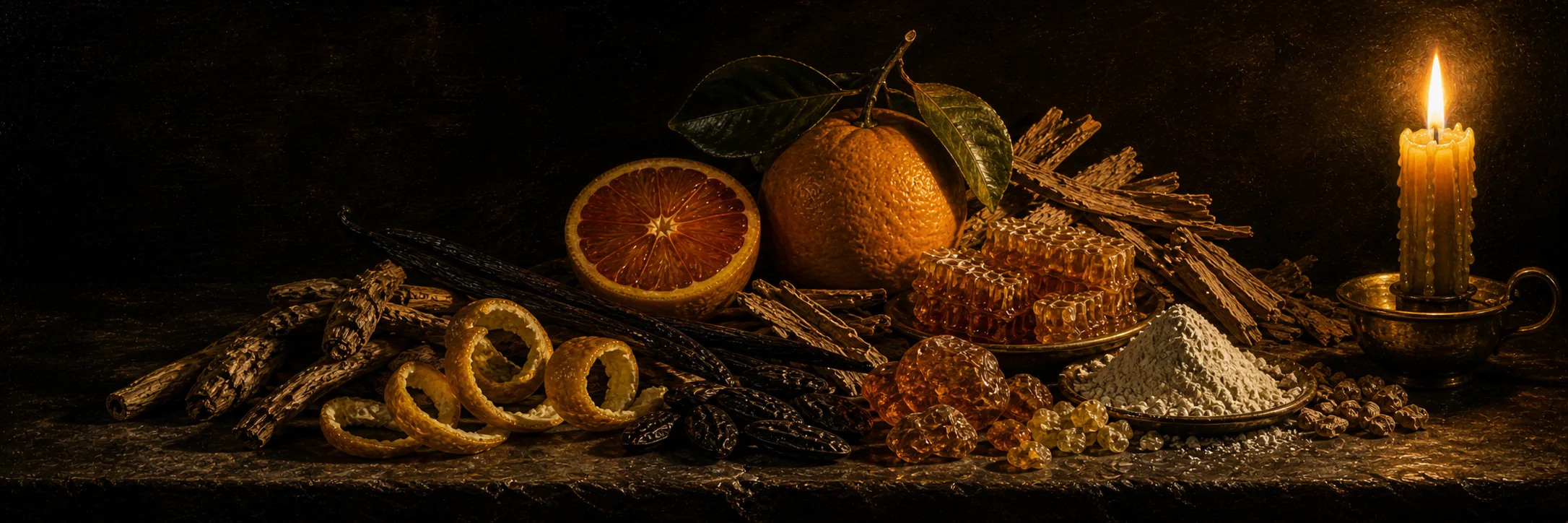
The heart, from about thirty minutes to three hours, is cedar and musk. The Atlas cedar is the dry, dusty, older-forest kind rather than freshly-shaved pencil - Cafleurebon called it “a darker, dryer, older smell of worn linen chests or old forests.” The musks are the most interesting part: several synthetic musks layered so that one reads detergent-clean and another reads sweatier and skin-like, the two alternating against each other. Tonka bean runs through the heart as a softener and sweetener rather than a gourmand lead - there is no almond pastry or dessert here. Orange blossom makes a short “creamsicle” return around the two-hour mark.
After three hours the drydown settles in: styrax and vanilla rise from the base, the cedar persists, and the musks turn sweeter and more enveloping. This is the most coherent and most skin-close phase, and it lasts a long time. The composition is moderately linear - once the cedar-musk accord locks in around the half-hour mark, it stays recognizably Tonka 25 until it fades.
Performance
Projection is moderate. In the first hour the fragrance carries to roughly a meter, then settles into a closer 30-40 cm halo. Sillage is moderate - recognizable but not aggressive. Longevity on skin runs 8-10 hours for most wearers, with the cedar-musk base outlasting everything; on clothing it can persist 24 hours or more. Heat amplifies the musk and can push it toward a sour or sweaty reading on some skins, while cold weather pulls the cedar and tonka forward and reads warmer and sweeter. Two to three sprays is the sweet spot - the modern musks give compound returns, so over-application tends to flatten the scent rather than boost it.
Wearing Context
This is a cool-weather fragrance: best in fall and winter, secondarily in cool spring, and least interesting in hot summer heat. It leans toward evening, late afternoon, and cozy indoor settings - sweaters and overcoats, dinner, fireplaces, casual-luxury occasions. It can read too intimate for a formal black-tie context and too close for some offices. On the wearer it skews mildly masculine in social perception, though it is comfortably worn across genders. Expect intimate, close-range compliments rather than across-the-room impact.
Comparisons & DNA
Within the house, Santal 33 is the most common internal reference: Tonka 25 shares its modern Ambroxan-musk backbone but is darker, less violet-creamy, and less of a universal compliment magnet. Another 13 is the closer cousin in structure - clean-laundry ambroxan-jasmine - where Tonka 25 is woodier and sweeter. Outside the line, Guerlain Tonka Imperiale is the famous tonka reference and almost an opposite: far more gourmand, almondy, and honeyed, where Tonka 25 is dry and woody. Tom Ford Fucking Fabulous occupies adjacent woody-sweet territory but is more leathery and aggressive. L’Occitane Eau de Cade is the cheapest plausible structural cousin - drier, less sweet, and a frequent decant comparison.
Reception
Reception is sharply split. Mark Behnke at Colognoisseur gave it one of the warmest reviews, praising perfumer Daphne Bugey’s layered-musks work as the technical achievement of the perfume and concluding that anyone who likes musks and cedar should have it on their list. The Candy Perfume Boy called it “great,” “androgynous and angular,” and easy to wear with anything. Kafkaesque was the loudest dissenter, dismissing it as “as dull as dishwater” and framing it as synthetic, Ambroxan-driven niche-by-numbers at a high price. Wearers consistently praise its comfort, cozy fall/winter character, long wear, and the way the musks layer; recurring criticisms are that it carries too little tonka and too much cedar, that the woody-amber base can read generic, and that some skins turn it sour or animalic. The most common practical verdict is to sample rather than blind-buy, because results vary unusually widely with skin chemistry.
Versions & Reformulation
Tonka 25 is offered as Eau de Parfum in 15, 50, 100, and 500 ml sizes, with a perfume oil version also produced. It is a single composition with no Extrait or Intense flanker and no known reformulations; decants from before and after launch smell consistent.
Acquisition Notes
Pricing sits in the upper-niche to lower-luxury tier and rose substantially after launch - the 100 ml moved from roughly $270 at the 2018 launch to around $340 by 2025, with the 15 ml near $98 and the 50 ml near $235. The brand’s refill program on the 15 ml bottle is the only structural discount. Buy from the brand’s own site, Le Labo boutiques, or authorized luxury retailers such as Nordstrom, Saks, Liberty, Selfridges, and Luckyscent. As a recent permanent-collection launch it is a more common counterfeit target than older line entries, so verifying the batch code and typewriter-style label is worthwhile.
Notable Facts & Lore
- Released October 15, 2018, as Le Labo’s seventeenth main-collection fragrance - its first widely distributed launch in three years, after The Noir 29 in 2015.
- It was the house’s first new permanent fragrance launched at scale under post-Estee Lauder ownership.
- The “25” in the name refers to the number of ingredients in the formula, following Le Labo’s note-count naming convention.
- Despite the name, Atlas cedar - not tonka - is the lead material; co-founder Edouard Roschi confirmed the cedar-first intent in launch press.
- Perfumer Daphne Bugey also co-created Le Labo’s debut palette with Rose 31 and Bergamote 22, making her return a deliberate continuity gesture.
- It is frequently discussed as a darker, less ubiquitous alternative for buyers tired of Santal 33.