Le Labo — Rose 31
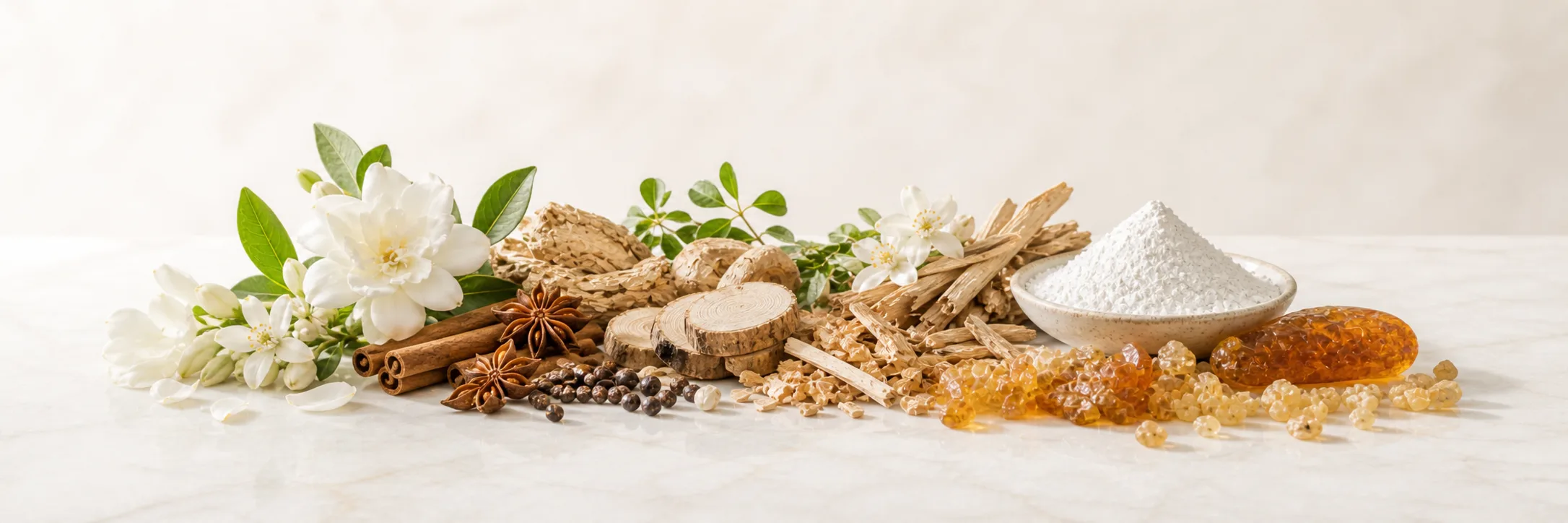
Essence
Rose 31 is the “anti-rose” rose: a Grasse rose smudged with cumin, dragged through cedar and oud, and finished with an animalic, smoky resin trail. Released in 2006 as part of Le Labo’s debut line, it deliberately strips rose of its bridal-sweet, soliflore associations and replaces them with something dusty, masculine-leaning, and unmistakably human. It is the fragrance that taught a generation of niche shoppers that “rose” did not have to mean “feminine” — and the one that Fairmont Hotels & Resorts eventually licensed as the signature scent of every lobby in its global chain.
Scent Profile
The first ten minutes are the polarizing minutes. The cumin is dosed loud — not as background warmth but as a foreground smell that reads, depending on nose and skin chemistry, as either toasted spice-market or unwashed skin. Around it sit black pepper, a caraway-like edge, and a Grasse rose that is more dewy and herbal than jammy. There is no fruit, no honey, no powder, and a hard cedar plank with a medicinal sliver of oud frames the flower.
Within twenty minutes the cumin recedes from foreground to skin-temperature warmth and the rose turns camphoraceous and gin-like rather than floral. The heart, lasting roughly one to three hours, is where the fragrance does its real work: a dry, smoky cedar-and-vetiver scaffolding holds the rose suspended over olibanum smoke, with patchouli adding an earthy depth and a woody-airy halo running underneath.
The drydown is the payoff and the part that hooks people: a quiet, ambery glow of labdanum, guaiac, musk, and a residual rose ghost. The earlier skankiness has burned off, leaving a warm-skin scent that reads as expensive and lived-in. The wear is mildly evolutive rather than linear, but the through-line is the cedar-frankincense-rose triangle that defines the entire middle and base.
Performance
Performance is moderate to strong on both axes, with the usual caveat that it varies a lot by skin. Projection is loud for the first hour as the cumin and pepper carry, then settles to an arm’s-length sillage for three to five hours and finally to a close skin scent that can last eight to ten hours on fabric. Longevity on cloth is exceptional — Rose 31 is one of the line’s better clingers. Two to three sprays on pulse points or a scarf collar is the sensible ceiling; oversprayers risk pushing the cumin into body-odor territory. Heat amplifies the cumin and flattens the rose, while cold, dry air lets the smoke and resins shine.
Wearing Context
This is best in shoulder seasons and cool weather, defensible year-round on cloth but punishing in summer humidity. It skews toward evening, dinner, and intimate company, working as a sophisticated date-night scent and a serviceable office scent when sprayed conservatively. It shines in candle-lit restaurants, gallery openings, and hotel-bar gatherings, and falls flat in open-plan offices, gyms, and summer weddings where proximity cannot be controlled. It reads more masculine than feminine in the Western market, but unisex is the accurate label — the structural goal was to neutralize rose’s gendered baggage.
Comparisons & DNA
Yves Saint Laurent M7 is the clearest predecessor: the original masculine oud-rose-cedar template, though it leans louder on oud and lacks the cumin signature. Frederic Malle Une Rose is the obvious peer, another rose-cumin pairing, but wetter and earthier — a rose-in-soil where Rose 31 is rose-in-smoke. Tauer L’Air du Desert Marocain shares the dry-spice-and-resin desert atmosphere while skipping the floral focus entirely. Acqua di Parma Rosa Nobile is the bright, transparent soliflore counterpoint that shows exactly what Rose 31 is reacting against. Aramis 900 is the herbal-masculine-rose grandparent that predicts the whole genre.
Reception
Reception is unusually polarized for a niche staple, and the cumin is the dividing line: roughly half of wearers describe a modern masterpiece of unisex rose-craft, and roughly half describe something closer to body odor or “rose deodorant over a spicy meal.” The love side reaches for “boozy,” “camphor-like,” and “intimate skin scent”; the dissenting side reaches for “armpit” and “scrub immediately.” It is widely treated as a benchmark sample-before-buying. Mark Behnke of Colognoisseur named it a “Modern Masterpiece” and called the opening like nothing else he had encountered; Robin Krug at Now Smell This noted the cumin did not, for once, read as sweat. Luca Turin was sharply dismissive, calling it “aldehydic carrot juice,” while Denyse Beaulieu treated it more sympathetically as part of Le Labo’s early experimental period.
Versions & Reformulation
Two concentrations exist: the canonical EDP and a Rose 31 Perfume Oil launched in 2012, which is softer, more linear, and substantially dials back the cumin. The EDP is what wearers mean when they say “Rose 31.” Le Labo also sells the scent across body lotion, shampoo, conditioner, and bar soap as the Fairmont in-room amenity line. No major reformulation of the EDP is publicly documented, though some wearers report a slight softening after the 2014 Estee Lauder acquisition.
Acquisition Notes
This sits at Le Labo’s standard niche price tier, around $99, $230, and $322 for the 15, 50, and 100 ml sizes, with a 500 ml decanter option from boutiques. Buy from Le Labo directly, its boutiques, or authorized retailers; the personalized handwritten label is applied in-store and is part of the experience. Counterfeiting is a moderate concern — far lower than for the house’s most famous scent, but real — so authenticate via cap-seal integrity and batch-code resolution through Le Labo when buying outside official channels.
Notable Facts & Lore
- The “31” refers to the number of ingredients in the composition, a naming convention shared across the Le Labo line.
- Fairmont Hotels & Resorts licensed Rose 31 as its global signature scent in 2011, diffusing it in lobbies and stocking it in room toiletries worldwide.
- For a generation of business travelers it became “the Fairmont smell” before they ever encountered it as a perfume on a person.
- That hospitality footprint, more than any celebrity endorsement, drove its early word-of-mouth.
- Penot and Roschi describe it as one of the line-defining originals of the 2006 launch, alongside Iris 39 and Patchouli 24.