Le Labo — Patchouli 24
Essence
Patchouli 24 is famously not a patchouli fragrance. It is a birch-tar leather smoke-bomb with a slick of dry vanilla underneath, and the named patchouli is essentially decorative — present in the formula but submerged beneath the much louder smell of cured meat, charred wood, and Russian-leather phenols. Released in 2006 as part of Le Labo’s original line and widely attributed to Annick Menardo, it reads as the spiritual sequel to her cult Bvlgari Black, pushed into a more extreme and uncomfortable register. Luca Turin gave it five stars and ranked it among the top ten orientals in his guide — extraordinary praise for a house he generally disdains.
Scent Profile
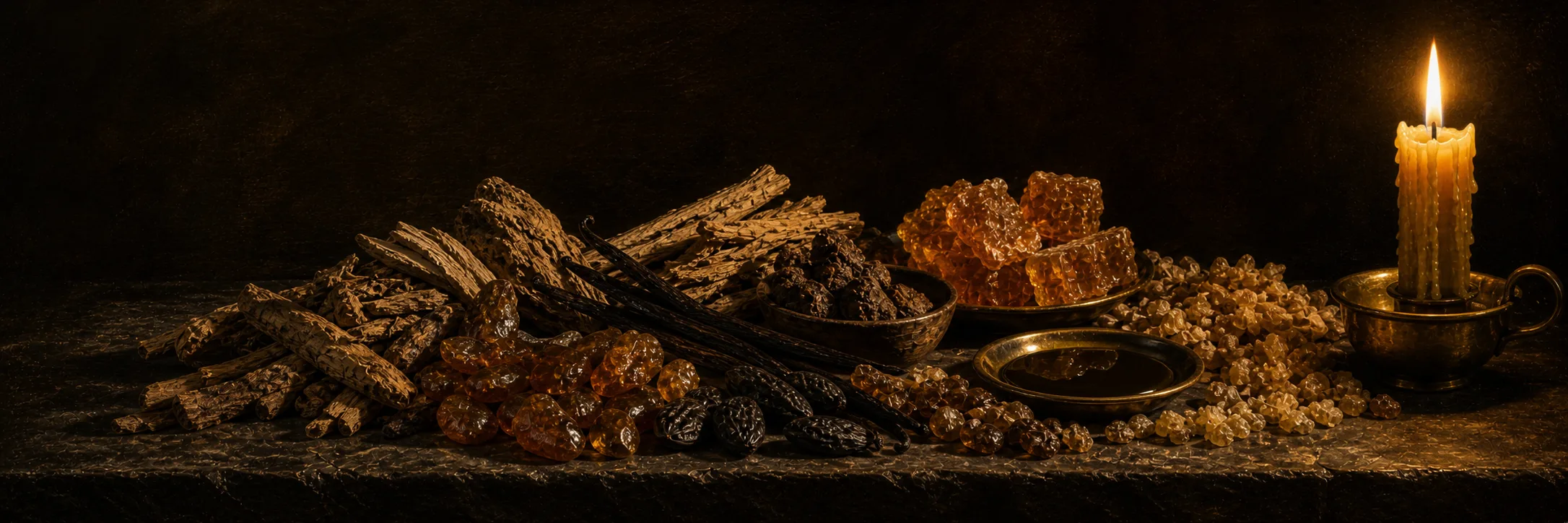
The opening hits like a struck match held over creosote. Birch tar is the dominant first impression: the smell of Russian-leather workshops, lapsang-souchong tea, and fresh asphalt on a hot day. Styrax piles smoky resin on top, and a phenolic, medicinal facet reads to many wearers as “Band-Aid,” “burnt rubber,” or “antiseptic hospital corridor.” Cade oil reinforces the smoke. The patchouli is barely audible underneath the firestorm.
By the thirty-minute mark the composition begins to relax. The smoke does not vanish but settles into a steadier billow, and the vanilla — a dry, ashen vanilla rather than a gourmand one — blooms underneath. The heart, lasting roughly one to three hours, is smoky vanilla over leathery birch, a hint of styrax-cinnamon, and a slowly surfacing earthy patchouli that finally announces itself before sinking again.
The drydown grows increasingly wearable: a warm, sweetened smoke in which the vanilla wins its duel with the birch tar but still wears the scars. By six hours in it has settled to a soft, lapsang-and-cured-meat skin scent, the kind wearers reach for words like “smoked-vanilla bacon,” “pit barbecue,” or “campfire and pipe tobacco at dusk” to describe. The signature accord is the birch-tar-over-dry-vanilla axis — leather smoke met by patisserie sugar — and it is genuinely unusual.
Performance
Strong on every metric. Projection in the first hour borders on aggressive; a few sprays will fill a small room. Longevity on skin runs roughly eight to ten hours, with the smoky tar phase clinging to clothing for days and sometimes surviving a wash. In cold dry air the smoke reads cleanly and the fragrance turns architectural; in heat and humidity the medicinal facets amplify and can tip toward burning rubber. Apply lightly — two sprays is plenty for most wearers — and consider keeping it off the collarbone if you dislike a hot leather note rising on body heat.
Wearing Context
This is a cold-weather, evening, indoors-leaning fragrance: fireside, library, and vinyl-bar territory, ideal for the early hours of November and out of place at a beach club. It excels in cool, low-light settings and falls flat in bright sunshine, where it reads as overwhelming and out of context. Social perception skews “weird and confident” — people who notice it tend to remember it, while those in tight quarters may object. It is not an office scent unless you sit alone, and it pairs better with denim and wool than with summer linen.
Comparisons & DNA
The unmistakable sibling is Bvlgari Black: the same smoky-vanillic DNA with rubber-tire latex and lapsang tea, but softer and rounder — Patchouli 24 plays as the extreme version of that idea. Memo Russian Leather is a polished, suede-driven cousin, where Patchouli 24 is rougher and tarrier. Tauer Lonestar Memories is the closest “campfire” reference point, a smoky leather with aromatic geranium. Comme des Garcons 2 Man and the broader CdG smoky-resin catalog occupy adjacent territory at a gentler volume. Histoires de Parfums 1740 Marquis de Sade shares the leather-and-burnt-sugar idea with more obvious civet.
Reception
Reception is polarizing but, among Le Labo releases, more critically respected than commercially popular. Wearers split sharply between treating it as a masterpiece and dismissing it as plastic smoke they cannot wear, and the dividing question is less “do you tolerate this note” than “is this a perfume or a chemistry demonstration?” Praise gathers around “the best leather smoke-bomb” and “patchouli done right despite not being patchouli”; criticism centers on a burning-tires impression and the charge that it is a novelty rather than a wearable scent. Named-critic reception runs warm: Luca Turin’s five-star verdict, Denyse Beaulieu calling Menardo “the closest thing we’ve got to Germaine Cellier nowadays,” and endorsements from Persolaise and Colognoisseur all frame it as a genre-defining smoky leather. It is not a blind buy, but the people who love it tend to love it on first sniff.
Versions & Reformulation
Le Labo announced one significant change to customers in November 2011, switching the cade-oil extraction from crude (non-rectified) to a cleaner rectified process. The house stated the only difference was the cade oil, that the new oil is cleaner in quality, and that the smell is “very very similar if not identical,” while the juice visibly shifted from deep amber to pale yellow. The prevailing view is that the post-2011 version is roughly 90 to 95 percent of the original, losing a little of the opening’s smokiness and intensity. A further softening is suspected after the 2014 Estee Lauder acquisition, but no official statement confirms it and those reports are anecdotal.
Acquisition Notes
This sits at Le Labo’s standard niche price tier, offered around $99, $230, and $322 for the 15, 50, and 100 ml sizes, with a large decanter format from select boutiques. Buy from Le Labo directly, its boutiques, or authorized retailers. Counterfeiting is far less of a problem here than for the house’s most famous scent, but it is worth being cautious about bottles priced well below retail. Because of the reformulation, juice color doubles as a rough date check: dark amber predates November 2011, pale yellow postdates it.
Notable Facts & Lore
- The “24” refers to the number of ingredients in the formula, though Le Labo notes they do not all appear on the published note list.
- Annick Menardo’s authorship is an open secret in niche perfumery despite Le Labo’s policy of not crediting perfumers on the label.
- Menardo’s wider catalog — Bvlgari Black, Dior Hypnotic Poison, Lolita Lempicka, Bois d’Argent — established the smoky-anisic-vanillic grammar that Patchouli 24 pushes to its extreme.
- Luca Turin ranked it among the top ten orientals in his guide, a rare distinction for a Le Labo.
- It is widely read as the connoisseur’s antidote to the house’s ubiquitous Santal 33.