Le Labo — Labdanum 18
Essence
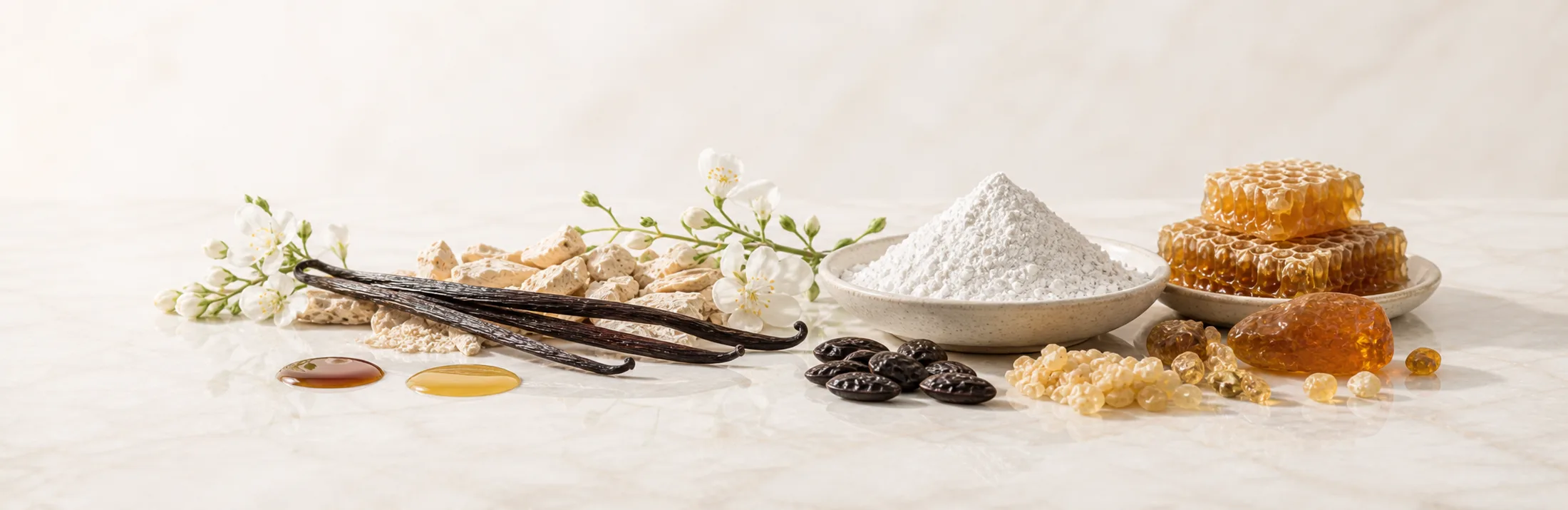
Labdanum 18 is Le Labo’s powdery animalic amber: a warm, vanillic, faintly civety skin scent built around a soft amber-musk-castoreum trio with a powder-cosmetic feel. Despite the name, labdanum is not the loud headline note-the resin is folded into a creamy, slightly sweet base that most wearers compare directly to Frederic Malle’s Musc Ravageur, which makes sense because the working consensus among critics is that the same perfumer (Maurice Roucel) reworked a similar template here. It is one of Le Labo’s most close-to-skin, conventionally “sexy” propositions and one of its most polarizing among iris-civet purists.
Scent Profile
The opening is short and indistinct compared to most niche launches. The labdanum announces itself for maybe five to ten minutes as a faintly resinous, very slightly herbal warmth, with a glimmer of what reads as cinnamon or a sweet-spice murmur (one wearer described it as “citrusy and creamy like a lime soda float,” which seems off but tracks if you read the brightness as cistus’s own naturally citric edge). Within fifteen minutes the resin recedes, and what most wearers actually perceive-and what reviews are nearly unanimous about-is a powdery vanilla-amber accord that has very little to do with raw labdanum and a great deal to do with cosmetic-counter warmth. Castoreum and civet are listed in the base, but the animalic character here is dialed down: not the urinous skank of vintage Shalimar parfum, not the leathery fur of L’Ombre Fauve, but a quiet biological hum sitting beneath the powder. The heart, from roughly thirty minutes to three hours, is the perfume’s most coherent phase and the one most often described. Vanilla and amber come forward together, lightly dusted with what nearly every wearer calls “baby powder” - a comparison so common that it functions as the perfume’s signature.
Performance
Projection is light. For the first hour Labdanum 18 can be sensed at conversational distance (about 30 - 45 cm), and after that it settles to a true skin scent at about 10 cm. Sillage is correspondingly modest-this is not a perfume that fills a room. Longevity on skin runs 7 - 10 hours, with the powdery vanilla base outlasting everything else; on clothing, particularly wool and cashmere, it can persist past 24 hours and is one of the longer-staying powdery ambers in this style.
Wearing Context
Best in cold weather: late autumn, winter, the cold edges of spring. It can be worn in summer but loses much of its character to heat, and against air conditioning it tends to read powdery and flat. Time of day: evening more than morning, dinner more than office, with a strong slant toward bed/lounge wear and intimate contexts-it is genuinely a “smell yourself” perfume rather than a projector. Social-perception skew is decidedly feminine to most noses despite Le Labo’s official unisex framing; multiple wearers describe a self-conscious “feels like an old woman’s makeup” reaction on men, which is consistent with the powdery vanilla amber being read in Western markets as a women’s cosmetic register.
Comparisons & DNA
The single dominant comparison, repeated by nearly every critic and aggregator, is Frederic Malle Musc Ravageur (Maurice Roucel, 2000). Labdanum 18 is the quieter, more powdered, less spice-driven cousin: same amber-vanilla-musk core, less cinnamon, less lavender, less of the carnal swagger. Take One Thing Off was particularly cutting on this point, calling Labdanum 18 a “defanged” Musc Ravageur and noting that “Shalimar has more underpantsy funk than this.” Helmut Lang EDP (Roucel again, 2000) is the third point of the triangle-drier, more bubblegum-heliotrope-doll’s-head, less ambery; Labdanum 18 sits between Musc Ravageur and Helmut Lang in temperature. Guerlain Shalimar EDP is the obvious classical reference, but Shalimar is louder, smokier and more obviously vanillic-bergamot, where Labdanum 18 is closer to skin and more powder than perfume.
Reception
Critical reception was lukewarm-to-favorable but consistently shadowed by the Musc Ravageur comparison. Take One Thing Off was the harshest serious review: “the trouble is, of course, that Le Labo Labdanum 18 can only cower in the shadow of its more outgoing big brother, Musc Ravageur, and its more distinctive, characterful little sister, Helmut Lang EDP.” Olfactoria’s Travels was the warmest, treating it as a genuinely sensual skin scent and a serious member of the powdery-animalic-musk family. Now Smell This folded it into a comparison set rather than treating it as a standalone highlight. There is no Luca Turin entry for it in Perfumes: The A-Z Guide.
Versions & Reformulation
Labdanum 18 was originally released in 2006 under the name Ciste 18 (ciste being the French for cistus, the plant from which labdanum is derived); it was renamed Labdanum 18 within a few years and the two names refer to the same juice. A perfume oil version was added in 2012; multiple wearers report it is denser, warmer, less green at the top, and lasts even longer than the spray, while projecting less. There is no widely documented major reformulation post-Estee Lauder acquisition in 2014, though a subset of wearers from 2020 onward note the animalic facets seem less pronounced than in 2008 - 2012 decants, consistent with broader IFRA restrictions on civet substitutes and certain musks rather than a targeted recomposition. Concentration is EDP only at standard spray sizes; there is no Parfum/Extrait variant.
Acquisition Notes
Pricing is upper niche: roughly $98 for 15 ml, $235 for 50 ml, $340 for 100 ml as of 2025, with the 500 ml around $1,100 and the 30 ml perfume oil near $185. As with all Le Labo, no discounts at house-owned points of sale; authorized department stores gift-card events occasionally apply.
Notable Facts & Lore
- Originally released in 2006 as Ciste 18 (ciste is French for cistus, the plant labdanum comes from), then renamed Labdanum 18 to fit the house’s marquee-ingredient naming.
- The perfumer is widely attributed to Maurice Roucel, though Le Labo does not consistently publicize perfumers, so a strict reading leaves it unattributed.
- Much of the lore concerns Roucel’s relationship to his own Musc Ravageur (2000) and Helmut Lang EDP (2000).
- A persistent critical claim, never confirmed by Roucel, holds that Labdanum 18 is the third leg of a single accord he sold to three different houses; the Take One Thing Off review pressed this hardest.
- Le Labo’s own marketing leans into an “enigma” framing, describing it as a perfume that “doesn’t conform to any of the laws of perfumery.”
- It is frequently cited in lists of “Le Labos that smell nothing like their name.”