Le Labo — Santal 33
Essence
Santal 33 is the most influential niche fragrance of the 2010s. Composed by Frank Voelkl of Firmenich and released in 2011, it is built on Australian sandalwood, cedar, leather, ambroxan, and iso E Super, and it effectively created a new genre of woody-musky unisex perfume. It sold itself by word-of-mouth into a cultural ubiquity no other niche scent has matched and spawned a clone industry that now dwarfs the original — a 2015 New York Times piece called it “the most ubiquitous scent in fashion.” Voelkl has described it as his “masterpiece on ‘perfect imperfection.’”
Scent Profile
The first ten to fifteen minutes are sharper and stranger than the reputation suggests. Cardamom and violet leaf open with a green, slightly metallic crackle that hits roughly a third of wearers as a “dill pickle” or “vinegary cucumber” note — the famous Santal 33 pickle problem, traceable to the violet-leaf-and-cardamom interaction over a synthetic sandalwood. Iris adds a powdery smoothness, dry cedar shavings brush through, and a wisp of papyrus gives a paper-dry quality.
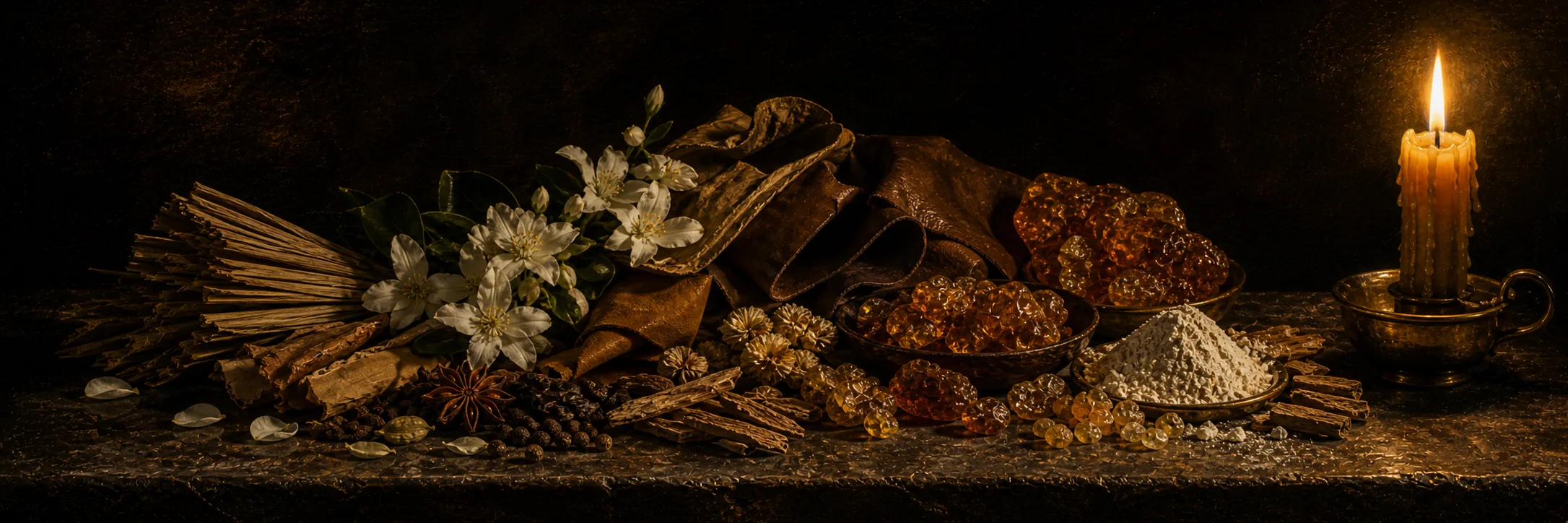
By the half-hour mark the heart reveals what made it a phenomenon: a creamy, slightly smoky Australian-sandalwood-and-Virginia-cedar accord lifted by leather and ambroxan. This is not the milky Mysore sandalwood of vintage perfumery, which is functionally extinct, but a drier, smokier, more medicinal register augmented by modern sandalwood molecules. Voelkl leaned deliberately into those dry-smoky-leathery facets rather than faking a creamy Mysore. The leather reads as soft suede rather than tar, and the ambroxan supplies the warm-skin halo and radiant projection.
From three hours on, the drydown becomes “the Santal 33 smell” of cultural memory: a comforting, slightly powdery, slightly smoky woody-musk with a soft leather glow and a halo you can smell a meter away but cannot quite locate. The wear is more linear than evolving, with the cedar-sandalwood-leather-ambrox quartet dominating from forty minutes onward. The pickle facet is real for some wearers and entirely absent for others, depending on skin chemistry.
Performance
Performance is excellent. Sillage runs strong for the first two hours, projecting roughly half a room, then stays noticeable at arm’s length for four to six hours, with eight-to-ten-hour skin presence and clothing persistence well beyond a day. Iso E Super and ambroxan push the diffusive halo, and heat tends to amplify rather than wilt it. The practical caution is restraint: two to three sprays is the ceiling, because Santal 33 is famous for being over-sprayed, and oversprayers fueled its New York subway backlash.
Wearing Context
This is as close to a universal-wear fragrance as niche gets — year-round, all-day, all-occasion. It excels in office, casual, date, and travel contexts, where the unisex, inoffensive woodsy-musky character suits nearly every adult setting. It falls flat in only two: when the wearer is bothered by smelling like everyone else at the bar, and at very formal black-tie events where a classical chypre or oriental reads as more dressed. Its social reading has cycled from “in the know” in the early 2010s to “basic” mid-decade to a settled “well-dressed default” by the mid-2020s.
Comparisons & DNA
Diptyque Tam Dao is the obvious creamy-sandalwood predecessor and the gentler, wood-only sibling. Maison Louis Marie No. 04 Bois de Balincourt is the most-recommended affordable adjacent — woody and smoky, more rugged, with less ambroxan. Comme des Garcons Wonderwood shares the dry-cedar-iso-E-Super axis. Glossier You, which Voelkl co-created, is the lighter, more skin-scent descendant built partly out of Santal 33’s lessons about iso-E-Super halos. D.S. & Durga Radio Bombay is the more eccentric, peppered-coconut-sandalwood take on the same wood.
Reception
Santal 33 is the most-reviewed niche fragrance on the internet and one of the most polarizing, splitting along a love-versus-ubiquity-fatigue axis. Praise centers on its uniqueness, diffusion, and compliment-magnet reputation; criticism centers on the pickle facet, the sheer everywhere-ness, and the sense that it is overpriced ambroxan and cedar. Named-critic reception was mixed early and warmed over time: Victoria Frolova was lukewarm in 2011, hearing “a clear masculine ring”; Persolaise called it “one of the most impressive releases” of that year and “an absolute must-try” while wondering whether it was merely very good or outstanding; Kafkaesque found it “vaguely enjoyable” as a clean creamy wood. Industry figures, by contrast, have called it the icon fragrance of a generation. It is the safest blind buy in the Le Labo catalog, with the caveat that the pickle facet is a real risk for sensitive noses.
Versions & Reformulation
Santal 33 is a single core composition with no public reformulation. Some wearers claim post-2014 bottles smell softer, but no Le Labo statement supports this and the consensus is that the formula has stayed stable, at a consistent EDP across all sizes. The scent also appears across body lotion, shampoo, conditioner, a room spray, and a related candle (Santal 26, a different but adjacent formula), all of which are weaker, more linear interpretations of the EDP.
Acquisition Notes
This sits at Le Labo’s standard niche price tier, around $99, $230, and $322 for the 15, 50, and 100 ml sizes, with a large flagon format from boutiques. Costco became an authorized US retailer in 2022, the one mass channel reliably below MSRP. Buy from Le Labo, its boutiques, or authorized retailers. Counterfeiting is unusually high here — Santal 33 is the single most-counterfeited niche fragrance in the world — so authenticate via cap-seal integrity, batch-code verification, and box-barcode resolution, and treat far-below-retail bottles as suspect.
Notable Facts & Lore
- Voelkl’s stated intent was a Marlboro-Man reverie: a man and his horse before a fire on a great plain under tall blue skies.
- The launch grew out of a sandalwood idea cut from Le Labo’s 2006 line, first sold as the Santal 26 candle and a room spray before becoming the 2011 EDP.
- Penot reportedly greenlit the perfume after smelling a man in a bar wearing the room spray and asking what it was.
- Emily Weiss’s love of it led directly to her commissioning Voelkl for Glossier You.
- Estee Lauder acquired Le Labo in 2014, the watershed that pushed Santal 33 from cult status to the mainstream and triggered the dupe explosion.