Ormonde Jayne — Formosa
Essence
Formosa is a tea-and-osmanthus EDP built as a love letter to Taiwan, released in 2022 as a Taiwan-exclusive within Ormonde Jayne’s “Four Corners of the Earth” collection in partnership with the Taipei retailer Noseway (Nose Way). Created by founder Linda Pilkington with perfumer Celine Ripert, it is a fresh-green tea fragrance that wraps a serene osmanthus-scented green tea accord in citrus effervescence and a soft woody-musk base. The conceit is literal and sincere - the misty cedar hills, tea culture, and osmanthus of the island rendered as a quietly elegant, gender-free scent rather than a loud showpiece. It is the rare niche release whose primary “lore” is its scarcity: only 500 bottles were made, all sold through a single Taiwanese boutique.
Scent Profile
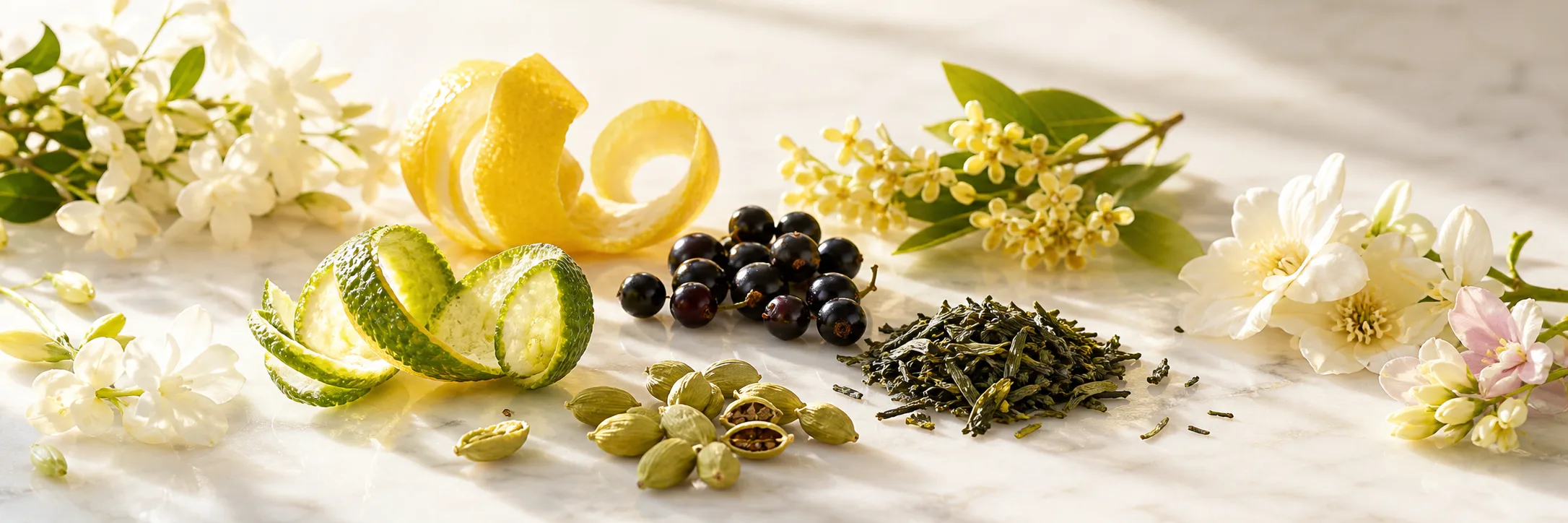
The opening is the most universally praised passage: an effervescent citrus arrangement of cedrat (citron), bergamot, and blackcurrant lifted by cardamom, which gives the top a slightly spicy-green sparkle rather than pure sweetness. This is classic Ormonde Jayne bright-citrus signature. The heart is the conceptual core - osmanthus infused into green tea, a pairing the house itself called “the masterstroke,” with freesia adding a clean, faintly powdery floralcy. Osmanthus contributes its characteristic apricot-and-leather facet, but here it is restrained and folded into the tea rather than allowed to dominate. The drydown moves to tea leaf, cedarwood, sandalwood, and musk, finishing soft, dry, and woody. A recurring critical complaint among the few who tried it is that the woods read as synthetic and the celebrated tea note can get buried: one wearer feedback user wrote that the “beautiful tea from OJ is hiding” beneath “synthetic woods,” detecting a “light animalic/Oud” quality not in the official pyramid. Compared to QI - OJ’s other osmanthus-tea scent - wearer members describe Formosa as a distinctly different, mistier, more cedar-forest interpretation rather than a QI flanker.
Performance
Reported performance is moderate, consistent with the house’s typically refined-but-not-monstrous profile. wearer voting puts longevity at strong qualitative reception and sillage at 2.17/4 - i.e., above-average length but close-to-skin projection. wearer feedback entry (submitted by user Essy07) states verbatim: “The longevity is above-average. The production was apparently discontinued… This scent is exclusively available at Noseway in Taiwan.” This is a quiet, intimate fragrance by design: a tea scent meant to sit close, not to fill a room. Given the green-tea-citrus structure, it is best understood as a daytime, warm-weather, skin-proximate wear.
Wearing Context
Formosa is a spring/summer daytime fragrance - fresh, green, tea-driven, and explicitly unisex (OJ markets all its scents as gender-free). The serene, “impeccable class” framing positions it for office, daytime social, and warm-weather casual-elegant wear rather than evening or seductive contexts. It is the kind of understated tea scent that signals taste rather than presence.
Comparisons & DNA
The most direct comparison is in-house: OJ’s QI (the brand’s well-known osmanthus-tea scent), which wearer members explicitly distinguish from Formosa - same broad osmanthus-tea theme, different execution, with Formosa reading mistier and more cedar/forest-leaning. Algorithmic similarity tools (treat as directional, not authoritative) flag Montabaco Verano and Montabaco Intensivo as relatives, sharing bergamot, cardamom, sandalwood, and tea, though those lean more aromatic/tobacco. Within the broader genre, Formosa sits in the bright-citrus-over-tea-and-woods lane that OJ has worked repeatedly; its differentiator is the osmanthus-green-tea heart.
Reception
Reception is extremely thin by necessity - with only 500 bottles sold in one country, almost no one outside Taiwan has smelled it, and major Western critics (Luca Turin, Bois de Jasmin, Persolaise, Colognoisseur) did not review it. Now Smell This and wearer feedback covered it only as a launch announcement. The reception that exists is sharply bifurcated: Taiwanese buyers responded with genuine national pride - one wearer reportser wrote, as a Taiwanese person, of being “intensely happy to see how foreigners view my homeland,” describing “verdant trees on spiky hills… tea leaves slowly blooming in boiling water.” Against that emotional resonance sits the more clinical OJ-fan verdict that it is a lesser entry in the line (“as a fan of OJ… there are better ones”). The polarization axis is essentially sentiment-versus-substance: the concept and packaging are beloved; the juice is considered good but not top-tier OJ.
Versions & Reformulation
No reformulation history exists - it was a single limited run of 500 bottles in EDP concentration, now discontinued. There is no known relationship to OJ’s later “Four Corners of the Earth Reimagined” higher-concentration collectors’ editions; Formosa was the Taiwan chapter of the original Four Corners concept.
Acquisition Notes
This is the defining practical fact: Formosa was sold exclusively at Noseway in Taiwan in an edition of 500 bottles, and the entire run sold out essentially overnight - a Taiwanese wearer reportser noted “(All of the 500 bottles sold out within one day.),” corroborated by Dcard forum buyers who reported the online stock sold out in the small hours (“凌晨官網就搶購一空”) and the ~50 in-store units gone immediately. It never came to the US, UK, or EU through official channels. There is effectively no decant market, no sample availability through the usual splitters, and no retail presence. Secondary-market bottles are vanishingly rare. Anyone outside the original buyer pool should treat this as a collector’s unicorn rather than a wearable acquisition. No counterfeit reports exist - the edition is too small and obscure to attract fakers.
Notable Facts & Lore
- The fragrance’s story is its scarcity and its diplomacy.
- Formosa (“beautiful isle,” the historical European name for Taiwan) was a deliberate tribute to Taiwan from a British house, created with Celine Ripert and presented by Pilkington in a striking bottle meant to “epitomize this beautiful isle.” All 500 bottles sold out within a day through Noseway, the same Taiwanese boutique that has commissioned other OJ exclusives (Yong Rose, and stocks QI).
- The emotional core of its lore is the response from Taiwanese wearers, who treated it less as a perfume launch than as international recognition of their home - a rare case where a niche fragrance’s cultural meaning outweighs its olfactory reputation.