Ormonde Jayne — Tolu
Essence
Tolu is the modern amber-oriental that launched Ormonde Jayne in 2002, and it remains the house’s most classically beautiful statement. Built around Peruvian tolu balsam - a sweet, cinnamon-tinged tree resin that Linda Pilkington and perfumer Geza Schoen claim to have been among the first to feature prominently in fine perfumery - it reads as a deliberate, intelligent reworking of the great French orientals. Critic JTD on wearer reports framed it as Schoen’s “stripped-down, modernized facsimile of Shalimar,” composed the way Christopher Sheldrake decoded the genre for the Bois series at Serge Lutens: not just copying the recipe but understanding its logic. What makes Tolu distinctive is that it delivers the warmth, resin and powder of a vintage floriental while staying airy, radiant and genuinely wearable - an oriental “without melodrama,” as the fragrance wearer review put it.
Scent Profile
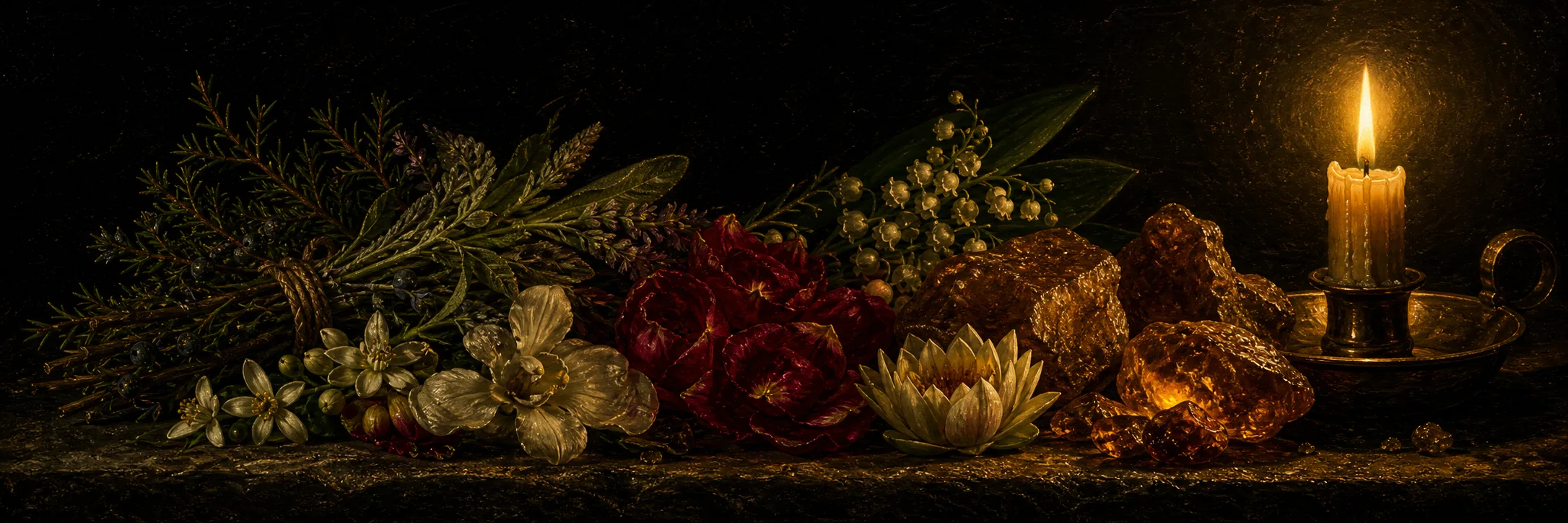
Tolu opens green and herbal-bright: a sharp, aromatic burst of clary sage and juniper berry cut with luminous orange blossom. Several reviewers single out the orange blossom as the early star - Kafkaesque calls the opening “startlingly beautiful orange blossom and lily of the valley contrasted with the watery piquancy of juniper berry.” Some note the juniper barely registers on their skin; the floral heart of orchid, rose and muguet tends to read as a soft, slightly powdery abstraction rather than as distinct, nameable flowers. As it develops, the resins take command. The drydown is where Tolu lives: honeyed amber, tonka, vanilla and a quiet thread of olibanum (frankincense) that, per most accounts, never steps fully forward but tempers the sweetness with a cooler, incense-like edge. Kafkaesque describes hours three through seven as “all incense, vanilla, honeyed amber and caramel, with a hint of pine,” with a “surprising earthiness” under the velvety softness. The signature accord is essentially tolu balsam itself - sweet, balsamic, faintly spicy and animalic - wrapped in golden amber. It is largely linear after the opening hour: the resinous base doesn’t perform dramatic twists, which admirers read as elegant cohesion and detractors as monotony. a perfume blog’s Victoria Frolova compared the wear to skin warmed under an aromatized body oil, evoking Patou’s long-lost Chaldee.
Performance
Performance reports are genuinely split, which is itself informative. The strongest accounts describe excellent longevity and radiating sillage: one Olfactoria’s Travels review cites “12 hours at least,” with a dark, almost chocolatey extreme drydown; fragrance wearer reviewers report eight-plus hours with arm’s-length radiance. A recurring observation is that Tolu can take time - and maceration - to bloom: more than one owner notes the juice was flat and “blunted” on first spray, then transformed into something captivating after sitting. The dissenting camp finds it surprisingly quiet: one fragrance wearer reviewer calls the radiance low, the sillage modest and longevity “moderate or less,” spending most of its life as a close-to-skin amber. The likeliest reconciliation is concentration- and batch-dependent variability - older bottles were poured at very high concentration (see Acquisition Notes) - plus skin chemistry. Practically, it rewards a generous application and cool weather; it is a fall/winter performer that “needs the cold to shine.”
Wearing Context
This is autumn and winter perfume, and nearly every source agrees. Olfactoria’s Travels calls it “a very wearable, warming, comforting and plush fall scent, even for ‘anti-orientalists,’” the fragrant equivalent of a cashmere shawl. It skews toward evening, quiet luxury and introspection - one fragrance wearer reviewer wears it for “solitude and quiet reflection” rather than nights out, while others find it perfect for a glamorous evening or an intimate dinner a deux. It is genuinely unisex, though several note it can lean slightly masculine or slightly feminine depending on skin; the resin dominates the soft florals, keeping it from reading as overtly either. Settings: cool-weather daywear at low application, dressier evenings at higher. As a practical reading, the sweetness and powder make it better suited to relaxed luxury than to a hot, crowded room.
Comparisons & DNA
The most-cited reference point is Guerlain’s Shalimar - JTD on wearer reports explicitly frames Tolu as a lighter, modernized Shalimar, and the fragrance wearer reviewer traces its antecedent to the amber-powdery Must de Cartier parfum and, more distantly, to Coty. fragrance wearer’s Miguel Matos compared its floral-ambery balance to Dior Dune, and several wearer reports reviewers independently flag a Dune resemblance. Matos also names Yves Saint Laurent’s Opium Pour Homme as his prior favorite tolu/Peru-balsam scent, dethroned by this. The fragrance wearer critic situates Tolu’s “perfumey,” reworked-to-abstraction quality alongside Chanel Coco and Teo Cabanel Alahine, and likens it to a less-powdery version of Lorenzo Villoresi Alamut. Detractors offer their own deltas: one wearer reports reviewer argues Diptyque’s Eau Lente and Boucheron’s Jaipur Homme are more complex for less money, and another that Rochas Absolu or modern Opium do the balsamic-oriental job for cheaper and longer. The clearest DNA statement: Tolu is the airy, radiant, citrus-and-herb-lifted take on the classic amber oriental, where the heavyweights are denser and more brocaded.
Reception
Tolu is one of the better-reviewed niche orientals of its era, with a strong critical halo and a more mixed wearer verdict. Luca Turin named it among 100 great classics in The Little Black Book of Perfume, and Ormonde Jayne as a house earned high marks from Turin and Tania Sanchez. a published review’s Michelyn Camen called it “plush, lush and opulent, Ormonde Jayne’s Tolu reminds me of the great Oriental fragrances of years gone by, but reimagined for the 21st century”; Kafkaesque devoted a rapturous full review (“a perfect, lovely paradox”). a perfume blog and Olfactoria’s Travels were similarly admiring. wearer sentiment on fragrance wearer, fragrance wearer and wearer reports is warm but more divided: praise centers on quality, blending and the orange-blossom-to-amber arc; criticism clusters around two complaints - that it is “boring,” “polite, inoffensive” and ultimately an ordinary amber once the opening fades, and that performance can underwhelm. A notable, specific caution comes from Kafkaesque, who developed an acute sensitivity to the ISO E Super common across the Ormonde Jayne line (especially Montabaco) and found it “ruined Tolu” for her - worth knowing if you’re aroma-chemical sensitive. As a blind-buy: reasonable for confirmed lovers of soft, resinous, slightly powdery orientals, riskier if you demand projection or novelty.
Versions & Reformulation
There is no widely documented official reformulation, but concentration history is relevant. Multiple owners report that older bottles were poured at very high perfume concentration - one fragrance wearer reviewer recalls 30% strength on bottles bought years ago, and Kafkaesque notes the line’s “most basic form” sits around 25%, closer to extrait than EDP for many houses. Tolu is also produced in parfum, plus bath/body oil, lotion, shower creme and candle formats; the body oil in particular is praised as a summer-appropriate alternative to the spray. Treat strength as having drifted with batch and era rather than as a single formal reformulation.
Acquisition Notes
Tolu sits in the accessible-niche tier. a perfume blog’s 2008 review cited UK pricing of £58 for 50ml EDP and £112 for 50ml parfum; it has historically been sold through Ormonde Jayne’s own boutique (the Royal Arcade, Old Bond Street) and website, and via US distributor Europerfumes. Bottle sizes include 50ml and 120ml; one reviewer recounts buying 120ml bottles on the secondary market for just over $100 each in the high-concentration era. The main acquisition wrinkle is the concentration variability noted above - if buying secondhand, older high-concentration bottles are prized.
Notable Facts & Lore
- Tolu was the debut fragrance of Ormonde Jayne and is treated as the house’s signature alongside Ormonde Woman.
- The headline lore: Linda Pilkington and Geza Schoen are credited (by a published review’s Michelyn Camen, with the caveat “I can’t fact check it but I do believe Linda Pilkingkton and Geza Schoen were the first to use tolu balsam in a perfume”) as among the first to build a perfume around tolu balsam, the sweet Peruvian tree resin that gives the scent its name and its character.
- Pilkington’s own evocative description - “Ormonde Jayne Tolu, sweet resins from Peru, cashmere coats, fine French cognac and a leopard on the rug” - has become the perfume’s calling card.
- The fragrance is part of Ormonde Jayne’s Signature collection.
- Schoen built it, per JTD’s analysis on wearer reports, as a close reading of the traditional oriental model, and it scores famously high on “radiance,” pegging it as an early-2000s “Millennial Perfume” composed with high percentages of woody-amber materials - though, to Schoen’s credit, it is widely felt to have aged “more gracefully than most perfumes of the early ’00s.”