Ormonde Jayne — Ormonde Woman
Essence
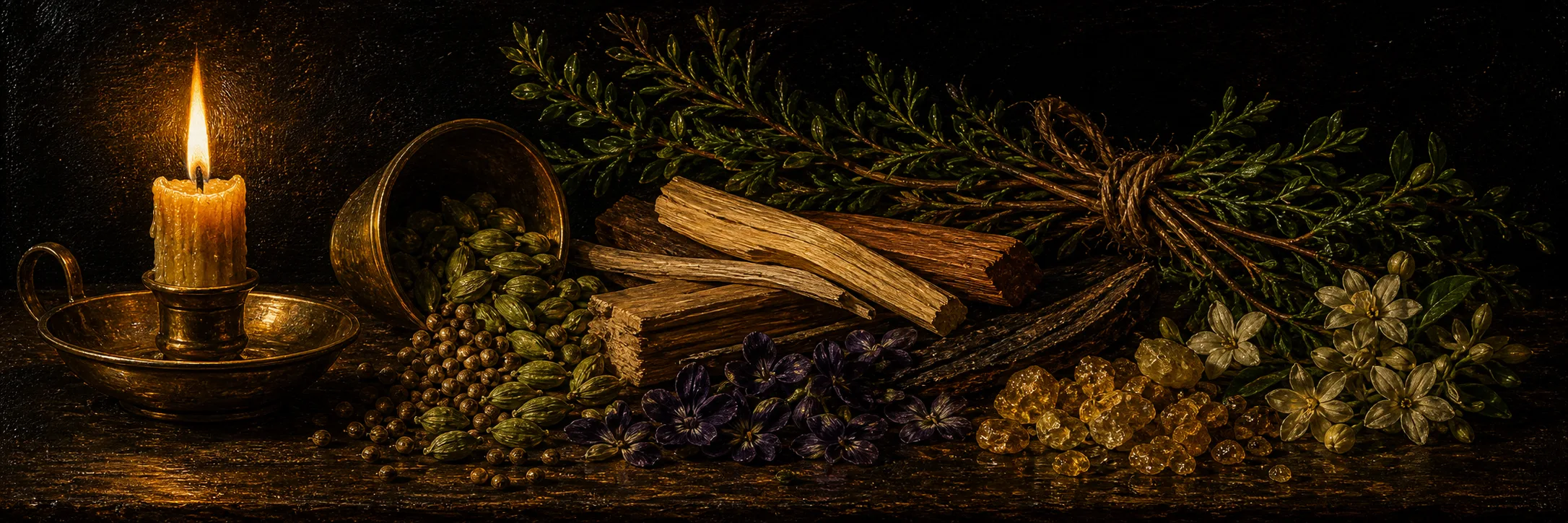
Ormonde Woman (2002) is the founding fragrance of British niche house Ormonde Jayne and its signature scent - a “forest chypre” built around the rare black hemlock (Tsuga) absolute, an ingredient Ormonde Jayne is credited with being the first to use in perfumery. Composed by Geza Schoen, it’s a green, woody, slightly witchy walk through a dark coniferous forest: dewy grass and cardamom up top, resinous evergreen and soft violet-jasmine in the heart, and a warm, creamy sandalwood-amber base. It earned a five-star rave from Luca Turin and Tania Sanchez and is widely regarded as a modern niche classic.
Scent Profile
The opening is fresh and green: dewy cut grass, warming cardamom and coriander, with the black hemlock already announcing itself. In the first ten to twenty minutes the hemlock is the focus - a resinous evergreen note with, per Kafkaesque, “burnt notes and black licorice,” cool and faintly mentholated/camphorous. Crucially, its intensity is dose-dependent: applied lightly it’s a bright, subtle conifer lifting the grass; applied heavily it becomes “a black cloud descending on the forest,” with a monumental dose of black licorice, more burnt aroma, and a tar-like, chilled impression. What’s loud is the grass-hemlock pairing; what’s subtle is the sweetness building underneath. In the heart (one to three hours) the fresh grass fades (mostly gone within the first hour) and the florals join - violet and jasmine absolute as background players that add a delicate, powdery sweetness and stop the green from ever turning harsh. The black hemlock stays central but softens, the pine-needle sharpness giving way to wood. The dominant mid-stage character is a soft, blurred-pine forest dotted with violets - green and contemplative rather than aggressive, with what some detect as a faint tea-like warmth from the spices. The drydown (three hours plus) is the most beloved phase: real, prominent sandalwood - “honeyed” and creamy - lit by an amber the color of “glowing orange Christmas lights,” with vetiver and cedar resonating beneath and a soft musk. It’s warm, cozy and resinous, like the scent rising from a heavy wool scarf on a cold walk, with the violet softening into gentle powder by the hour. Perceptible throughout: black hemlock, grass (early), violet, sandalwood, amber. Submerged: vetiver (often “barely perceptible”), jasmine, cedar. Ormonde Woman is recognizable as the same scent from start to finish - broadly linear with a clear arc from green-fresh to warm-woody. The signature accord is the black-hemlock-and-grass forest chord laid over creamy sandalwood-amber.
Performance
Performance is good but not enormous, and is the one consistent reservation even among admirers. The EDP is a high-concentration formula - Ormonde Jayne states on its own site that it pours “at a minimum of 25% concentrated oils.” Longevity runs roughly six hours on skin per detailed accounts, with whispers lingering up to twelve hours as faint puffs of powder; projection is strong but not overwhelming for the first two to three hours before settling close to the skin around the three-to-3.5-hour mark. Several reviewers wish sillage and longevity were “excellent” given the price, and call it just short of “holy grail” for that reason; the parfum concentration is sought out for extra potency. Notably, performance and even the scent’s character are temperature-sensitive: per The Scentaur, in an overly warm room the powder “feels plastic and stifling,” while in cool conditions it becomes “a natural wonder.” It therefore performs best in cool weather and on cooler skin. Best strategy: dosage materially changes the experience - go light for a bright forest, heavier for the dark, licorice-tar version - and spraying on fabric extends it.
Wearing Context
Ormonde Woman is a cool-weather, contemplative fragrance - best in fall and winter, and on cool spring/summer mornings. Reviewers tie it to specific imagery: a misty forest edge, a summer cottage at dawn, “a kind yet clever witch.” It works for daytime and evening, casual dinners, and even the office (with restraint on quantity given its concentration). Though named “Woman,” it is near-universally described as unisex - “tailor made for a hot smart person of either sex,” equally intriguing on any gender, and several reviewers prefer it over the masculine Ormonde Man. Where it shines: anyone who responds to “forest, magic, wisdom,” green-woody lovers, and cool, quiet settings. Where it falls flat: hot, humid heat (the powder can turn plastic-stifling), and for those who dislike conifer/pine or find heavy Iso E Super “radiance” sinus-clearing - a minority recoil at the bitter hemlock or the synthetic-woody amplification. The relevant perception skew is the “witchiness” framing, which Tania Sanchez’s review popularized and which some feel reduces the scent to a Halloween novelty rather than the year-round sophisticate it is.
Comparisons & DNA
The defining lineage point is that Ormonde Woman pioneered black hemlock in perfumery; per Ormonde Jayne’s own product copy, the house “decided to incorporate it into our library and it now proudly represents our house signature. Where we lead, others soon followed.” Tania Sanchez situated it explicitly against Chanel Bois des Iles as a woody feminine, but distinguished it from the “cozy, powdery-rosy” woody femininines that came before. Within the house, Ormonde Man (2004) is the close sibling - a strikingly similar cedar-heavy spicy-woody with a green glow, differing by adding subtle oud and peppered heat where Woman has violet; reviewers often judge Woman the more successful of the two. Ormonde Elixir (2019) is essentially Ormonde Woman with a large dose of Cambodian oud added - greener, denser, darker and oilier - to the point that owning both Woman and Elixir is called “redundant.” Outside the house, comparisons are sparse because the black-hemlock accord is genuinely unusual: one reviewer likened it to Olivier Durbano Amethyst (swap the pencil-shavings/incense for grassy vetiver and evergreen) and noted kinship to certain masculine Amouage compositions. As a niche release built on a signature natural material and heavy specialty oils, no true designer clone or dupe exists - say so plainly. Its influence runs forward through the entire Ormonde Jayne “Ormonde” sub-line and helped establish the green forest-chypre as a niche archetype.
Reception
Ormonde Woman has unusually strong critical and wearer standing. The cornerstone is Tania Sanchez’s five-star review in Perfumes: The A-Z Guide, which described its “haunting, outdoor witchiness of tall pines leaning into the night - a bitter oakmoss inkiness, a dry cedar crackle, and a low, delicious, pleading sweet amber, like the call of a faraway candy house,” and called it “lulling” and unsettling in equal measure; Luca Turin also named it among the great classics in The Little Black Book of Perfume. Critic and enthusiast coverage is rhapsodic: The Candy Perfume Boy calls it “an incredibly beautiful perfume”; Kafkaesque ranked it among the most genuinely luxurious, old-school-rich niche scents she’d tried. Common praise: originality, the black hemlock, the real sandalwood drydown, unisex wearability, and richness. Common criticisms: performance falling short of the price, and a minority who find the Iso E Super “radiance” excessive/synthetic or the hemlock bitter - fragrance wearer carries dissenting reviews calling it over-radiant or “not living up to the hype.” A documented pattern: several bloggers who recoiled on first try later fell in love and bought full bottles. Blind buy verdict: for green-woody and niche lovers it’s one of the safer high-end blind buys (one fragrance wearer reviewer reviewing a 2025 sample called it “a safe blind buy for those who love mossy woody scents”), but the performance reservation and the dose-sensitivity argue for sampling first.
Versions & Reformulation
Ormonde Woman has been reformulated since its 2002 launch, and this is a live wearer concern. It exists in EDP (the standard, minimum-25% concentration), a higher-strength Parfum (offered in 40% and 50% perfume-oil concentrations, historically “Made to Measure”), and a solid perfume. Sentiment holds the original/early EDP as the magical benchmark; a more recent EDP reformulation drew sharp criticism - some longtime wearers found it a “chemical mess” or even nauseating/irritating. A newer Parfum-concentration reformulation is regarded as a meaningful improvement over the disappointing recent EDP, though still “not the magic of the original.” The EDP has at times been listed as discontinued, with vintage bottles wiped out on secondary markets - buyers should be aware that batch/era materially affects the experience.
Acquisition Notes
Ormonde Woman is priced in the genuine niche-luxury tier - and reviewers repeatedly note that performance is merely “good” for that price, a recurring value gripe. It’s sold via Ormonde Jayne boutiques and ormondejayne.com in EDP, a higher-concentration Parfum (with the 4x10ml travel-spray edition a more affordable entry point, historically around £64, versus the parfum around £184), and a solid. The decant ecosystem carries it: Scent Decant, Scent Split and ScentBird have offered samples/decants, and full bottles appear at Jomashop. There’s no widely publicized consumer batch-decoder; buy from Ormonde Jayne directly or trusted decanters, and consider the current Parfum if you want the closest thing to the original richness.
Notable Facts & Lore
- The founding lore is central: Ormonde Woman was the debut release of Ormonde Jayne, the British house Linda Pilkington launched in 2002, and it remains the house signature.
- Its identity rests entirely on black hemlock - and Pilkington has spoken specifically about it, explaining in interviews that the perfume is “based on hemlock” and clarifying that the type used is the Tsuga tree (a spruce/pine relative), not the poisonous hemlock plant, deliberately defusing the “witch’s poison” association the name evokes.
- The house was the first to use the material in fine perfumery, a genuine innovation that became its calling card.
- The “witchiness” of Sanchez’s Guide review took on a life of its own, spawning countless reviews invoking witches, forests and Halloween - a framing Kafkaesque argued unfairly minimizes the scent.
- Turin’s broader praise of Ormonde Jayne - the sentiment that the young house was “beating Caron and Guerlain at their own game” - helped cement the brand’s reputation.